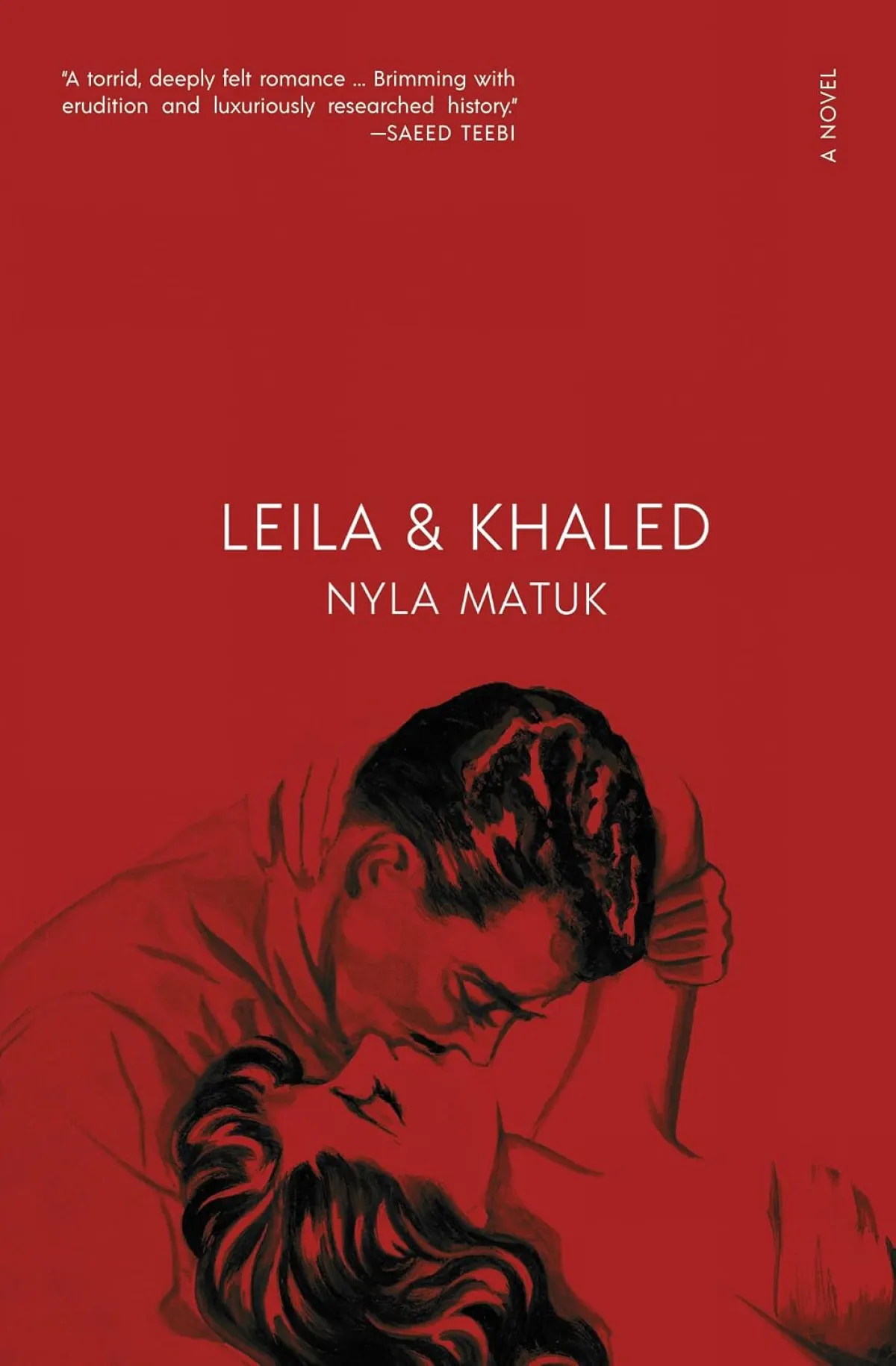
In 'Leila & Khaled', Nyla Matuk tells not only of a return to Palestine, but also of the impossibility of escaping the images shaped by her own Western socialisation
Colonialism does not begin only when territories are occupied or borders are redrawn. It begins earlier, the moment people learn to see the world through the eyes of others. Nyla Matuk’s Leila and Khaled tells the story of precisely this form of colonisation. At first glance, her novel tells the story of a Palestinian-Canadian film scholar who travels to the land of her ancestors for the first time and falls in love with a younger Palestinian man there. In reality, however, it addresses something more fundamental: the realisation that even the longing to return is already shaped by a cultural socialisation that has taken place outside Palestine. It is not exile, therefore, that is the novel’s true subject, but rather the question of what remains of exile in one’s perception of the world.
In this way, Leila & Khaled differs from much of Palestinian diaspora literature. Those narratives often revolve around memory, family tradition, or language as the last bastions of cultural continuity. Matuk, on the other hand, is interested in the reverse process. Rather than describing how identity is preserved across generations, her novel recounts how it gradually transforms under the conditions of migration. Leila does indeed travel to Palestine, but she finds it an unfamiliar world. She enters a place whose political history she knows, but whose cultural grammar has remained largely foreign to her.
It is here that the novel’s subtle radicalism lies. Matuk shifts the colonial gaze from the familiar 'occupiers and occupied' to the perception of her own narrator. Leila is not an outsider, but neither is she a woman returning home. She moves through Jerusalem and the West Bank with the perceptual patterns of a North American intellectual whose aesthetic and cultural coordinates are drawn almost exclusively from Western traditions. The fact that, of all people, the young Israeli settlers initially seem more familiar to her than the Palestinians themselves is therefore one of the novel’s most revealing observations. She describes the young settlers not primarily as ideological opponents, but as people whose clothing, demeanour, and body language are immediately recognisable to her: American sweatshirts, penny loafers, pastel-coloured chinos—familiar signs of everyday North American life, whose codes she intuitively understands. The true sense of alienation, by contrast, emanates from the very land that is genealogically hers.
From this, Matuk formulates an insight that is as simple as it is far-reaching: diaspora does not necessarily mean the preservation of cultural identity. It can just as easily mean its replacement. Origin remains a biographical fact, while the categories through which one perceives the world may have long since shifted. Leila perceives Palestine only fragmentarily not because she lacks historical experience, but because her perspective already belongs to a different cultural order.
It is therefore hardly surprising that Matuk chooses to make her narrator a film scholar. This profession is far more than a biographical embellishment; it forms the poetological key to the entire novel. Leila fundamentally reads reality as an image. She notices early on that literary metaphors of light have lost their appeal for her, while the light of the cinema has retained its evocative power. In the dark of the cinema, she writes, one’s own bodily awareness disappears behind the power of the projection. This idea describes not only her aesthetic preferences, but her way of experiencing the world.
From this moment on, the numerous film references appear in a different light. Wenders, Resnais, or later Vincent Minnelli are not merely academic citations from a well-read narrator. They form the archive of perception through which Leila is initially able to decipher her present. At first, Palestine does not appear to her directly, but rather as a sequence of already familiar images. Paradoxically, therefore, her return takes place through a canon of Western film and art history. Herein lies the novel’s true tragedy - Leila is searching for a lost origin, yet she possesses only the aesthetic tools of the very culture from which that origin once separated her.
Love as a Form of Insight
Against this backdrop, the function of the love story also undergoes a fundamental shift. Leila & Khaled is far less a romance than a novel about how intimacy transforms one’s own perspective. Khaled is therefore not the novel’s true protagonist, indeed remaining surprisingly opaque for long stretches of the narrative. The reader learns fragments of his biography: his work as a journalist and translator, his stints in prison, his matter-of-fact approach to a daily life structured by the occupation—yet Matuk shows little interest in his psychological development. Rather, the narrative focuses on the slow erosion of the certainties with which Leila arrived in Palestine. The true protagonist of the novel is therefore not Khaled, but Leila’s perspective.
It is interesting that this process of realisation is not set in motion by political debates. Although the novel contains numerous conversations about expropriation, expulsion, and the logic of settlement policy, it is not these discussions that are decisive, but rather those moments of physical closeness in which Leila realises how closely her life up to that point had been bound within the framework of a Western education and experience. It is only through Khaled that she begins to question her own biography.
Matuk achieves this particularly impressively in the passages in which Leila looks back on her time as a student in Montreal. The men she was interested in back then were representatives of precisely that academic milieu in which cultural capital, literary education, and aesthetic distinction determined social status. In retrospect, the fact that she always judged her own attractiveness by the standards of that world no longer strikes her as mere personal insecurity, but as an expression of a cultural order whose dominance she had never questioned. It is only her relationship with Khaled that reveals how naturally she had conflated Western ideals with universality. Her later realisation that she had been “unaware of what she was unaware of” therefore describes less a political learning process than an epistemological upheaval. It is not her convictions that change first. Rather, it is the very conditions under which she forms her judgments that shift.
It is also for this reason that Khaled does not embody a projection of a lost homeland. He does not lead Leila back to her roots. Rather, he makes it clear that these roots are no longer directly accessible. The journey does not end with a reappropriation of Palestinian identity, but with the realisation that origin itself is not an original state to which one could simply return. What Leila encounters in Khaled is not the past, but a present that she had previously viewed only from a safe distance.
In this context, another aspect of the novel—one that seems unremarkable at first glance—takes on special significance: language loses its traditional function as a marker of identity. Especially in the literature of exile, the mother tongue often appears as the last bastion of cultural continuity. Matuk subverts this motif as well. Khaled moves effortlessly between Arabic, Hebrew, and English; his multilingualism reflects the political reality of a daily life in which translation has become a matter of survival. Leila, on the other hand, possesses the genealogical connection but not the same linguistic ease. Origin and language diverge.
It is noteworthy that Matuk does not imbue this loss with sentimentality. She neither stylises Arabic as a lost original language nor romanticises multilingualism as a cosmopolitan utopia. Rather, language appears as an expression of historical power relations. Khaled speaks Hebrew because the occupation demands it. He is fluent in English because international communication would be virtually impossible without it. His linguistic competence is not a sign of cultural freedom, but the result of political necessity. This, in particular, reveals how differently the two characters were socialised. Leila is a child of a diaspora whose relationship to Palestine is mediated primarily through memory. Khaled, on the other hand, embodies a present in which history must be renegotiated anew every day.
This is where the novel unfolds its greatest narrative strength. It is not interested in identity as a fixed category, but rather in the conditions of its formation. Khaled does not change Leila by providing her with answers, but because his mere presence exposes the questionable nature of the cultural order within which she had previously understood herself. The love story derives its significance precisely from the fact that it offers no solution. It merely reveals how far the narrator has already distanced herself from the world she believes she longs for.
The Limits of Literature
The remarkable restraint of much of the narrative in Leila & Khaled means that those passages in which the novel begins to explicitly articulate its political positions stand out all the more. The character of Dov Weiss, in particular, remains less a literary figure than an argumentative construct. Admittedly, his confrontation with Khaled serves a comprehensible function within the novel; it brings to light the historical violence that forms the backdrop of every personal encounter. Yet it is precisely here that the character of the text shifts. Narrative openness gives way to political argumentation.
The same applies to Khaled’s open letter, in which personal accusation, historical reckoning, and journalistic polemic are intertwined. In terms of content, this anger is hard to dispute. It stems from an experience of expulsion and disenfranchisement that the novel has previously depicted with sufficient intensity. Literarily, however, a peculiar asymmetry emerges. While Matuk develops Leila’s inner turmoil with great psychological precision, the Israeli perspective is largely reduced to its argumentative function. The characters cease to be bearers of differing perceptions; they begin to represent positions.
This is perhaps the novel’s only real weakness. Not because literature should avoid political conflicts - on the contrary, Leila & Khaled impressively demonstrates how naturally politics permeates the most intimate aspects of human relationships. Rather, these passages become problematic precisely where the novel no longer trusts its own narrative power. Previously, Matuk had made power dynamics visible almost in passing: in clothing styles, shifts in language, hotel rooms, car rides, or views of landscapes whose political history never had to be explicitly stated to be felt. It is this narrative economy that makes the novel so powerful. Where it is replaced by explicit explanations, the text loses the ambivalence that characterises its most striking scenes.
However, this weakness hardly affects the novel’s actual subject matter. For Matuk’s interest ultimately does not lie in the dialogue between two political narratives. Unlike authors such as Amos Oz in his masterpiece A Tale of Love and Darkness, she does not seek a literary space for mutual understanding. Her novel focuses on a different void: the experience of a diaspora whose relationship to its lost homeland is no longer shaped by immediate memory but by cultural mediation. Thus, the encounter with Khaled appears less as the romantic fulfilment of an unconventional love between an older woman and a younger man than as a confrontation with the limits of one’s own perception.
Consequently, Matuk also rejects any form of catharsis. The pandemic accelerates the farewell and turns the encounter into an event that eludes repetition. Leila returns to Canada without her journey having come full circle. Nothing has been resolved; nothing has been rediscovered. Love remains an episode; Palestine remains both present and past.
The final narrative reference to Alain Resnais’ Hiroshima mon amour is therefore particularly significant. The fact that Leila comes to terms with her separation through, of all things, a French film about memory, war, and the impossibility of return is far more than an elegant cinematic reference. It constitutes the logical consequence of the entire narrative structure. Even where she feels closest to her origins, she draws on the imagery of a different cultural tradition. The journey has changed her perspective, but it has not undone its underlying premises.
Here lies the true achievement of this remarkable novel. Leila & Khaled does not tell the story of a return to Palestine. Rather, the novel examines the conditions under which such a return would even be conceivable. Exile no longer appears here as a geographical state, but as a form of perception. It ends neither with the entry into the lost land nor with the encounter between two people who carry the same history within themselves, albeit in different ways. It continues in the gaze with which this land is viewed. Perhaps this is precisely why Nyla Matuk articulates one of the most unusual insights in contemporary diaspora literature: It is not the greatest distance that separates us from our origins, but the images through which we have learned to see them.




 Anansi