



Quicksand
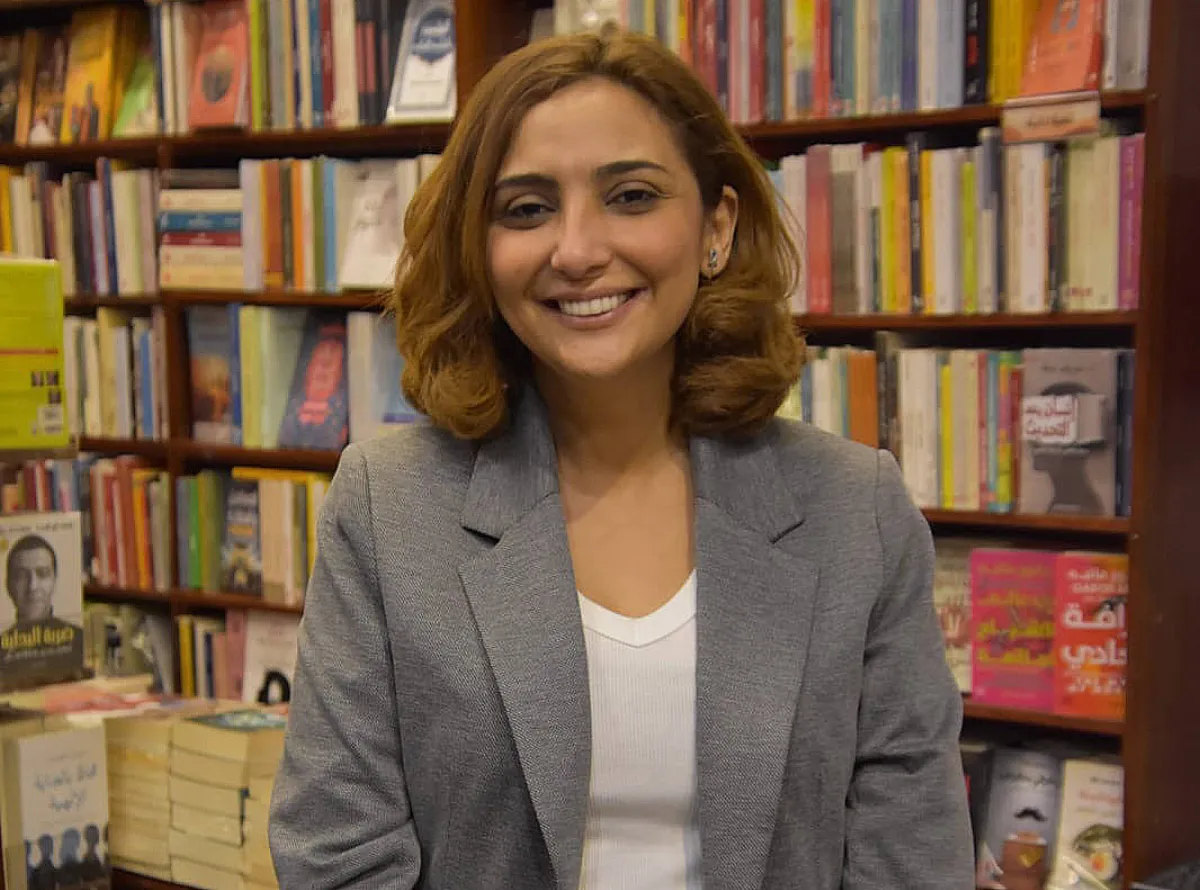
Nora Nagi is an Egyptian journalist and novelist born in Tanta in 1987. A graduate in interior architecture from the Faculty of Fine Arts (2008), she is editor-in-chief of the women's website Nawaem.
Author of several novels, including Bana (2014), Al-Gidar (2016) and Banat al-Basha (2017), she was shortlisted for the Sawiris Prize in 2018. Her novel Atyaf Camellia (2020) won her the Yahya Haqqi Prize. She has also published Al-Katibat wa al-Wahda (2020), the collection Mithl al-Aflam al-Sazija (2022), awarded the State Encouragement Prize, as well as Sanawat al-Jari fi al-Makan (2023) and Bayt al-Jazz (2025). She has also been awarded the Radwa Ashour Prize for Arabic Literature.
A single image haunts me.
It returns every time I close my eyes, every time I think about writing, every time thought lingers on it, walking down the street, looking up. An image in motion, like an endless loop: shattering glass.
White sand scatters above me, spills into my eyes. I see the sand, glass ground to dust, returned to its original state, drifting with unreal slowness, opening in the air like the silent explosion of a star, spreading its field above my body. Then it falls again, in a fine rain, on my black coat, in my hair, into my mouth, my nostrils, my eyes.
If I slow down the scene further, it becomes clearer: the face of a young man, a fire extinguisher in his hands, which he strikes against the side window - temporarily the roof - of the overturned car. The impact makes no sound. No crash. As if my thoughts had adopted the slowness of the world around me, this outer space where nothing resonates. As if all this belonged to an imaginary life. Or to those dreams where I know I'm asleep, where I say to myself: This is a dream, I want to wake up. And I wake up, indeed, motionless, my eyes fixed on the ceiling.
But this time, I said nothing. I didn't want to wake up. And yet, I wasn't sure I was awake.
I go back in time. Before the rain of sand, of glass, in my eyes. At the exact moment the car flips.
I was looking at my phone. I barely lifted my head and something slammed into the side of the vehicle. It lifted, hung suspended for a moment, then fell. Objects around me began to accelerate, yet time stretched on, almost unbearably slow. Everything unfolded in slow motion, like those pivotal moments in films.
Does nature imitate art, to quote Oscar Wilde, or does the mind, on the threshold of terror, fabricate another, more bearable reality, to shield us from the sight of actual reality?
A stripped-down image. No details. A car suspended in the air, then overturned.
My thoughts slow down. Silence blankets everything. No-one is screaming. Neither do I. I say to myself: is this what it means to die? There was an unexpected heaviness to this awareness. To die knowing you are dying is not easy. Perhaps it was even harder because my daughter was there, at my side.
*Praise be to Allah
A fleeting, almost comforting thought: in a flash, I realise that the car is going to tip over on the side where I'm sitting. Perhaps her chances of survival will be greater than mine. I murmur: al-hamdu li-llah*.
Then the car flips over. Hits the ground. Twice. Then nothing.
There are those suspended moments when you wonder: am I still alive?
I didn't ask if my daughter was.
I forgot her.
One second.
One second I've never forgiven myself for.
Guilt preceded pain. I screamed her name, lying on my side. A wetness spread through my body, from chest to legs. Was it blood? Was I going to bleed to death? Or the water bottle I was holding? It had burst, soaking me. Cold seeped into me. I went through, in rapid succession, everything a body goes through when it dies.
Then I saw her face. Untouched.
And my heart stilled.
I wanted nothing more than that: for her to be taken out, unharmed.
I raised my left arm. I hit the rear window, now a side window. Maybe I screamed. I have no memory of the sound. There's no soundtrack. Only the faces of men running towards us. One of them knocks on the window from the outside, as if in response to my blows. He motions: wait. His lips move: we'll get you out. He has the assurance of those who act. I believe him.
They break the glass. Sand rushes into my eyes.
Then they pull my daughter out. I see the heels of her shoes pass over me, her body pulled toward the light. She was wearing jeans and a loose T-shirt. Yet every time I revisit the scene, she appears differently: a brown dress with red flowers, a dress that was once mine, and black velvet shoes.
Why this image?
I don't know.
Even now, as I write, this is how I see her. Younger too. Six, maybe seven. She was eleven.
Why did I want to suspend time in an image that never existed?
They'll pull me out of the mangled car. I'll stand next to the overturned wreck and see a compact, indistinct crowd. I'll look for my daughter in this mass, and many anonymous hands will guide me to her. I'll embrace her. I'll bring her wounded hand to my lips. She'll cry against me, clutching, and say mommy, as if that word had never been uttered before. She'll say I'm scared. And I'll scream, incoherent, not knowing where the scream is coming from.
We'll be taken to hospital. A few bruises. Superficial cuts. Nothing. Nothing, except this proliferation of scenarios: everything that could have happened. Everything that came close to existence but didn't register. I'll have the sensation of having lost her for a moment before finding her again. And that feeling will persist.
But even more tenacious: that tiny moment when I thought only of myself.
When I forgot I was a mother.
That moment won't leave me.
I forgot I was a mother. The survival instinct overwhelmed the maternal instinct. And I will begin to hate this human banality in myself, I who had believed that motherhood knew only one face, the immaculate face of the angel. There are no angels. We'll have to start all over again. Redefine the words. Think differently about weakness, cracks and vulnerability.
Life-changing moments are rare. This one is one of them.
I want to understand myself. And writing is the only way for me to do that.
I will have to find myself through writing. Go back in time, all the way to childhood. Break down the image I have constructed of myself. Delve beneath the layers: genuine and feigned emotions, sincere and disguised desires, love and revulsion, gentleness and violence.
This sand, in my eyes, in my heart, has not been washed away. It persists, in fine bursts, like a static electricity. It invades the soul, gnaws at the flesh, thickens the blood. Sand is neither earth nor water. It is that unstable in-between, like everything I have been through.
I walk upon it, unsteady. Just as I walked between the seats of trains, planes, buses. It gives way beneath my feet, seeps in, obstructs my breathing, fills my shoes. It irritates the skin. Then it compacts, clumps together, forms a thick crust which, under the heat, turns to glass — a translucent wall that isolates me from the world. I see, but no longer touch.
Burning sand. Clear glass. Shattered glass.
That is me.
I will go back. Before the fracture. To that intact glass, to that incandescent sand. To understand. To learn to pull myself together.
...
The stories my mother tells me about my childhood end up, over time, settling inside me like real memories. I relive them as if I were conscious of them. Like this scene: me, at one year old, perched on the low wall of the balcony, as if on the back of a horse.
*Fatma's hand
I imagine myself in a pink dress, with a white bodice, belted at the waist. My head is almost bald, two little golden earrings, ḥamṣa* , on my earlobes. This is how I look in the large photograph that hung on the wall of our old house for a long time, before it disappeared.
I can see myself climbing onto the ledge, straddling it, smiling. The balcony is on the fourth floor. Behind me, the sky is vast, blue, with no buildings to interrupt it. In the street, people crowd around, startled. Someone has seen me. The alarm spreads. A man comes up, knocks on the door and announces impending disaster. My father, my mother and my uncle come running.
My mother says that when she saw me laughing, standing on that ledge, she broke down. I was just a split second away from falling. My father approached slowly, whilst my uncle, at the next window, tried to distract me so that I wouldn’t see him coming. My father grabbed me suddenly. I laughed. He held me close for a few seconds, before my mother snatched me from his arms.
Today, when she tells this story with a laugh, I feel within me the intensity of those few seconds, that moment when she saw her daughter, and behind her, the open sky. She must have thought she was going to lose me.
I pick up the story again. I piece it back together. Then I ask myself: what would have happened if I’d fallen?
Nothing would be any different.
Because when I hear my mother talk about that uncle who died as a child, I think of my grandmother, and I wonder how she managed to carry on living.
His name was Ahmed. Dark skin. Soft hair falling over black eyes. He was handsome, says my mother, with a sigh. And boisterous.
My mother had tried to calm him down to stop him from being beaten. But he kept crying, struggling. So his mother had hit him.
“After that, he fell silent. He lay there. Then the fever rose.”
The fever rose. They took him to the doctor. A few hours later, it was all over.
He died.
My mother says it simply. It’s a long time ago now. But something tightens inside me — not for the child I never knew, but for that grandmother whose life was nothing but the house, the balcony, kohl around her eyes, chickens to feed, dough to knead.
How did she live with that?
The child’s death had nothing to do with the slap. A virus, no doubt. One of those that took children away before we even understood. But it is not the cause that haunts me. It is the moment.
Every time I picture the scene—the slap—I cry. Not for him. For her.
She must have replayed that moment thousands of times. Every night before going to sleep. Every time she looked at her children, her grandchildren. Every time a child died somewhere.
Right, I’ll carry on, maintaining this slow, almost haunting tension:
She must have replayed that gesture thousands of times. Every night, before letting herself drift off to sleep. Every time she laid eyes on her remaining children. On her grandchildren. Every time a child’s face appeared, somewhere, in the street, in a story, in a stranger’s memory.
I remember her eyes.
Black. Intensely black. Lined with kohl. Two pupils so dense they seemed full, opaque, as if nothing was reflected in them any more. As if light entered them without ever leaving.
It seems to me, today, that their darkness had deepened after her son’s death.
I often ask myself: how does a mother survive her child?
Perhaps that is how it is.
She survives, yes, but something within her ceases. Something invisible, which barely manifests itself, in the minutest details: in the stillness of a gaze, in a nameless weariness, in a shadow settled at the back of the eye.
Yes. I think I can recognise that now. In certain exchanged glances. In certain eyes haunted by a void that nothing can fill.
Perhaps that is what it means to carry on living.
The faces carry on. The gestures too. We laugh, we talk, we feed, we care for. We get through the days. But a part of us, an irreversible part, fades away and remains there, lurking, in the gaze.
My grandmother laughed, no doubt. She must have laughed far from the photographs, far from that stiffness captured by the images. She must have felt joy for her children, for her grandchildren, for the hens she kept on the balcony, for the dough she kneaded with her hands, for everything her green fingers brought to life.
But something within her had stopped.
She, too, died in an instant.
Without warning.
She was speaking. She was laughing. Then her head fell back. And she was gone.
Gone—that is how I perceived it. Not a gradual death, not a slow fading away, but a brutal removal. As if the world had withdrawn her presence without warning.
They carried her past me. An ambulance arrived. It swallowed her up. And she was gone.
I was ten years old.
I slept beside her, every night. I watched her breathe in the dark, with that quiet fear that she might stop, that it might cease without a sound. I prayed that none of the illnesses I heard about on the television would take her: cancer, AIDS, pneumonia, heart attacks.
But death out-foxed me.
It chose a different way.
A brain haemorrhage. Sudden. Final.
She died within a few hours.
At the very moment of her death, the ceiling fan came loose and fell to the floor.
And, in my child’s mind, death took this form: that of a falling object. A piece of the ceiling. A fragment of sky breaking away and crashing down.
Ever since, I have been unable to separate death from that fall.
I still keep my grandmother’s kohl. I remember the smell of her clothes in the old wardrobe, her woollen scarves, her round gold earrings. I remember her voice, which is unusual, as I never remember voices.
I remember the mandarin cream she used to make for birthdays. The way her hands moved as she kneaded the birthday cakes, or operated the biscuit-making machine fixed to the coffee table. Her silhouette sitting in front of the oven, taking out the trays of bread and flatbreads.
I also remember an object.
A basin, hidden away under the sideboard. Inside was a soft, shapeless thing, the nature of which I still do not know. A neighbour had brought it one day, claiming it was a blessing for the house. Every morning, you had to pour a quarter of a glass of unsweetened tea into it.
The thing swelled. It almost seemed to breathe. It looked like a living puff pastry. Then, after a few weeks, it would split in two. My grandmother would take the new mass, place it in another basin, and give it to a neighbour or a relative.
A gentle proliferation. Silent. Incomprehensible.
Then, one day, she stopped feeding it. The thing dried out. Hardened. She broke it into fragments, which she kept in a small velvet pouch.
I asked everyone. Was it a sea creature? A type of fungus? A figment of my imagination?
Everyone remembers it.
No one knows.
My grandmother died before I could understand.
She wasn’t even sixty.
On the morning of her death, she had gone out onto the balcony. She had fed the chickens. Made breakfast for my grandfather. Shouted at a neighbour’s child, sitting on the ledge, to pull his head in so he wouldn’t fall.
Then she came back inside.
And she died in her chair.
I can’t help but imagine the grief that had built up inside her since her child’s death, like a slow, constant pressure, until it finally gave way.
I can’t help but keep returning to that moment, the one when she saw death take hold of him. That child who, just a few hours earlier, had still been running.
Did she kill him with that slap?
She must have asked herself that question.
Over and over again.
Perhaps she never forgave her hand.
That hand which had fed, washed, kneaded, planted, caressed, cared for. That hand which had built the chicken coop on the balcony, a little wooden hut, with a door and a roof. That hand which had taken in the animals, had given them life.
One day, the cockerel had swallowed a clump of hair. He had stopped eating and drinking. He lay on his side, in agony.
So my grandmother had grabbed him.
She had cut open his belly with a red-hot knife whilst he was still alive. She had removed the crop, extracted the clump of hair, and washed it in salt water. Then she sewed the body back up with a needle and white thread.
The rooster hadn’t moved. Hadn’t put up a fight. As if he knew.
Two days later, he was walking again, proud, amongst the hens, tapping the ground with his beak.
Everything my grandmother touched came back to life.
Except her child.
He alone died.
+++
Did you enjoy this text? If so, please support our work by making a one-off donation via PayPal, or by taking out a monthly or annual subscription.
Want to make sure you never miss an article from Literatur.Review again? Sign up for our newsletter here.
This short story is an extract from a novel currently being written. The English adaptation is based on the French translation from Arabic by Rita Barotta.