



The Bottle Man
It's summer in the global North and winter in the global South. Reason enough to bring summer and winter together on Literatur.Review in August and publish previously untranslated or unpublished stories from the North and South of our world.
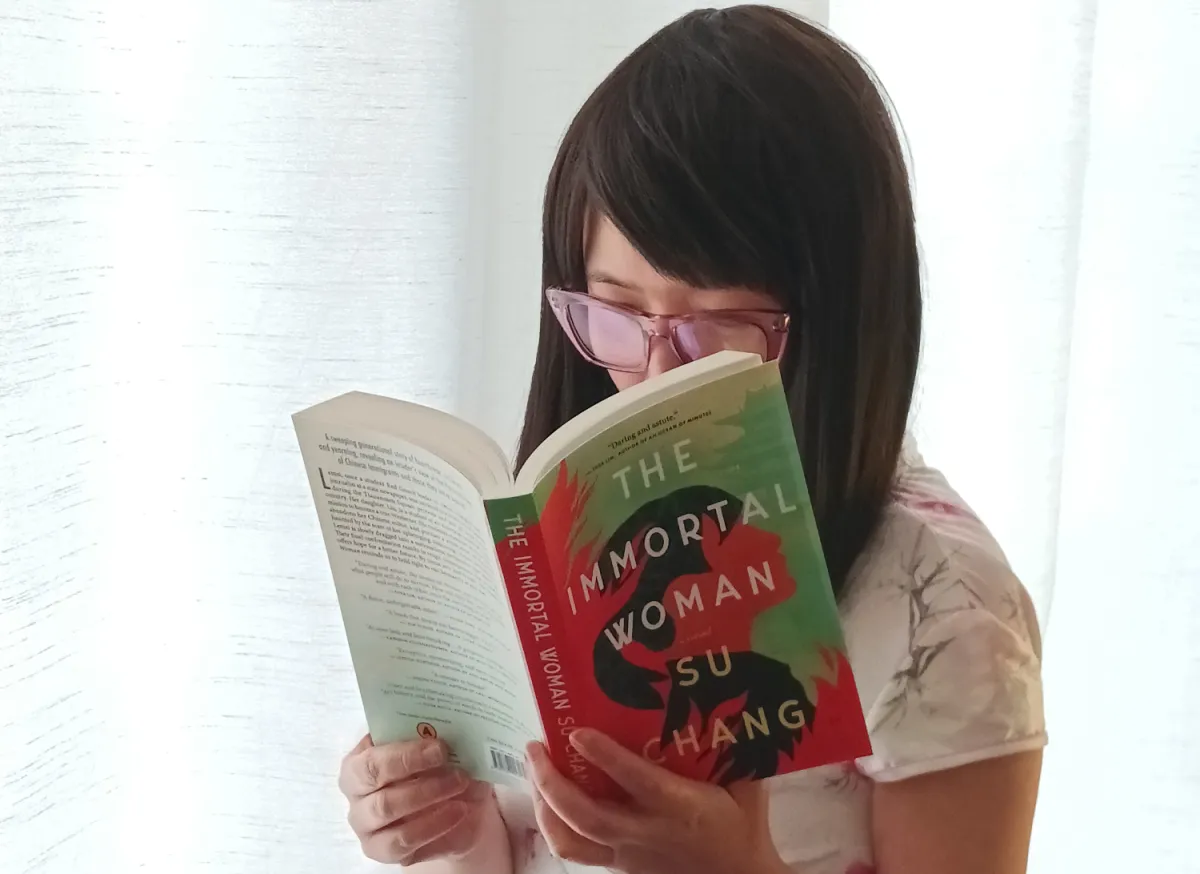
Su Chang is a Shanghai-born Chinese-Canadian writer. She is the author of a debut novel, The Immortal Woman (House of Anansi, 2025), which is a CBC Best Fiction of 2025, a Toronto Book Award finalist, a Foreword INDIES finalist, shortlisted for the William Saroyan International Prize for Writing, and won the 2025 Independent Publisher Book Award, among other awards and accolades. CBC named her a „Writer to Watch“ in 2025. Her short stories have won awards or been shortlisted by the Montreal Fiction Prize, SASFest Fiction Contest, Prairie Fire Fiction Contest, Canadian Authors‘ Association National Contest, Disquiet Literary Prize, among others.
Since returning from Toronto this summer, I have found myself thinking often of Winston. He is Jiajia’s next-door neighbor. From her second-floor balcony, I often saw him working in our shared laneway: dismantling a weather-beaten bicycle, rinsing liquor bottles in a plastic basin, turning a broken radio over in his hands as if he might persuade it back to life. During my first visit to Toronto two years ago, he had gone out of his way to make my acquaintance, practically blocking my exit in the alley. “So which part of China are you from?” he demanded in Shanghai-accented Mandarin. When I told him I was also from Shanghai, he smiled shyly, as if embarrassed by his excitement. “Your son-in-law is a good person,” he responded in Shanghainese, a remark that seemed to come from nowhere. “White people don’t usually bother with us, but your son-in-law always says hello. Sometimes he gives me bottles too.” His speech had a charged, staccato quality, like a nervous current running through his wiry frame. Then, without warning, he cut short the small talk and launched into a tale of woe. I was startled. In Shanghai, strangers rarely talk to each other, let alone offer up private wreckage of their lives.
“Asian faces don’t open doors here. I don’t care what they say about this city — multiculturalism, multiculturalism — all hot air. Discrimination won’t disappear for another thousand years,” he said matter-of-factly, after telling me about his son, who, after graduating from a top medical school in the United Kingdom, could not land a single job in Canada. “My boy gets interviews - his résumé must be good. Then they see his Chinese face and - finished. Of course they don’t say, we want no Asian. They say fit, communication style, Canadian experiences, all the usual garbage.” His brows pulled together. “I spent a fortune on his education. I pushed him to go abroad. Now he sits on my couch all day, a doctor with nowhere to go.”
When I repeated Winston’s complaints to Jiajia that evening, she merely shrugged. “He’s probably leaving out half the story. Maybe his son has an unpleasant personality. Maybe he freezes in interviews. I wouldn’t be surprised, growing up with an anxious father like that…” She stopped herself and looked away, trying, I think, not to sound cruel. Jiajia had often declared her faith in Canada’s multiculturalism. I never found a way to tell her that perhaps her confidence came from the fact that she was no longer an immigrant in the true sense of the word. She’d come to Canada for graduate school on a scholarship, married a white Canadian, and from what I could see, had no Chinese immigrant friend she could call in an emergency. Except with me, she almost never spoke Chinese. She’d done everything to assimilate into the white society, to rub away the prints of her origin. I wanted to tell her that her immigrant perspective was an illusion.
But I always held my tongue; I knew such talk aggravated her. She’d been on her own in an adopted culture with no one to fend for her. She must have hated being marked as foreign. I could not blame her for shedding what she needed to shed, or even for looking down on the older generation of immigrants. She reminded me of the many young people I’d known during the Cultural Revolution, children born into the wrong class of family — landlords, industrialists, rich farmers — who jostled for acceptance by denouncing their own kin.
Once, when we were walking through Trinity Bellwoods Park, Jiajia tugged at my sleeve. “Baba, look.” A few elderly Chinese men and women were roaming along the grass with plastic bags, waiting near the picnic blankets, asking for cans, sometimes hovering too close to the hands that held them. “How humiliating,” she said. “You see the contrast? Them on the edge, and everyone else drinking, laughing, completely at home.” What she did not say, and what I heard clearly, was: How could I ever be one of them?
Winston fell squarely into the group my daughter feared. He’d turned his backyard into a processing yard: dozens of used bicycles chained to the peeling fence, milk crates stacked under a blue tarp, bags of bottles slumped against the wall, cloudy with dried beer. On weekends he put on a pair of large black headphones and sang old Chinese songs while methodically stripping bare one bicycle at a time. His voice surprised me. It was supple and low, with a small ache caught inside its smoothness. On weekdays he devoted himself to his bottle operation, starting at dawn, as he filled the laneway with the clink and scrape of glass. By eight, he’d charge out on his bicycle with half a dozen bags balanced precariously from the handlebars. When the haul was too large, he wheeled out a shopping cart, almost certainly liberated from a grocery-store parking lot. Some evenings he made a second bottle run.
One day, early in our acquaintance, I bumped into him on his way to the recycling depot. He hopped off his bicycle and smiled bashfully. “This is only something I do on the side. I have a full-time job at the Hilton.” Another time, he stopped me to clarify that he did not roam the parks collecting bottles like “those people”; he got his in bulk from the Hilton, his workplace. At first I was astonished by such bursts of uninvited explanations; I wanted to tell him it was none of my business. But I saw him straighten his spine and stand a little taller after every confession, like the dignified proprietor of an established recycling operation. So I nodded along, feeling a dull ache sneak into my heart.
He’d been a mechanical engineer in Shanghai, he had told me. After June Fourth, he convinced his wife to immigrate to Hong Kong, and two years later to Toronto, when an advantageous family connection opened a path. I liked to imagine that he’d once been a pro-democracy youth, fired up by romantic notions of a land of freedom. Perhaps he’d been a rising star at his factory, impressing his co-workers with his technical expertise and silky singing voice. I searched his face for a trace of that young man. But his yellowed, dull eyes stared back through thick glasses; the long banality of survival had worn the shine from him. He was already in his early thirties when he arrived in Canada. With barely a dozen words of Tarzan English, he had no chance of resuming engineering. So he did what most FOBs had to do, taking whatever menial work he could get. “A Hilton chef is well respected! Took me a decade slaving in Chinatown to earn enough credit for a hotel job. Laowai crave our dishes! Lucky for us, coming from a country with yummy food.” He chuckled.
“It must’ve paid well,” I said. “You bought a house. You gave your son a good education.” Then I remembered what Jiajia had told me: for years Winston’s family of three had squeezed into one upstairs room so he could rent the downstairs room for cash. The arrangement continued until the neighbors found out — through the local police.
“He once rented to a mentally ill man,” Jiajia had said, incredulous. “When the man couldn’t pay, there was a horrible fight. Winston threw him out, along with all the junk he’d collected. The man refused to leave and built a shelter in the alley. He lived there for weeks, until the police came. They told us to watch Winston and report him if he took in questionable people again.”
“Why would he risk his own family’s safety like that?” I’d asked.
“Who knows.” Jiajia shrugged. “Maybe his place was too shabby for normal tenants. Maybe his limited English cut off better options. Beggars can’t be choosers.” She stepped out onto the balcony and rested both hands on the railing. Below us lay the narrow trench of cracked asphalt, green bins, and the sour smell of old beer. She lowered her voice, though no one was near enough to hear us. “Or perhaps it’s his insecurity. People who’ve lived through scarcity never really recover. They keep looking for chances to grab one more scrap. They call it being prepared, but underneath it’s panic, the feeling that a decent life can vanish while you’re tying your shoes.” She stared straight ahead, and a shade of sadness moved across her face. I knew my daughter was not only speaking about Winston. I wondered about her own journey of solo immigration, how she’d shed her old skin and arrived at the relaxed-local façade she wore today. She refused to speak of those early years, and that was the closest she’d ever come to admitting a wound.
During my most recent visit to Canada, I saw Winston one crisp early-summer morning while walking along Queen Street West. Jiajia had told me how the once seedy neighborhood had transformed itself into one of the most fashionable districts in the country, even making Vogue’s list of the World’s Coolest Neighborhoods. The old brick row houses had become boutiques, salons, tattoo parlors, paper shops, bars, and coffee places with chalkboard menus. Murals spread across the alley walls: blue faces with enormous eyes, birds bursting from a woman’s hair, letters inflated into impossible shapes. The street had the brightness of something staged. Fashionable young women in black boots and dark eye shadow drifted past with lattes in hand, perhaps just emerging from a night of partying. Out of this jungle of eye candies came Winston, pushing a shopping cart crammed with bottles.
From a distance he looked almost comical, his head bent, his narrow frame doddering behind a cart so wide it occupied the entire sidewalk. As soon as he spotted me, he quickened his steps. Up close, I saw that he’d aged noticeably in two years. Grey had spread through his hair; dark pouches hung beneath his eyes. A shine of mucus sat under his nose; the stubble on his chin had gone silver; his shirt collar had softened into a grayish fold. For a moment, in that fashionable street, he was indistinguishable from the men who slept in doorways.
“Don’t pity me,” he said shyly, as if reading my mind. “I know how I look. You mainlanders come to visit sons and daughters and dress nicely, to show you’ve done well. People like me dress down for the opposite reason.”
Seeing my confusion, he drew closer and lowered his voice. “Watch out. There are mafias here. If they know you’re rich, they’ll bother you.” He drew back and watched me with clear satisfaction as bewilderment spread across my face. Then he leaned in again. “This is between you and me - I own an entire apartment building in the west end. Eighteen renovated units. All kinds of people come looking for housing, mostly white. You wouldn’t believe it. Some dress like kings and queens but have only a few hundred dollars in the bank. We Chinese look poor, but we hold the purse. Stay here long enough and you’ll understand.”
With that, he began pushing the cart past me. After a few yards he turned back, as if offering a final proof. “Every time I show up to collect rent, I see such sympathy in their eyes that they pay right away!” He let out a twitchy laugh, waved his hand, and moved on with a new spring in his step.
I was astonished by his words and told Jiajia as soon as I returned home. As usual, she immediately offered the story to my son-in-law, Alex. She told Alex everything, just as she used to tell me everything when she was a young girl. “I can’t believe this,” Jiajia said in a defensive tone. Was she jealous of Winston, the downtrodden immigrant she and Alex had quietly placed beneath them? Or jealous of me, for extracting, without effort, such a juicy tale from the man who had lived next door to them for five years?
Alex widened his handsome blue eyes and exclaimed something. I knew little English, but it must have been along the lines of “Who the hell would’ve guessed?!” Jiajia questioned him urgently, and I caught the word “mafia” several times. Alex only shook his head, looking lost.
“Do you think he’s paranoid? Imagining things?” Jiajia pivoted toward me and asked accusingly, as if I’d been appointed guardian of her neighbor’s secrets.
The next day, unwilling to drop the topic, Jiajia brought it up at lunch. “I think he was just embarrassed, having you see him like that. After all, he’s the overseas Chinese who’s supposed to be living a life of luxury, and you’re the mainlander who’s supposed to have a lower status. Now it’s all upside down. He must be making things up. Look at him. Why would he collect bottles if he were such a rich landlord? So little money in bottles.” I reminded her of her own shrewd analysis of the immigrant psyche during my last visit. She frowned at her bowl. “I just don’t believe it. He’s making it up.”
In our later conversations, Winston became fixated on the mafia. I couldn’t understand his intention. Was he warning me? Asking for my sympathy? Or simply relishing the sensational stories and the fear they produced in my face? Whatever the reason, he’d gathered many tawdry tales: the armed robbery on a quiet residential street; the corrupt Chinese official who got his throat slit by a friend who discovered his deep pocket; the turf wars hidden in plain sight in Old Chinatown. I always lent him my ear, and secretly looked forward to our chance encounters. At home Jiajia and Alex had so much to talk about in English, a language I could not follow. Jiajia rarely bothered to translate. Most of the time I sat at the table watching the excited couple pass jokes and news back and forth, while my thoughts drifted like a lone boat cut loose from shore.
So perhaps Winston and I were bound to become friends. In a few short weeks, I learned about his extended family and its history dating back to the late nineteenth century, the many jobs he’d held in Canada, and his son’s stagnation. The 28-year-old had become both the anchor of Winston’s life and the stone tied to his ankle. Since that first conversation two years earlier, when Winston told me what he considered the racist treatment of his son, nothing had improved. Living under the same roof, father and son had begun to scrape against each other like two metal bowls in a sink.
“He hates me, blames me for his misery.” One evening, a vexed-looking Winston said to me in front of our backyards. He kept rubbing one thumb over the other as if trying to remove a stain. “It was my idea to send him away to study medicine. I paid for it, made all the logistical preparations. Now nothing.” Winston sighed through his nose. “I tried to give him something to do. Manage my rental units. I’d pay him. Once a month he visits, collects rent, checks if anything’s broken. Tell me, is there an easier job? But no. He says it’s embarrassing. Beneath him.” Winston’s mouth tightened. “That useless boy will kill me before any gangster does!”
I heard a hiss behind my back. When I turned, a shadowy figure stood behind the screen door. A young man’s stiff face hovered behind the mesh, his mouth twisted as if he’d swallowed something bitter. He snarled at us. Winston looked at me apologetically and hurried inside. Behind the closed door came the sound of breaking glass.
Weeks passed. Summer was ending, and I had not seen Winston, not even in his backyard. No bicycle stripping, no bottle runs, no old songs trembling over the fence. I grew worried. I’d stand in our yard and crane my neck, trying to steal a look past his gate. The night before I returned to Shanghai, I could not bear the thought of leaving without saying goodbye to him. I went to his front door and knocked gingerly. After a while the floor creaked and footsteps approached from the other side. To my surprise, Winston himself opened the door. He looked up at me, confused at first; then a smile bloomed across his face. “My dear friend!” he cried, “So good to see you!” His old nervous energy crackled again, though now it seemed powered by something brittle.
“Has something happened to you?” I asked.
He hesitated. “I went into CAMH,” he said, then quickly waved it away. “No big deal. Tiao yang, tiao yang.” He used the Chinese phrase for casual recuperation, instead of zhi liao, formal treatment. “I’m all recovered, you see,” he continued. “Wife made me rest for a week after I got out, and today’s the last day. Tomorrow I go back to work!” He shifted his feet like a boxer anxious to re-enter the ring. I told him I was leaving the next morning and asked whether he’d take one last walk with me in the park.
We walked toward the setting sun. Young people sat on the grass in clusters, occupying most of the park. Their blankets were spread with cans, paper bags, small dogs, pale bare feet. A few old Chinese men and women in dowdy jackets lingered near the revelers, waiting for the perfect moment to swoop in. “Have you ever thought about going back to China?” I asked, and immediately regretted it. It was too late. Winston glanced at me with a wounded look, a look that said, I’m not the loser you think I am. Then he lowered his eyes to the path. “My son was raised here. China would be foreign to him. Can’t leave him alone here.” The sun had disappeared. Under the streetlamps, his glasses briefly flashed white, and I could not tell whether his eyes were wet.
I never told Jiajia about Winston’s stay at CAMH. She called CAMH an insane asylum, and she’d have offered her Told-you-Winston-was-crazy line. Winston had come to mean something to me that I couldn’t quite name, and such a retort would have felt too personal to bear.
The next morning, as I checked my luggage, Winston’s voice drifted through the open window. He was singing one of those old ballads everyone of our generation knew, a song about the moon over the Motherland, the frontier, and the people who looked at the same light from far-flung corners of the world. I thought of his son asleep somewhere behind the screen door, of Winston returning to work, to bottles and bicycles, to all the small wars by which a man convinces himself he is still needed. Downstairs, my daughter called for me. The taxi had arrived. I zipped my suitcase shut and stood for another moment in the borrowed room, letting Winston sing to me in a language no one in that house had much use for anymore.
+++
Further literature by Su Chang:
Memory as resistance
Between political amnesia and diaspora experience, Su Chang shows in her compelling debut novel "The Immortal Woman" how violence is perpetuated in bodies and biographies. Even where freedom is promised
Did you enjoy this text? If so, please support our work by making a one-off donation via PayPal, or by taking out a monthly or annual subscription.
Want to make sure you never miss an article from Literatur.Review again? Sign up for our newsletter here.