



The New Republic of Fear...
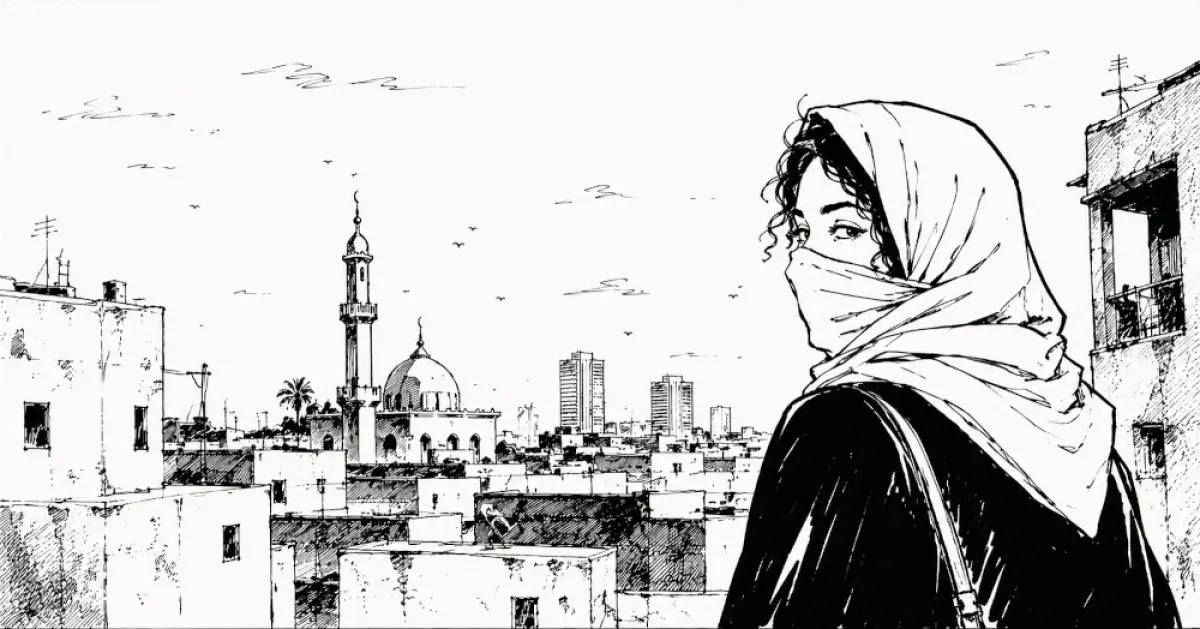
Inan M. Blai is a transgender woman and author. Her work focuses primarily on gender issues and the rights of LGBTQIA+ people. Through her writing, she seeks to deconstruct the patriarchal narratives that shape dominant social institutions by placing lived experiences at the center of her analysis of the mechanisms of marginalization and exclusion.
My experience as a transgender woman in Iraq opens up a vast field of reflection on what citizenship truly means. It not only reveals a particularly acute form of social and legal vulnerability; it also highlights the conditions under which a person becomes worthy of recognition and authorised to appear in the public sphere. Consequently, the transgender body ceases to be merely another object in Iraqi debates about the state, violence, or society. It becomes an analytical tool that unveils the normative structure through which bodies are interpreted, classified, and hierarchised, and assigned varying degrees of legitimacy and protection.
This issue can be approached through two major traditions of Iraqi political thought. The first is that of Faleh Abdul-Jabar, who analyses the Iraqi state through its ongoing entanglement with pre-modern communal structures. In this interpretation, the citizen does not appear as an abstract individual defined by law, but as a subject embedded in tribal, sectarian, and familial affiliations and in networks of loyalty that predate the state itself. The second is that of Kanan Makiya, who describes power as a climate of fear that shapes daily life and trains individuals in both obedience and survival.
The queer experience does more than simply add a new angle to these analyses; it reframes them from a different point of view: how do conditions for a recognisable form of gender visibility arise? Why do some bodies gain access to protection and legal recognition, while others are relegated to a zone of indeterminacy, caught between denial, criminalisation, and constant exposure to violence?
From this perspective, citizenship goes far beyond mere legal status or national affiliation. It emerges as a normative economy of recognition, which distributes not only rights but also the very possibility that a body may be perceived as legitimate and that a life may be considered worthy of protection. The transgender experience thus reveals a dimension even deeper than the simple opposition between inclusion and exclusion: it confronts us with subjects who are not merely cast to the margins of citizenship, but through whose exclusion citizenship itself is constituted.
The Boundaries of Recognition
The vulnerability that marks my existence as a transgender woman takes on a daily, unobtrusive, and yet profoundly violent form in all those moments when I am asked to state my identity: at a checkpoint, in a government office, to a receptionist, during a job interview, or while filling out a form presented as gender-neutral.
At that moment, the question “Who are you?” ceases to be a simple request for information. It becomes a test of legibility. It's not just a name that is expected: the body itself must fit into a pre-existing legal and social framework. When the correspondence between official documents and the body breaks down—or between the body and what these documents permit to be seen—what emerges is no longer a mere administrative error, but an entire political logic in which recognition and rights are unequally distributed.
The problem, therefore, is not merely that of a person deprived of their rights. It lies in the very fact that a subject is not recognised as a coherent subject within the prevailing symbolic order. Not all bodies enter the political sphere from the same starting point. Some are welcomed as citizens whose legitimacy is taken for granted; others enter only amid suspicion, defined from the outset as a threat or as an anomaly requiring control and discipline. Consequently, the question is no longer: “How are the rights of queer people violated? ” It becomes a more fundamental one: how is a non-conforming body produced, from the very beginning, as an object of unstable recognition?
This reality has been further reinforced since the Iraqi Parliament amended the law on combating prostitution on April 27, 2024. The amendments now criminalise same-sex relations, penalise “biological sex reassignment,” and introduce deliberately vague concepts such as “promotion of homosexuality” or “imitation of women.” This expands the criminalisation of certain acts to that of gender expression itself. In this context, it is no longer merely a matter of a lack of protection: certain bodies are now redefined as punishable simply by virtue of their presence in social space.
Being a transgender woman in Iraq is therefore not merely an individual condition. This experience reveals the normative structure that produces citizenship itself as a system of interpretation, classification, and recognition. A system that does not merely distribute rights, but also determines which bodies can be understood as legitimate and worthy of protection. From this point on, the debate moves beyond the discourse of victimisation to focus on deconstructing the very mechanisms of political recognition.
The State, community structures, and the mechanisms of gender recognition
Faleh Abdul-Jabar’s analysis shows that the post-2003 Iraqi state did not emerge through a break with tribal, sectarian, and familial structures. On the contrary, it has established itself as a modern apparatus that integrates, reorganises, and reproduces these structures within itself. In this context, citizens do not access the state as abstract individuals, equal to others before the law. Rather, they enter it shaped by prior affiliations, which determine the extent of the protection they can receive, the limits of their representation, and the scope for negotiation granted to them.
The strength of this analysis lies in the fact that it shows the Iraqi state does not function as the antithesis of communal or “pre-modern” structures, to use Abdul-Jabar’s terms. It coexists with them, borrows their logic, and reconfigures it into a new administrative and political form.
But if we take this line of thought a step further, another question arises, one that goes beyond the issue of the distribution of protection based on affiliations. The non-conforming body does not merely enter this space laden with prior identities, but already deprived of the very possibility of being recognised. The tribe, the religious community, or the family does not perceive it as a mere social difference. They see in it a rupture in the very conditions that make a body intelligible: a rupture in the categories of masculine and feminine, in the logics of filiation, honour, and inheritance, and, more broadly, in the place assigned to the body within the social narrative.
From this perspective, community structures appear to be much more than mere spaces of belonging or protection. They can be understood as mechanisms that produce the very conditions of gender visibility. They neither include nor exclude individuals solely on the basis of their social position, but also according to their body’s capacity to be perceived as morally and symbolically intelligible.
At this level, it is no longer a matter of mere unequal negotiation within citizenship. Any negotiation already presupposes a subject recognised as a legitimate interlocutor, capable of speaking, making claims, challenging, and participating in the debate. However, in the case of the non-conforming body, this very starting point is lacking. Even before being deprived of a specific right, it finds itself excluded from the symbolic legitimacy that makes any claim audible, let alone possible.
It is here that the language of vulnerability reveals its own limitations when used in isolation. Vulnerability still implies the existence of a political actor who, though weakened, is nonetheless present in the public sphere. Yet what is revealed here is more radical: a conditional presence, one in which mere visibility is always liable to become grounds for punishment.
From this perspective, the notion of “spectre,” proposed by Manal Hamid, seems more accurate than that of “margin.” The spectre is not a total absence; it is a presence without guarantee. A being visible enough to be monitored, suspected, and punished, but without the sufficient recognition to benefit from effective protection mechanisms. The non-conforming body thus does not merely appear at the bottom of the citizenship ladder; it is situated at the very boundary where citizenship is defined by its exclusion.
Fear as an Economy of Visibility
While Faleh Abdul-Jabar helps us consider the intertwining of the state and community structures, Kanan Makiya offers us a particularly powerful framework for understanding power as the production of fear. In *The Republic of Fear*, power does not act solely through the law or direct violence; it establishes a diffuse climate of terror that shapes daily life, redefines perceptions of security and danger, and teaches individuals to survive through conformity, denial, and constant vigilance.
This work remains essential for understanding a fundamental dimension of the Iraqi experience, including the period after 2003. Yet the case of the non-conforming body reveals an additional layer that merits more precise definition. Violence does not serve solely to engender obedience; it also generates a veritable economy of visibility.
For the non-conforming body, fear becomes a technology that organises the very conditions of presence in public space: who disappears, who goes unnoticed, who dares to move about, who avoids an institution or a street, who rewrites their voice, their gait, their clothing, or their gaze in order to stay alive.
The goal, therefore, is not always to reduce the individual to obedient conformity. Rather, it is to redistribute the very conditions of their presence in public space. Fear thus gives rise to conditional forms of existence: calculated movements, intermittent appearances, a constantly strained relationship with institutions, and a constant suppression of the self in shared space.
Violence against the non-conforming body cannot be explained by the fact that it opposes power or advances a competing political discourse. Its mere presence reveals other possibilities for the body, gender, and social life. This is why such bodies are targeted—not to crush their desire for visibility in order to reintegrate them into the social order, but to produce their absence as the desired outcome: to teach them not to merely obey, but to disappear in order to survive.
Militias as a Mechanism for Regulating Gender Visibility
Understanding the violence perpetrated against non-conforming bodies in Iraq requires moving beyond the dichotomy between state and non-state as the sole framework for interpretation. Militias are not merely parallel forces challenging the state’s monopoly on violence, nor are they simply actors situated outside the political sphere. They fulfill a more complex function: they participate in defining the moral and gendered boundaries of public space. Their intervention thus goes beyond the imposition of a security order; in practice, it establishes the rules that determine which bodies may appear, in what forms they may do so, and which types of presence are deemed legitimate or, conversely, are to be corrected, erased, or eliminated.
Militia violence does not arise in a vacuum. It occurs at the end of a process that has already deprived the non-conforming body of its legal and social stability: a law that criminalises visibility, a discourse that transforms gender non-conformity into a moral scandal, a family that withdraws its protection. When militias resort to threats, abductions, blackmail, or murder, they are merely carrying out a verdict long since delivered in more subtle ways.
The 2024 amendment to the Iraqi law on prostitution and homosexuality further reinforced this framework. It provided the militias with additional legislative cover. By criminalising, in deliberately vague terms, the act of “imitating women,” the law instils in the collective consciousness the idea that certain bodies deserve to be prosecuted. The law and the militias thus cease to appear as two opposing realities: they are part of the same logical continuum.
An even deeper dimension underlies this discourse. The militias do not present their violence solely as a defence of morality. They frame it within a broader political narrative according to which queer identities are an American fabrication and a project of Westernisation intended to destroy the cultural and religious foundations of Iraqi society.
The power of this narrative lies precisely in its connection to the memory of the U.S. occupation of Iraq. Violence thus acquires a dual legitimacy: moral, because it invokes religion and social norms; political, because it presents itself as an act of resistance and defence of national sovereignty.
This narrative then closes in on itself. Defending non-conforming bodies or gender identities becomes proof of allegiance to foreign interests; denouncing the violence they suffer becomes a sign of loyalty to the West. In such a scenario, those affected no longer have any space from which to speak as citizens asserting their rights: their very existence has already been redefined as a form of treason.
The militias are thus part of a network in which responsibilities are distributed to the point of becoming almost invisible: the state enacts laws, religious discourse confers legitimacy, the political narrative transforms persecution into resistance, the family withdraws its protection, the militias carry out the sentence, and collective silence perpetuates impunity. Violence against non-conforming bodies thus no longer appears as the consequence of a collapse of the rule of law, but as the logical product of a system in which certain bodies are already rendered expendable even before they have been singled out.
Writing as an Act of Visibility
What the queer experience in Iraq reveals goes far beyond simply adding a new injustice to the list of injustices. It confronts us with a theoretical and ethical imperative: to rethink citizenship from its very foundations, rather than attempting to correct its margins.
Faleh Abdul-Jabar’s analysis shows that community structures neither include nor exclude individuals solely on the basis of their affiliations, but also according to the extent to which their bodies remain legible in the eyes of the prevailing social imagination. Kanan Makiya’s analysis reveals that fear does not merely produce obedience: it produces an economy of visibility that redistributes the very conditions of presence in the public sphere, between those who dare visibility and those who learn to disappear.
When the militias’ narrative—which transforms the queer body into an act of national treason—is added to these two dimensions, the entire system becomes fully coherent: a body that community structures refuse to recognise, that daily fear condemns to orchestrating its own disappearance, and to which public discourse denies even the possibility of having a voice as a citizen.
Consequently, the issue goes beyond inclusion or reform. A citizenship defined by the exclusion of certain bodies does not need to be expanded; it must be deconstructed. As long as the conforming body remains the implicit measure of legitimacy, as long as the capacity to exist politically remains conditioned by conformity to a preexisting familial, religious, and moral model, any policy of inclusion will only confirm the rule rather than undermine it.
The goal is not to grant rights to non-conforming bodies because they constitute a special case deserving of compassion. It is a matter of rebuilding citizenship on the principle that recognition no longer precedes rights. Protection must not be a privilege granted to those who conform to the norm. Visibility is not a favour that the system grants to the most deserving; it is a human condition that precedes any classification.
In other words, the problem does not lie in the absence of a law protecting non-conforming bodies. It lies in the existence of an entire system that defines these bodies as criminal before they have committed any act whatsoever. The law that criminalises visibility, the community structures that withdraw their protection, the militias that carry out the sentences, the political discourse that presents this violence as national resistance: none of this is an exception or a malfunction. It is the system itself functioning exactly as it was designed.
Calling for reforms without challenging this architecture amounts, at best, to asking that the cage simply be a little bigger.
That is why I am speaking out. Not to secure a place on the margins of this order, but to show that a system capable of producing such a margin suffers not only from a deficit of justice; it reveals an even more fundamental inability to conceive of what citizenship means.
I may be a spectre. But a spectre is not merely what remains after death. It is what survives attempts to erase it when it is denied any recognition, without ever giving up the right to speak. And that voice, in and of itself, is already an act of visibility in the face of an order that would have it silenced.
+++
Did you enjoy this text? If so, please support our work by making a one-off donation via PayPal, or by taking out a monthly or annual subscription.
Want to make sure you never miss an article from Literatur.Review again? Sign up for our newsletter here.
This article was first published on the Lebanese website Daraj Media on June 18, 2026.
The English adaptation is based on the French translation from Arabic by Rita Barotta.