



Orders in the "jungle"
 Hanser
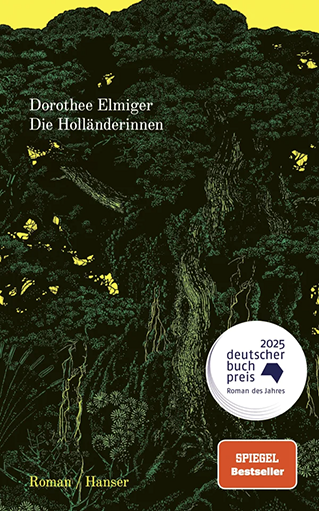
Dorothee Elmiger | Die Holländerinnen | Hanser Verlag | 160 pages | 23 EUR
The novel Die Holländerinnen (The Dutch Women) brings together stories, narrative forms and varying characters that contradict and confuse each other. Without claiming to be able to shed light on everything in the world, the text makes fundamental narratives of colonialism and the Anthropocene legible. In order to remain in the thicket and not continue to help build violent orders of knowledge, it must once again become a text instead of a novel.
In the text, in the thicket: a possible beginning
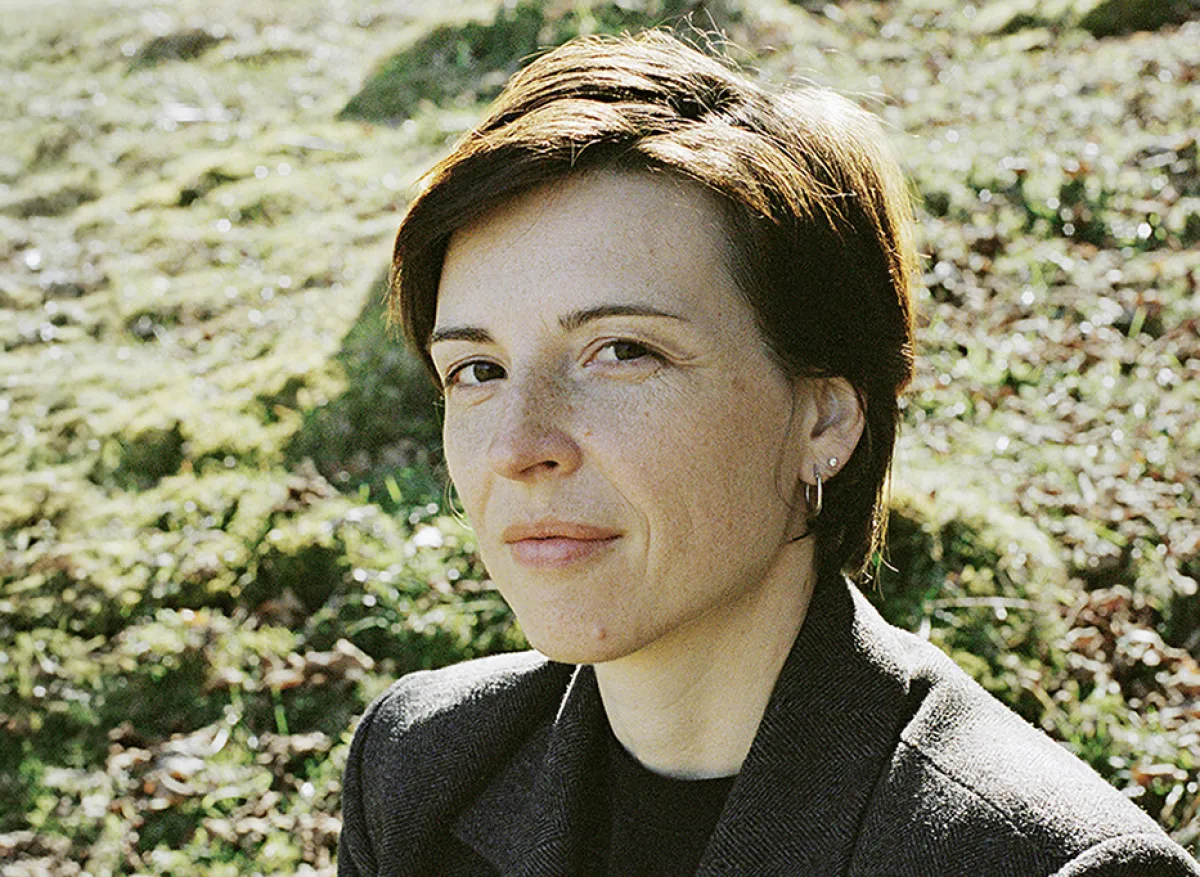
The following is about a novel that originally wasn't one. Instead of a linear story, Dorothee Elmiger's "novel" Die Holländerinnen, which was published last year, contains a multitude of narratives; its characters, whether human or not, are neither heroes nor clear protagonists. The text was awarded the German and Swiss Book Prize. And it is messy: her stories are inconsistent, contradict each other, and yet the material remains in place. As a carrier bag, as the text could also be called, it refers to its cultural contexts.(1)
In the following, I will not be able to resolve these contexts, but I want to delve into the material. I want to sense the extra-literary reason for the text by following its traces in the text - and I will "fail" because there is no single reason. Even a carrier bag has creases. No matter what form the text takes, there are opaque passages, even in Die Holländerinnen. Read as a collection of material,(2) it becomes a thicket. No narrative dominates. This unusual untidiness releases imaginative elements, but continues to conceal others; it remains a text of European imaginative elements. In its courage of fragility, however, the text will prove to unfold cautiously.
Ultimately, I will stumble. For in the form of epistemic violence, which also characterises a seemingly floating sphere such as art, the connection of this text to the world of multiple possibilities(3) is nevertheless fenced in. It is only made into a novel by the literary field - and this has consequences for its perception. For months, the literary establishment has been talking about Die Holländerinnen as a novel, instead of holding it, and allowing it to support itself (4) in its messiness.
I would like to say: Die Holländerinnen is read by critics as a literary form, while the text itself problematises literary form as part of colonial and anthropogenic orders of knowledge. Precisely by presenting concepts of nature and colonial imaginaries as fragile, it creates problems from these orders. It traces their furrows, leaves the European "man" behind in the thicket – and clarifies what could be literature.
What material is gathered: Themes and narrative styles in "Die Holländerinnen"
To read Die Holländerinnen is to collect and yet only be able to track down the material, not organise it. The text takes up various narrative forms of the world: literary and scientific attempts at interpretation, newspaper reports, voices of speakers, the author, theatre makers or South American climbing plants. It is permeated by architectural, explicit and implicit intertextual references; a collection of quotations from several perspectives and employs different narratives: "whether [...] it is about dying in the so-called Anthropocene? Yes and no, she, the production assistant, answered, suddenly unsettled, as if what she previously thought she knew was slipping away from her [...]"(5). These narratives break off again and again. In a polyphonic and unruly way, a narrative opens up about what different narratives - initially linguistic systems of order and cultural imaginaries - construct the actual world. It is about experiences of a speaking nature and at the same time about the refraction of this "concept",(6) while the non-human narrative world already lies fallow. Road signs still refer to plantations, while a character thinks he recognises traces of Humboldtian scientific curiosity in the landscape.(7) Did these lead to the terrain reshaped by colonialism? A few pages later, the nameless author character finds herself at the scene of colonial violence: Bavarian cupboards stand in the South American hut, the old German sits behind her in the semi-darkness. She feels uneasy.
Dorothee Elmiger's text Die Holländerinnen collects the imaginative and material production contexts of a nature/culture dualism and colonial violence. These, and others. The world here and "outside" appears as a multi-layered thicket. In Die Holländerinnen there are also inscriptions of gender relations.
It is about a text that confuses European imaginatives, exposes them as fragile and at the same time places them on a stage, in a world that bears deep furrows from them. This world can no longer be put in order "differently" without contradiction by the European female author figure.
In Die Holländerinnen, an unnamed author reports in the form of a poetry lecture on her time as a member of a theatre project that travels to the South American jungle. She reports in indirect speech - a first sign that different modes of reality clash here. The fact that the actual narrative world is also a lecture at a European university shows that the stories about the South American jungle are produced here and possibly already distorted.
She reports on discussions and memories that the project participants share with her. She reproduces the theatre maker's lecture on the "Dialectic of Enlightenment", as well as scientific quotations. References are made to diagnoses from the history of ideas and literary texts. But the story is also told through non-linguistic signs: menacingly falling fruit, non-human noises as screams. At the same time, this interpretation is immediately problematised: the characters feel as if the fruit is threatening.[8] The fact that speaking positions depend on the other person acknowledging them and on how they read always makes reality into something disguised - or a reality among others. Through its intertextuality, the text opens up various contexts of meaning, but remains only loosely connected to them. None of them is narrated in detail or transferred into a clear plot structure.
Instead, narratives and stories question each other. In this way, it becomes clear that European travel literature about the "jungle" produced imaginative narratives that did not remain mere ideas, but legitimised colonial violence or carried it within them. Ideas dig furrows. They must be understood as material.
The European in the concept of the 'jungle'
In German there is the word "Großstadtdschungel" (urban jungle). I think of this as I take the S-Bahn to Wannsee in December, to a reading in which Elmiger reads a text that is not really about the South American forest.
This "jungle" metaphor was particularly influenced by European literature and literary criticism of the 1920s.(9) It tells of the "urban jungle" as a form and experience of the industrialised city: of meandering streets between shady facades, of bustling, roaring traffic, of the fragmentary nature of every encounter. Stench, arrogance, dazzling fascination - these are all commonplaces that can be found in the texts of Georg Heym, Hans Fallada or Erich Kästner and that build up the "urban jungle". And it's not just theirs. It lives on in cultural imaginaries to this day.
In 2021, the Berlin rappers viko63 and penglord wrote: "Outside ice cold, urban jungle / I feel like I'm in a forest [...] I walk around and make sure I don't fall down."(10) The city appears here as uneven, opaque terrain. Not only because of its twists and turns, but also because of the experience of disorientation and loss of control. It becomes clear: The comparison of the city with a "jungle" is not based on external similarities alone. Above all, it needs the cultural imaginative of the "wild".
Most of the primeval forests that are imagined as pristine are not even "jungles". The etymology of the word is Persian. The term 'ǧangal' brings together various ideas of forest or thicket. Only the translation into English - jungle - narrows the meaning to subtropical monsoon forest and bamboo-rich swamp areas. With the translation into English and German, a distinction begins that is also adopted by geography: The "jungle" becomes the European other of the (forest) woodland.
To grasp the experience of the city, then, we need the other, the incomprehensible: the imagery of the "jungle". What might at first appear to be a relativisation of the distinction between civilisation and absolute nature quickly proves to be an intensification of that distinction. For the "urban jungle" is, then as now, a space of experience in which a white subject learns to assert itself. In English literature, it is referred to as the "concrete jungle".
If the metaphorical transformation of the city is supposed to be the "concrete" jungle, did the "real" jungle that German or English literature refers to ever exist? Wasn't the "jungle" built into the European city - as a concept of nature and as a colonial space of experience?(11) This elsewhere is cultivated and suppressed through overexploitation; at the same time, aesthetic value is extracted from the terrain.
Although the narrative world of Die Holländerinnen is located in a Panamanian "jungle", the confrontations with the "unpredictable" and the "entanglements" of the "jungle" are probably just as much set here: in the archives of European cultural imaginaries, to which the Literary Colloquium Berlin also belongs.(12)
Talking about nature is itself an imagination
Die Holländerinnen exhibits aesthetic extractivism by tracing the text back to its origins:
"In the night, she found herself completely at the mercy of the jungle. It was filled with a tremendous, even hellish noise [...] all those statements, all those sentences and phrases that dealt with the vulgarity, with the violence of this nature immediately flashed through her mind [...]"(13)
The 'as-if' mode is crucial here. It provides an example of the unruly, communicative mode of narration in Die Holländerinnen. For this 'as-if' no longer presents the non-human as vulgar or primal. Rather, it exposes its inauthenticity: that the experience depends on the speaker's cultural contexts. The "phrases" are marked as attempts at interpretation. The process of imaginative reshaping of the non-human – the "hellish noise" – becomes just as legible as the process of its containment in language.
At the same time, literary and scientific sentences are collected and related to the world, but prove only relatively apt - more precisely, they are more strongly connected to the speaker's European contexts than to what they attempt to capture. They could always be different. The text exhibits this continuity of inauthenticity, of the relative, through its consistently indirect mode.
This narrative mode of the subjunctive, which is also evident in the intertextuality and the transposed speech of the lecture, tells of communication contexts that readers encounter in Die Holländerinnen – and in which they can become involved. The narrative style not only indicates that many people are speaking; it invites us to listen carefully, to be confused and disturbed.
In a closing archive: on the consequences of calling the text a novel
The focus is now on Elmiger's text as one that has become a novel. In recent months, the literary public and its critics have not understood Die Holländerinnen as a collection of material. Rather, the text is read as self-referential literature, even though it makes visible precisely this underestimation of literature and the imaginative as part of the colonial and anthropogenic order of knowledge.
Hanser Verlag already classifies Die Holländerinnen as a novel. I read this as a momentous marking of a literary field with its own logic.(14) For me, the literary public is part of this field, with its awards, discussions and reviews, which I have been following in recent months. To label the text a novel is to assign it a form, a literary-historical order that limits its understanding.
This is exactly what continues in the reviews. Marie Schmidt discusses the text in the Süddeutsche Zeitung almost exclusively through the figure of the author, Dorothee Elmiger.(15) She addresses the work's origins, highlighting the image of the female author figure - thus obscuring the cultural and material contexts of the text. In a review by the FAZ, the text is primarily turned into a poetical question for the review: do we need the subjunctive to discuss this narrative?(16) The material of the text is thus reduced to a self-referential discussion immanent to the field; its possible content – the entanglements of enlightenment, the Anthropocene and colonialism – is narrowed down to a question of form.
Both reviews emphasise the literary stubbornness of the text. This is strategically intelligent for sales and actualises the doxa of the literary field to be autonomous: the much-invoked 'art for art's sake'. At the same time, however, it conceals the fact that art is only ever relatively autonomous and that its special access to the world arises precisely from remaining connected to it in its delimitation.
The "unfathomability of the human abyss" is described without going into more detail about what this abyss might consist of in the text or in social reality. Reading the novel is described as "stirring", as something that "won't let go".(17) But why? Platthaus attests to the novel's "striking continuity"(18), but in what exactly? In the end, the narrative style appears above all as a literary circling of intertextual references.
Platthaus describes Elmiger's text as "new" literature, made from great old literature.(19) Thus, although the intertextuality is elaborated, its potential is contained in the self-referential circles of criticism.
Is it even necessary for the text to have potential at all, one could ask. Is this claim not yet another fatal enlightenment curiosity? Does it not objectify the unruly material? And doesn't the search for a potential sound like the next anthropocentric, even phallocentric, perspective? But asking about the potential of the text also means being attentive to its connections with an actual world. This does not remove the objections, but allows the reader into the text. Understanding it as a collection of material and recognising potential in it opens up more possibilities for uncovering contexts. Reading it in its untidiness opens up more than a reading practice immanent to the field, which simultaneously incorporates and excludes.(20)
Back to Wannsee, to a central institution of the literary public: reading. It produces authors and texts whose meaning is framed by the presence of a seemingly absolute speaker. I contemplate wood-panelled walls, neat rows of chairs, the book sale table eager to fulfil its function, at black roll-necks, seeming almost orthodox. I have to interpret the reading as a culmination of the contradictory nature of what literature is: historically made possible by the bourgeois public sphere, which forms both its freedom and its limitation; in its institutionalisation a medium of symbolic and epistemic violence.
Throughout the reading, I had the feeling that what the novel attempted to place in a concrete world as a collection of material was once again closing into a vacuum. The feature writers ask Elmiger how to write with a language that is accused of no longer being able to grasp reality; they ask where "Die Holländerinnen" has gone – and the non-human becomes the background again.
Intertextual references are repeated that have already been neatly strung together in the reviews: a path into the "heart of darkness", a book of books, a path into darkness. Book closed, world dead.
Staying in the thicket
Despite the messiness, I want to stay in the text, which is here also.
This experience in the Literary Colloquium could itself be just another narrative in The Dutch Women. For Elmiger's collection of material breaks with the outside of the text. And as much as this experience contradicts the collection of material, it corresponds to one of its characteristics: to resolve nothing, to leave us questioning.
After reading Elmiger's novel, nothing seems to be in order anymore: art and knowledge seem to be integrated into different, violently obfuscating contexts; their separation from the world into their own spheres is obsolete.
What happens to literature when it is confronted with its imaginative collaboration to something as material as colonialism and the Anthropocene? This reading is intended to show that it becomes a collection of material, it is brought back into a thicket. It is then no longer an object of contemplation held in abeyance. It becomes questionable.
Who is allowed to tell, who can tell? Who are stories made of?
This reading does not stand outside the field it criticises. I write as a white, academically socialised reader who moves in the same literary space that she describes here as self-referential. My perspective is thus part of that European imaginary whose traces I follow in the text.
Such a materialist view of literature exposes her. It also becomes messy: art and the world are interwoven. When literature becomes a collection of materials, as a reader I have to ask myself, searching for traces, where the Bavarian cupboard in the South American hut comes from. At this moment, I find myself in the story - or the story in my world.
A young, white woman, standing between the city and Wannsee, has to endure such disorder. And at the same time, attempt to shed certain narratives.
+++
(1) In her essay "The Carrier Bag Theory of Fiction" (2021), Ursula Le Guin suggests telling stories as carrier bags, in which the hero appears just like his environment. From the perspective of stories as carrier bags, the hero is one character among others and his story one among many. I would now like to understand the concept of the carrier bag not only as a practice, but also in material terms: Stories that are carrier bags stand in the 'extra-literary' world, the boundary between text and non-text suddenly seems dubious - because a carrier bag stands somewhere and does not float.
(2) Reading this text as a collection of materials is inspired by the notion of understanding literature as a cultural technique that gathers knowledge and is itself situated (cf. Struck/Mangold/Fechner 2025). The concept of collecting, which is used in my reading, is also largely based on the work of Wolfgang Struck's research network "Kulturtechniken des Sammelns" (Cultural Techniques of Collecting). Collecting, as Friedrich, Mangold and Rau, collecting is characterized by a " [...] central ambivalence, which on the one hand preserves what has been handed down, expands knowledge, enables series or comparisons, produces and represents history(ies) and thereby generates meaning, and which on the other hand destroys contexts, isolates or fragments objects, tears gaps in tradition or habitat, which in turn lead to alienation in cultural processes of self-understanding" (Friedrich/Mangold/Rau 2023: 14).
(3) This is based on the assumption that the relationship to the world is always situated, that reality is to be understood as one of a multitude of constellations and is produced by specific, contingent relations.
(4) There are new perspectives or even new worlds to be held upside down: For this text could be a tipping figure, as Judith Schalansky (2023) describes it, which carries along the furrows of the world and simultaneously attempts to break them.
(5) Cf. Elmiger 2025: 50f.
(6) In Phillipe Descola's comparative study, it becomes clear: 'nature' is a concept, thus does not simply exist (cf. Descola 2013).
(7) Cf. Elmiger 2025: 15.
(8) Cf. ibid.: 41f.
(9) Cf. Becker 1993.
(10) Cf. Viko 63/penglord 2021: 0:27-0:41.
(11) On the colonial imaginary of the 'jungle', especially in travel literature, see Marie Louise Pratt (1992): Imperial Eyes. Travel Writing and Transculturation.
(12) The archive is to be understood here not only as a place, but much more as an ensemble of discourses and institutions that have been historically legitimized to collect, classify and discard narratives in their broad understanding (cf. Foucault 1981: 187).
(13) Cf. Elmiger 2025: 41f.
(14) Pierre Bourdieu essentially developed the terminology of the literary public sphere as a field with its own logic in "Die Regeln der Kunst. Genese und Struktur des literarischen Felds" (1999). Carolin Amlinger has updated this perspective and applied it to the German literary scene in "Schreiben. Eine Soziologie literarischer Arbeit" (2021), she reveals the literary production, distribution and reception practices, as well as the delimitation processes of the field and its relativity.
(15) See Schmidt 2025.
(16) Cf. Platthaus 2025.
(17) Cf. ibid.
(18) Cf. ibid.
(19) Cf. ibid.
(20) The way in which texts are read and how they are spoken about is determined by the inherent logic of the literary field. This inherent logic is therefore incorporated. It is produced by the institutions of literary criticism, but also by academic literary studies. These boundaries are naturalized by the doxa. They therefore seem self-evident. But they are not, just as the reading practice of the field is not autonomous. Literary reading practice, for example, presupposes knowledge of literary history or literary theory and expects a certain vocabulary that excludes other readers.
+++
Literature
Elmiger, Dorothee (2025): Die Holländerinnen, Munich: Carl Hanser Verlag.
Amlinger, Carolin (2021): Schreiben. Eine Soziologie literarischer Arbeit, Berlin: Suhrkamp Verlag.
Becker, Sabina (1993): Studien zur Großstadtwahrnehmung in der deutschen Literatur 1900-1930, St. Ingbert: Röhrig Verlag.
Bourdieu, Pierre (1999): Die Regeln der Kunst. Genese und Struktur des literarischen Feldes, Frankfurt a.M.: Suhrkamp Verlag.Pierre
Descola, Phillipe (2013): Jenseits von Natur und Kultur, Berlin: Suhrkamp Verlag.
Foucault, Michel (1981): Archäologie des Wissens, Frankfurt a.M.: Suhrkamp Verlag.
Friedrich, Susanne/Jana Mangold/Susanne Rau (2023): Wandlungen des Sammelns. Introduction, in: this. (ed.), Transformations of Collecting. Practices, Knowledge, Arrangements - A Reader, Bielefeld: Transcript Verlag.
Le Guin, Ursula (2021): The Carrier Bag Theory of Fiction, in: HKW/Sarah Shin/Mathias Zeiske (eds.), Carrier Bag Fiction, Leipzig: Spector Books, pp.34-45.
Schalansky, Judith (2023): Schwankende Kanarien, Berlin: Verbrecher Verlag.
Schmidt, Marie (2025): Es ist mein Körper, der da liegt, in: Süddeutsche Zeitung, 25.08.2025, n.d., p. 9.
Platthaus, Andreas (2025): Konjunktiv III dringend gesucht, in: Frankfurter Allgemeine
Pratt, Marie Louise (1992): Imperial Eyes. Travel Writing and Transculturation, London: Routledge. Newspaper, October 10, 2025, n.d., p. 2.
Struck, Wolfgang/Jana Mangold/Nadine Fechner (December 17, 2025): Was bleibt, was kann weg? – Sammeln als Kulturtechnik, in: WortMelder - Universität Erfurt [Audio-Podcast].
Viko 63/penglord (2021); Großstadt'Dschungel' [Song], on: Großstadt'Dschungel', recordJet.
Did you enjoy this text? If so, please support our work by making a one-off donation via PayPal, or by taking out a monthly or annual subscription.
Want to make sure you never miss an article from Literatur.Review again? Sign up for our newsletter here.