



Life as an echo

 Atlantic
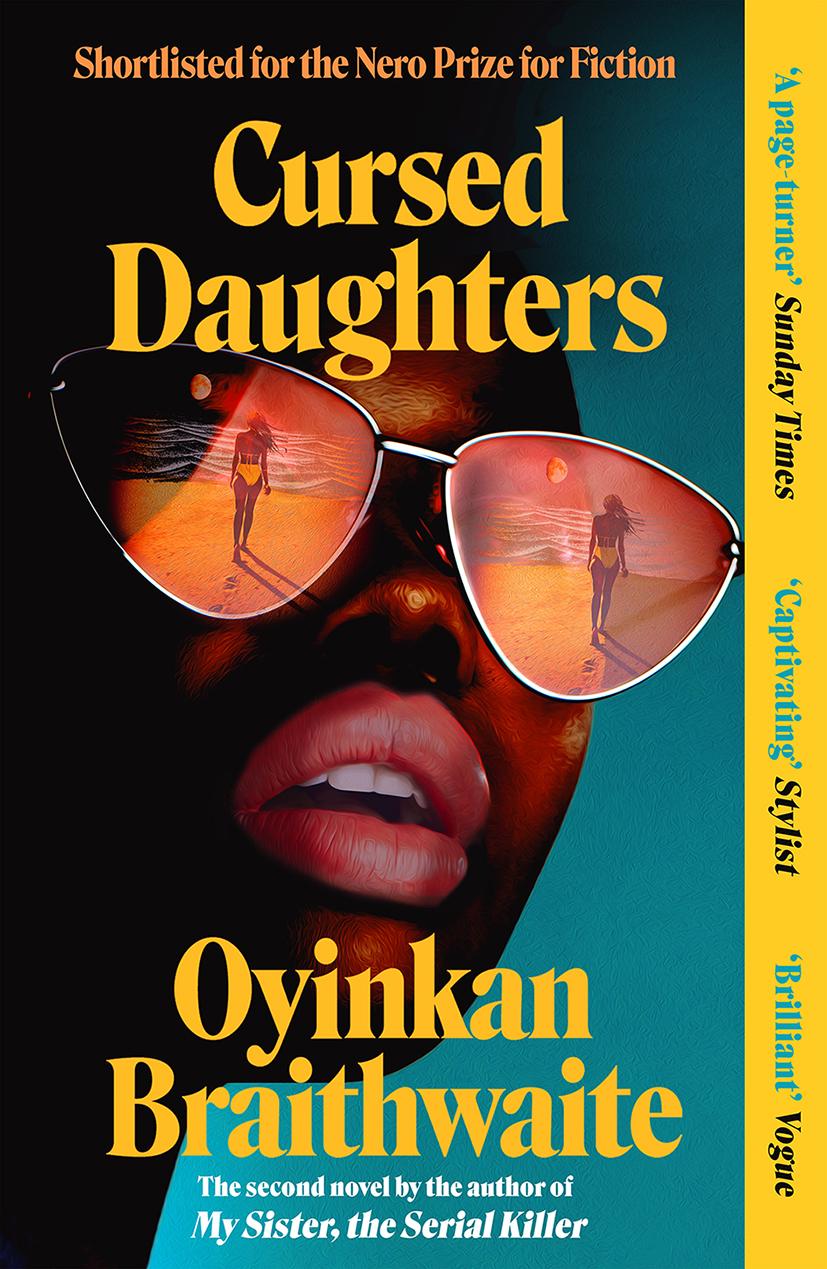
Oyinkan Braithwaite | Cursed Daughters | Atlantic Books | 379 pages | 18.99 GBP
Nigerian literature, which - like the Nigerian film industry, known as Nollywood - boasts an almost uncannily diverse output, never ceases to surprise us. Not necessarily the modern classics of Nigerian authors such as Wole Soyinka or Chimamanda Ngozi Adichie, whose last novel Dream Count, for all its formal elegance and political urgency, was more programmatic activism than literary distillation. Rather, it is the work of a younger generation that takes narrative risks. Be it the innovative Facebook poetry or a novel such as The Girl with the Louding Voice by Abi Daré, which not only took content into a new realm with the coming-of-age of a young housemaid, but was also a linguistic sensation: English that switches between standard and pidgin, giving self-empowerment an audible movement.
In contrast to Abi Daré's novel, in which a marginalised young girl is "sold" from the countryside to the city and endures an almost biblical ordeal as a housemaid, in Cursed Daughters we are confronted with the Nigerian middle and upper classes. After the success of her thriller My Sister, The Serial Killer, Oyinkan Braithwaite, who lives in London, is moving away from the thriller genre. She sets this novel in houses with barred windows, on Lekki beaches, in chauffeured cars, and among families acutely aware of their social standing and, therefore, all the more haunted by inner demons.
Cursed Daughters is also a coming-of-age novel, exploring the transition to adulthood across several generations. The curse that hangs over the women of the Falodun family - "No man shall call your house his home, and should he try, he will have no peace ..." - seems like an archaic verdict reminiscent of modern and ancient tragedies. One thinks of Henrik Ibsen's Ghosts: there, too, it is not supernatural forces, but protracted truths and inherited guilt that poison the present.
When Ebun gives birth to her daughter Eniiyi on the day of her cousin Monife's funeral, the rumours begin. The resemblance is too striking. In an oppressive scene, Ebun looks at the child's scar: "This burn, the shape of it ...". "Mo's was bigger", she says - and yet "a sense of dread ... like a cat, digging its claws into her skin" comes over her. Braithwaite depicts these moments with subtle irony and psychological accuracy; the superstition does not arise from stupidity, but from an instinctive need for understanding.
Formally, the novel jumps between eras, voices and life trajectories. "Kemi, daughter of Afoke, daughter of Kunle ..." - this genealogical chain is not a mere ornament, but a narrative principle. The past is always present. And the house of the Faloduns is always there. "She looked back at the house. It would be years before she returned home ..." - Years later, she would know that "Sango the Immortal" would die, that Oba would court her mother, that Ebun would move out. "All that would remain of the Falodun house were the ghosts." This house is more than just a backdrop; it is a memory, a resonance chamber and a machine of destiny all in one. This is reminiscent of Heimsuchung (Visitation) by Jenny Erpenbeck, but also of more recent cinematic attempts to interweave time and space - such as Here by Robert Zemecki or In die Sonne Schauen (Sound of Falling) by Mascha Schilinski . As there, a place in Lagos becomes a matrix of generations.
Cursed Daughters is also very contemporary. Tribalism, social codes, urban youth culture - all of this flows organically into Braithwaite's text. When Eniiyi defiantly says: "My mum isn't tribalist", and Zubby dryly replies: "All Nigerians are tribalist", it is more than just a lovers tiff. It is a reflection of a fractured society. And when the child Eniiyi paints two figures - "Small me and big me" - she encapsulates the central theme: duplication, life as an echo.
It is remarkable how Braithwaite integrates modern discourses without being too explicit. Eniiyi reads about "epigenetics and generational trauma" and wonders whether it is not neuronal imprints rather than curses that are at work here: Perhaps it is not ghosts, but markers in their genetic make-up that repeatedly draw the Falodun women to the wrong men? But on this, the novel remains ambivalent.
One of Braithwaite's great strengths lies in the dialogue. "We did our best by both of you." - "And yet ..." That's all it takes to lay bare the tragedy of a family. Even the surprising encounter with the father - "I don't want you to feel pressure ... I know you Gen Z people care a lot about boundaries" - is not explored pathetically, but tentatively.
In the end, Cursed Daughters is a novel about second chances; can one rewrite the script of one's ancestors? As with Ibsen or in ancient drama, which African authors have long been productively incorporating, fate seems inevitable, and yet within every decision lies a crack through which freedom seeps. Braithwaite combines humour and toughness, modernity and myth to create a vibrant picture of Lagos and its women, in a novel that shows that whilst ghosts may linger, they needn't have the last word.
Did you enjoy this text? If so, please support our work by making a one-off donation via PayPal, or by taking out a monthly or annual subscription.
Want to make sure you never miss an article from Literatur.Review again? Sign up for our newsletter here.