


On the Futility of Words
 4th Estate
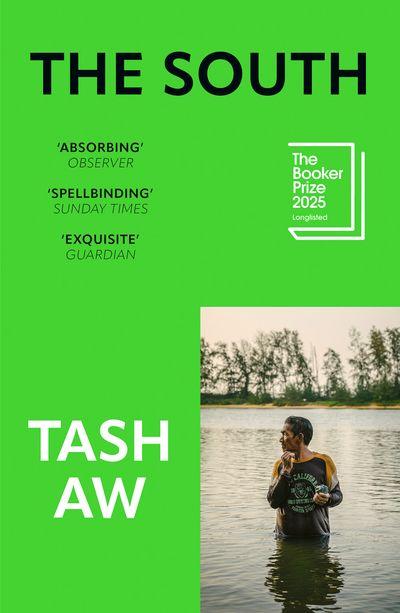
Tash Aw | The South | 4th Estate | 288 pages | 9,99 GBP
A fruit farm in southern Malaysia, just an hour’s drive from Singapore, where they grow dragon fruit, papaya, and star fruit, as well as the bright red, rather fuzzy rambutan fruits. This is the setting of Tash Aw’s new novel The South, published in 2025. The Malaysian-born author was longlisted for the Booker Prize with this work, and the novel is now also available in German translation.
The farm once belonged to the Lim family’s grandfather. He came to Malaysia as a teenager from the desperately poor Chinese province of Guangdong and built a fortune as an auto parts trader, enabling his children to attend college and rise into the Malaysian middle class.
Owning a small fruit farm in the most remote part of the country therefore doesn’t quite fit with this successful story of migration. The Lim family lives many hours away in the capital, Kuala Lumpur, and barely has any time for the farm. Fruit farming is also hard work and yields little profit; it is usually a loss-making venture. But as a child, the old man had witnessed how his family was repeatedly displaced and forced to begin again in a China ravaged by floods and hardship. As a consequence, owning this small farm meant a great deal to him. “Everyone thinks I’m crazy,” he had explained to his future daughter-in-law, Sui. She was the only one in the family who understood his need for security. Perhaps that is why she, and not his son, inherited this plot of land after the old man’s death. And why, at Sui’s request, the family now spends their summer holiday in the hot south at the family farm: Father Jack and Mother Sui, along with their two daughters, Lina and Yin, and sixteen-year-old Jay.
This is where Aws’s fifth novel begins, set during a period of multiple crises, such as we are all too familiar with. Starting in the spring of 1997, the climatic phenomenon El Niño affected many parts of the world. It caused a severe drought in Malaysia, which obviously impacted the fruit farm. However, it is the newspaper-reading family from the city who first give the phenomenon a name. Meanwhile, a severe economic crisis shook many Asian countries in the late 1990s. The small town not far from the farm, which had previously benefited from its proximity to booming Singapore, was not immune to this downturn. Now, half-finished holiday resorts stand abandoned, the ruins of failed investments for which vast swathes of forest were cleared. These crises together deal the final blow to the farm, already scarcely profitable: the harvest is so meagre that it is barely marketable, and the Indonesian migrant workers have stopped coming.
It is in this atmosphere of crisis, stagnation, and shimmering, dusty heat that the story begins, initially featuring many of the hallmarks of a coming-of-age tale: the long summer vacation, a change of scenery, first love and sexual experiences, and teenagers increasingly separating from their parents. The story is told mostly from the perspective of sixteen-year-old Jay. His strict father puts him to work on the farm, hoping to toughen him up, considering his son too delicate. But Jay comes to enjoy the backbreaking labour, mainly because it allows him to spend time with Chuan, three years his senior and the son of farm manager Fong. The two are drawn to each other, fall in love, and are soon inseparable. The first-person narrator allows himself, on a few occasions, to look back with a touch of wistfulness and serenity on his younger self - his awkwardness, desires, and hopes. Above all, though, he gives ample space to the boy’s immediate experiences and allows the reader to almost physically feel just how intense the impressions and experiences of those weeks in the south were for him.
While the parents initially still dictate the daily routine, the teenagers increasingly take liberties, partly enabled by the adults preoccupation with their own lives. Chuan and Jay, sometimes accompanied by Lina and Yin, ride scooters through the night, buy Tiger beer and Murtabak with curry sauce, swim in a lake formed from an old tin mine, and sing Jacky Cheung songs in a karaoke bar. In these moments, crisis and decline are forgotten; here, there is only the intensity and lightness of first love. Yet the novel never lets us forget that this love does not take place in a vacuum, but in a society marked by class differences, ethnic tensions, and homophobia. A few well-placed scenes and dialogues are all it takes, which makes perfect sense, because young Jay - whose voice we follow most of the time - is barely aware of these social issues.
Although, for the most part, the novel is told from the sixteen-year-old's perspective, the author also gives voice to two other characters. Jay’s mother Sui, the heir to the farm, is given space to tell her story and share her perspective. We also get to know the farm manager, Fong, his backstory, and briefly, his thoughts on the family from the capital. Both narrate from the immediate present of the events, thereby expanding the coming-of-age novel into a multilayered family saga that simultaneously reflects the upheavals in Malaysian society. It is striking, however, that Jay, who is recalling these events, nonetheless remains excluded from both of these narrative strands even in retrospect, showing just how skilfully and precisely Aw has constructed his novel. Despite the serenity that pervades Jay's perspective towards his own sixteen-year-old self, he still seems unaware of what was actually going on with the adults during those few weeks in the south.
Tash Aw deliberately denies his character Jay the usual painful realisations usually provided by coming-of-age stories: insights that ultimately facilitate a process of maturation. This decision may be somewhat unsatisfying for some readers, but it is consistent, because by choosing this narrative structure, the novel highlights how the closed-off Lim family actually functions. For even young Jay seems to have already adopted his parents’ attitude that words are essentially futile. Aw leaves open, however, whether the teenagers must therefore repeat their parents’ mistakes, namely their inability to open up to one another, or whether they will ultimately forge their own path. By the end of the novel, you find yourself hoping they will.
+++
More from Tash Aw on Literatur.Review:
Unwanted misfortune
Tash Aw's memoir "Strangers on a Pier" is an illuminating and touching document about the search for family and national identity in times of migration
Did you enjoy this text? If so, please support our work by making a one-off donation via PayPal, or by taking out a monthly or annual subscription.
Want to make sure you never miss an article from Literatur.Review again? Sign up for our newsletter here.