



The master of water
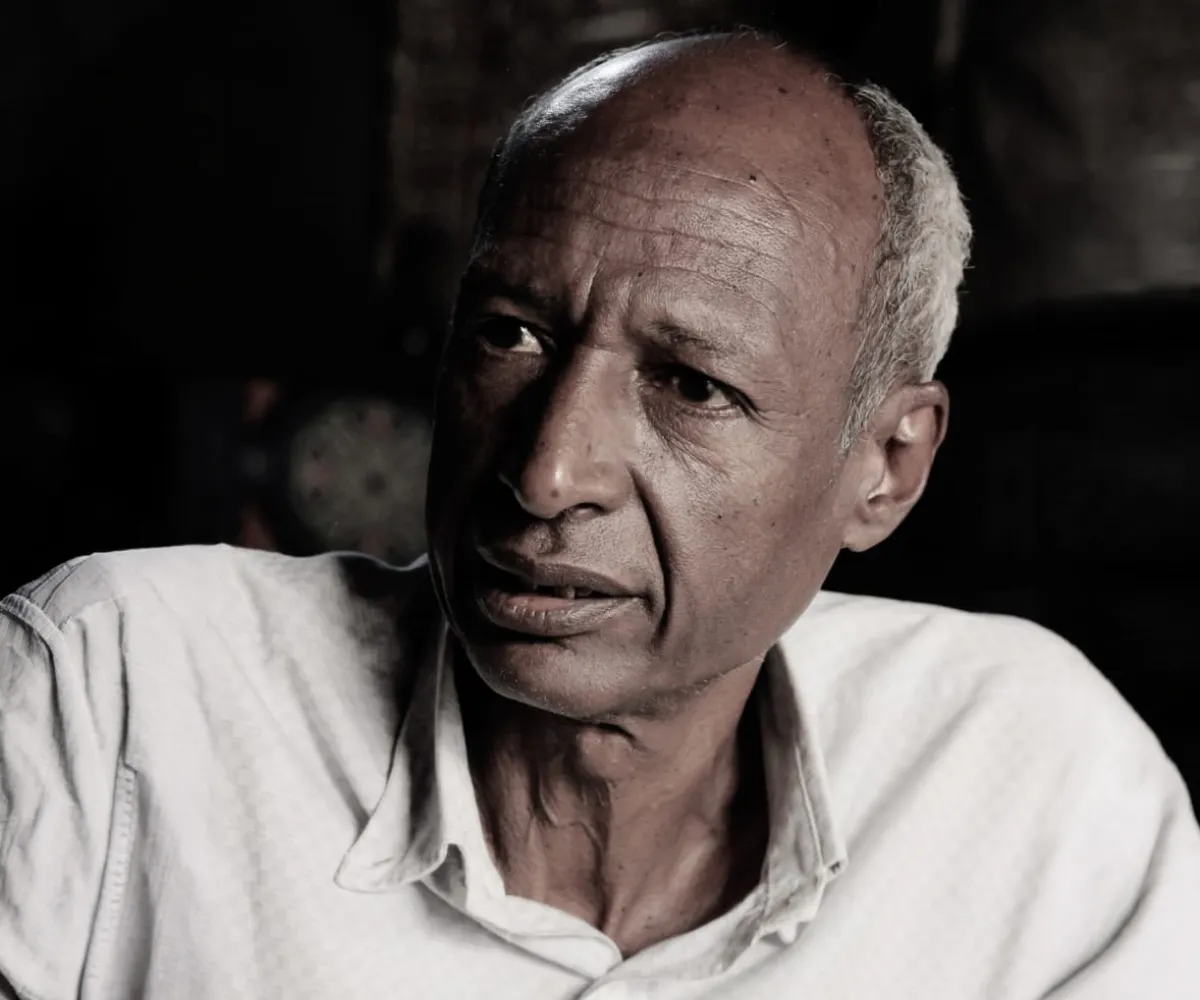
Khaled Osman is a literary translator (Arabic to French) and novelist. Born in Egypt, he studied in France. He has translated numerous works by renowned Arab authors from countries such as Egypt, Palestine, Iraq, Syria and Lebanon. His translation work has earned him several distinctions, including the Prix de l'Académie française.
Khaled is also the author of two novels in French: Le Caire à corps perdu (2011) and La colombe et le moineau (2016), both of which have recently been republished.
Ahmed Aboukhnegar is an Egyptian author born in 1967 in a small village near Aswan in southern Egypt.
His fictional world is entirely defined by the surrounding desert, the sometimes mythical characters who inhabit these lands and the popular values they embody. His work comprises some fifteen publications, including short stories, plays, novels and essays.
This deep connection to the desert is evident even in his appearance. On seeing him arrive at a Cairo café for an interview in 2008, "Libération" reporter Claude Guibal was struck by his bearing:"In the doorway of the café, a smiling shadow pauses, then passes through the fragrant smoke of the hookahs and sits down beside the novelist. With his tall, weathered silhouette, Ahmed Abohnegar carries within him the entire history of his people. Born near Aswan, he has retained the graceful, silent gait of the Ababda nomads. An almost forgotten tribe, unknown to the rest of Egypt and yet, since time immemorial, masters of the desert trails between the Nile valley and the shores of the Red Sea. "
When, in the same interview, she asks about his literary inspiration, he explains in his soft voice that, as a teenager, he discovered all the classic authors of world literature on the shelves of the municipal library and devoured Chekhov, "an absolute master, at the centre of everything". It was only later that he learned, much to his surprise, that there was such a thing as contemporary Arabic literature, a literature from his own country!
In that same year, 2008, French readers had the opportunity to discover Aboukhnegar when the Centre National du Livre invited 20 writers from around the world to a series of events marking the twentieth anniversary of its "Les Belles Étrangères" series, dedicated to the translation of major works of world literature.
It just so happened that among these 20 invited writers was the great Egyptian author Gamal Ghitany, an accomplished writer already familiar to French readers for his masterpiece Le livre des illuminations ('The Book of Epiphanies') published in French - its first translation - three years earlier.
Each established author was tasked with presenting a younger compatriot. By sponsoring Aboukhnegar, Ghitany had undoubtably chosen an author he admired and who, like him, hailed from Upper Egypt.
But these affinities, plus the fact that they shared a rather caustic sense of humour and injected their novels with a dose of the fantastic, do not prevent the two authors from being as different as they could be.
First of all, Ghitany was resolutely an urban writer, who made a specialty of wandering through Cairo's alleyways, following in the footsteps of its most famous chroniclers, such as Ibn Iyas or Maqrizi.
By contrast, Aboukhnegar, who earns his living teaching mathematics but spends his nights meditating in silence and filling pages with writing, has chosen to remain in his native Aswan.
When Josyane Savigneau (former head of the literary supplement at "Le Monde" newspaper) asked them both about their relationship with the city of Cairo during a joint meeting at the Library of Public Information in Paris, their answers were strikingly different: where Ghitany expresses an immoderate love of Cairo, Aboukhnegar explains that he has never been able to settle there and only visits when absolutely necessary, finding the bustle of the city too much.
More significantly, Ghitany was a keen analyst of urban societal and political relationships, while Aboukhnegar writes of the desert and its mysterious spells. His books are short but dense and well-constructed, always with a touch of magical realism, reminiscent in places of Gabriel Garcia Marquez's One Hundred Years of Solitude.
Gamal Ghitany was no stranger to discovering young talent through the Akhbar al-Adab ("Literary News") magazine he founded, which introduced many authors from all over the Arab world.
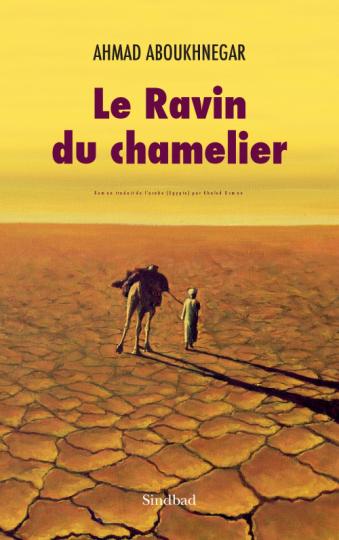 Actes Sud
Ahmad Aboukhnegar | Le Ravin du chamelier | Actes Sud | 208 pages | 22 EUR
Aboukhnegar's arrival in France had generated a great deal of interest, and the young author had been invited to several literary events in Paris, Arles and Bordeaux.
As a result, Actes Sud had decided to publish his novel Le ravin du chamelier for its Sindbad collection, entrusting me with the translation. I have to say that my discovery of the text (and I don't say this about every writer I've translated) was one of my most profound reading experiences.
For the man is capable of great flights of meaning, as when he takes the pretext of a Bedouin practice to speak to us of inheritance, responsibility and fault.
"Before leaving, he had expressly charged him with keeping the camel from the water. A mission that wasn't exhausting, but undoubtedly too demanding for the young teenager that he was, a mission that required constant vigilance, and the engagement of every sense.
But the father had paid no attention to this; he was driven only by the desire to force this son - the eldest of his children, no less - to assume responsibilities. He wanted to instill in him the feeling of being part of adult tasks, so that he would later learn to lead them. "This boy will inherit neither money nor business from me," he liked to repeat, "only a little common sense, an attention to small things, an ability to see beyond appearances."
At the moment of giving the signal for departure, he had
called his son over to him and, placing a hand on his
frail shoulder, had declared loudly: "'Abdallah will be the master of the water... Let no one quench his thirst without his approval..." Then he knelt down and, forcing the teenager to look at him, lectured: "In the desert, water is synonymous with survival. You alone will be responsible for keeping the camel from water." Then, softening a little:
"You'll be the master of the water, the master of the caravan, that's all."
He also knew how to be very funny, as the following little extract testifies:
"How many nights had he spent leaning against the wall of the hut, with the hefty camel next to him! He'd tell her about his far-off province, saying how much he missed it, his mother, his brothers and sisters, and also his father, who'd forgotten the way to the ravine. He would tell her about his childhood games, the moments of gaiety and carefreeness. He recalled the stories his mother had told him, and in moments of despondency, he would share them with the camel, even including episodes the latter had witnessed.
The animal generally showed interest in his master's stories; but it also sometimes marked its opposition by suddenly rearing up on its forelegs. The camel driver would then realise that he had overstepped the mark and introduced into his story events that had not taken place.
This had happened when he had told her about his meeting with 'Aisha: how she had spoken to him near the mouth of the canal, how she had seized his hand and squeezed it... "Her hand was all limp, as if it had neither bones nor veins. When she put it on mine, which was gripping the halter, I saw that desire was coming out of her eyes, and I wanted to draw her against me. Seeing my gaze, she knew how much I wanted to possess her and..."
At these words, the animal had straightened up as one - the camel driver, entirely drowned in his reveries, hadn't realised right away - and, with his tail, had dispatched a broadside of sand in his face that had filled his eyes and mouth, eliciting a cry of surprise. "
The book has had good critical success, for example the magazine "La Cause littéraire" devoted two separate reviews to it (a rather rare occurrence), both highly complimentary, and a reading note signed by Catherine Simon appeared in the major daily "Le Monde".
Unfortunately, the book wasn't a great commercial success, for reasons unknown (complicated author's name/ rather flashy cover/ something else?). In any case, Actes Sud has not continued to publish this author, and no other publisher has taken up the baton. The fate of books is sometimes inscrutable, but what is certain is that many have missed out on a great moment of reading.
Ahmad Aboukhnegar is in fact a fascinating author, author of rather short but dense and very well-constructed books, with a very beautiful pictorial and poetic language. Among them is a novel entitled La tante sœur des hommes, which owes its title to a very striking female character whose nickname comes from the fact that she was born the only girl in a sibling group of seven boys, a characteristic that would earn her a fate worthy of the greatest tragedies...
With Aboukhnegar, you're guaranteed to set off on an expedition into a world of spells and mysteries that provides a truly immersive experience. It is often said that the magic realism movement died out with the great South American authors of the late twentieth century. This is to ignore that, somewhere on the edge of the Aswan desert, not far from the plains of Nubia and the cataracts of the Nile, a fine and modest man had raised the torch: this man is called Ahmad Aboukhnegar and almost all of his work remains to be translated...
Did you enjoy this text? If so, please support our work by making a one-off donation via PayPal, or by taking out a monthly or annual subscription.
Want to make sure you never miss an article from Literatur.Review again? Sign up for our newsletter here.