


"I don't argue with fate“

João Anzanello Carrascoza is writer and professor at the Escola de Comunicações e Artes of the Universidade de São Paulo. He has published the novels Aos 7 e aos 40 and Caderno de um ausente and also storybooks O volume do silêncio and Espinhos e alfinetes, among others. His stories have been translated into Croatian, English, French, Italian, Spanish, Swedish and Tamil.
Among the awards he received, there are the Guimarães Rosa (Radio France Internationale), White Ravens (International Youth Library Munich), Jabuti, Fundação Biblioteca Nacional and Associação Paulista dos Críticos de Arte.
Famous poet, little-known advertising man
One of the most quoted poems by Paulo Leminski (1944-1989) is limited to four verses, distributed in two stanzas:
I don't argue
with fate
whatever it paints
I sign(Leminski, 2013, p.94).
In the text Transperto (2005), the Curitiba-born writer recounts his professional career, listing in chronological order the positions and roles he held thanks to his skill with language (teacher and journalist, for example), and, in his conclusion, he bluntly states: "The worst was reserved for last. After much hesitation, destiny, that synonym of something and nothing, wanted me to be an advertising man. Soaps, suspenders, consortiums, here we go" (Leminski, 2005, pp. 165-6).
Also accepting our fate, here we go, proposing, through this article, to open the archive of this singular creative's advertising production, thus inaugurating a research project specifically addressing the print advertising texts written by Leminski — a task, thus far, unaddressed by scholars in the field of communication. This challenge was only possible thanks to the founding of Instituto Paulo Leminski in 2023, an entity with the mission of cataloging, disseminating, and managing the writer's legacy, as well as carrying out initiatives to showcase other aspects of his talent, including his non-sporadic, but professional, work as an advertising copywriter. One of the institute's first endeavors was to showcase Leminski's advertising pieces at Foz do Iguaçu International Book Fair in November 2024. At that event, we met with Aurea Alice Leminski, the writer's daughter, who provided us, for this study, with access to a dozen printed advertisements, the texts of which were written by her father.
Observing this material, and so as not to treat it in a reductionist manner, merely as a curiosity, we immediately note a set of argumentative resources mobilized by the author, as well as his strategic use of intertextuality, which led us to initially investigate these two linguistic procedures, but not without first examining, in Leminski's poetic work, some themes and/or emphatic elements of the advertising sphere.
We will therefore highlight here the intersection of these two lines of creative force, expertly handled by both Leminski the writer-advertiser and the advertiser-writer. Another decisive reason for structuring our article in this confluent manner is the intention to distance ourselves from works that emphasize only the contamination of literary production by advertising's make-believe, when, for us, its complementary vector — advertising as raw material for literature — is also essential.
First, however, we must recall, as briefly as almost all of Leminski's poems, an author averse to verbosity, his relevance in the Brazilian literary scene and his professional dedication, at one point, to advertising activity. Leminski, as mentioned, gained notoriety during his lifetime, publishing works in a wide range of genres, including the experimental prose Catatau (1975), novels, including Agora que são elas (1984), stories for young people, short stories, essays, reviews, etc. But it was with poetry, in works such as Não fosse isso e era menos / não fosse tanto e era quase (1980), Caprichos e relaxos (1983), and La vie en close (1991), utilizing idiomatic expressions, popular sayings, the minimalist structure of haiku, and slang, his name took deep root in literary culture. However, it was only after his death, with the release of the book Toda poesia, in 2014, by Companhia das Letras, a collection of his previously published poetry and other scattered poems, that his name found the national resonance befitting his versatile talent. The edition of this work became the publishing phenomenon of that year, selling 120,000 copies, and to date, it is approaching 200,000 copies sold (Porto, 2025, p. B3).
Leminski's appreciation for advertising is explicitly embodied in a letter sent to his friend, fellow poet Régis Bonvicino, in which he recounts the controversy he caused by comparing literature as the locus of BEAUTY and advertising as the domain of NEWNESS:
(...)
advertising, my livelihood,
gives me some satisfaction
in the end
every layout man is a bit of a concrete poet
and by the way it's fantastic how the art men of the agencies
understand a concrete job at the time(...)
besides, they pay me well
and I have the best men of art in the square
all my friends(...)
I gave a lecture/debate
that I proposed
in the architecture here
on the topic THE BEAUTIFUL VERSUS THE NEWin which I developed the following idea
this is what is called modern art
shifted the center of the idea of BELO
to the idea of NEW
that I said is typical of industrial society
in an advanced state of consumerism
capitalists or socialists
I'll tell you about the stick that broke(Leminski, 1992, p.24-5).
Leminski doesn't hide his craft as a copywriter; on the contrary, he shows gratitude for his advertising career. Thus, the two creative vectors intertwine: his literary skill is transferred to advertising, and this then flows into his poetry, as we will see below.
Advertising in Leminski's Poetics
Research on persuasion frequently focuses on the linguistic, rhetorical, and poetic resources transferred from literary creation to advertising text, since, as we know, the arts are fundamental matrices of advertising (Carrascoza, 2003, 2004). What's unusual is the flipside, that is, investigations that demonstrate aspects of the advertising field (whether thematic, structural, critical, etc.) that have "inspired," contaminated, stabilized, or even clashed with literary production in its various genres.
However, without undertaking a scuba-diving into Leminski's poetic work — a more in-depth task for another occasion — we briefly surveyed it and found poems born from his knowledge of advertising rhetoric. We chose six as our corpus for analysis. In the first of these, below, we see a direct connection with the words (caution, fragile; this side up) inscribed on the packaging of certain merchandise:
heart
UP
written underneath
FRAGILE(Leminski, 2013, p.84).
Along the same lines, the poet incorporates, in the verses of the following poem, one of the typical promotional means of advertising in recent decades – clothing, which now displays images and statements not only about social behaviors, but, mainly, about consumer goods:
I was once something
written on the blackboard
today without a muse
just my name
written on my shirt(Leminski, 2013, p.92).
An authentic poet, Leminski became close to the avant-garde, especially the concretist group, the brothers Haroldo and Augusto de Campos and Decio Pignatari, but his poetry always possessed a blend of erudition and colloquialism, balancing the serious with the humorous, paving the way for his popularity. It is no coincidence that he will be the honored author at this year's edition of Flip – the Paraty International Literary Festival. According to its curator, Ana Lima Cecilio, one of the reasons for this choice was Leminski's approach to promoting poetry to the public. He enjoyed "getting close to people, bringing literature to the people" (Porto, 2025, p. B3). His critical and ironic verve is revealed, for example, in this poem, which, on the one hand, mimics the form of a haiku, and on the other, indirectly and provocatively cites a slogan spread to exhaustion by the military government in the 1970s – “Brazil, love it or leave it” –, surreptitiously challenging the political regime of the time, while at the same time connecting with the reader’s prosaic repertoire:
plums
love them
or leave them(Leminski, 2013, p.105).
By creating epigrammatic compositions of this nature, paraphrased or parodic, with the ironic use, for example, of enclisis (love them/leave them), Leminski anticipates the contemporary social media practice of memes, so focused primarily on social and political criticism.
His knowledge, as an advertising man copywriter, of the world of advertising brands, as well as their agreements to dominate the market, sometimes monopolistically, in a symbiotic manner, as Maffesoli (2021) theorizes — companies create bonds of interest in order to survive — will appear clearly in poems such as this one, composed of company names, with their similarities, approximations, and differences:
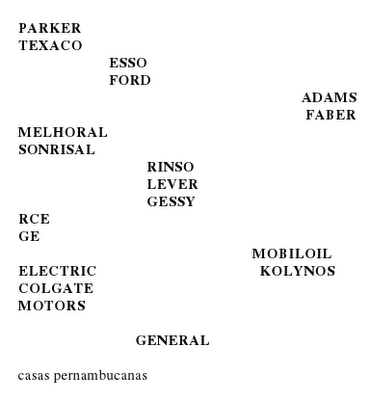
The poet clearly intends to pair the ESSO brand (vehicle fuel) with the FORD brand (car manufacturer), also in capital letters. Or, similarly, to combine three foreign soap brands (RINSO, LEVER, GESSY). And, most significantly, in the poem, as a counterpoint, in lowercase letters, in the last line, the inclusion of a Brazilian company: casas pernambucanas.
Advertising professionals have daily contact with businesspeople, executives who run marketing and/or advertising departments. They are the brand representatives, clients who request and approve campaigns, and they only focus on the impact of communication on product sales, losing their sensitivity to poetry, to natural beauty — like the strawberry fields in this poem written by Leminski in English, one of the languages he spoke:
business man
make as many businessesas you can
you will never know
who i amyour mother
says no
your father
says neveryou'll never know
how the strawberry fields
it will be forever(Leminski, 2013, p.49).
Copywriters, although they craft advertising pieces with arguments in favor of the products' advantages, are well aware of their shortcomings, which, in general, following the canon of the field, they tend to omit. Leminski (2013, p. 311), however, makes poetry out of this knowledge (hidden in the promotion of goods):
new roof tiles
at the first rain
the new leak
Many other of his poems draw on the semantics associated with the media, consumer culture, and other areas related to advertising, opening doors, in this sense, for future research, which we hope will be carried out by other scholars.
Arguments and intertextualities in Leminski's advertisements
From the material provided by Aurea Leminski, due to the limited length of an article, we selected six advertisements for investigation, since we immediately noted the investment in constructing diverse arguments and the presence of intertextual techniques (parody and paraphrase), not only as a starting point for statements from Brazilian culture, but also as references to the advertising itself — characterized as intratextuality.
Three of these advertisements are institutional advertisements from Exclam Comunicação, based in Curitiba, where Leminski worked. This type of advertising campaign strategically aims to showcase the advertising agency's inventive capacity to the advertising agency — if it wants to attract advertisers, it needs to demonstrate its ability to market itself effectively — which is why the advertisements are created by its most experienced professionals.
The fourth advertisement is for the Condor brand's comb and brush. The fifth is for the Stour travel agency, specializing in Foz do Iguaçu and the surrounding region. Finally, we will analyze the advertisement for the chemical company Carbomafra.
To this end, we will first highlight how these rhetorical and intertextual elements materialize in the verbal realm of advertising pieces.
Citelli (2004) and Carrascoza (2003, 2004, 2008, and 2014) list the most common arguments used by advertising creative professionals to strengthen the persuasive effect. Let's examine each of them and their respective definitions.
Place of quality:
a positive characteristic of the product (or service), a practical attribute, an economic benefit, etc.Place of quantity:
a numerical advantage, a benefit related to the mathematical dimension.Comparison:
an equalization, contrast, or confrontation that results in a competitive advantage.Appeal to authority:
an endorsement by a competent technician, a favorable testimony, and/or a celebrity's testimony.Valuing the superior:
a place of unsurpassed quality among competitors, an argument that denotes absolute superiority.Valuing the inferior:
a resource that consists of emphasizing some insignificant feature of the product (or service) as a way to transform a marketing disadvantage into a communicational advantage.Exemplification:
a linguistic element of persuasion that presents proof in favor of the product (or service), defines a rule, or explains a situation.Enemy creation:
a way of treating others not just as a competitor, but as a lethal adversary.
Also consciously explored by creatives, the intertextual operation – paraphrase and parody – is explained in several studies, especially by Barroso et at. (2011) in the research "Paráfrase e memória: estratégias persuasivas do discurso publicitário contemporâneo" and by Hansen (2015) in "A criatividade em jogo: paráfrase e polissemia no processo de produção do discurso publicitário." As stated, we will examine it in the advertising texts written by Leminski, who relied heavily on it to inform his literary work. Let's remember that paraphrases agree with the source text, while parodies disagree.
Let's begin our analysis with the first of Exclam Comunicação's three institutional advertisements.
Love
The one who invented love wasn't me, nor anyone else, says the song.
And it says it well.
The origins of love are lost in night of the ages.
By the way, it was a very cold night, the kind where it's more delicious to be with someone under a bearskin, in a warm cave. Some say that the origin of love lies in the fact that we are incomplete beings.
Love would simply be the desire to complete ourselves, in the other, reestablishing a lost unity.
If that's the case, without love, no gets through.
Living is the best thing that can happen to us.
You can ask the birds.
The alligators.
The fish.
And even the trees.
Life is the best.
Live it.
Exclam Comunicação
An agency that only advertises good products.
Three types of arguments are mobilized: quality places (love is "being with someone under a bearskin, a warm cave," "the desire to complete ourselves, in the other, reestablishing a lost unity," "without love, no one gets through," "an agency that only advertises good products"); (valuing the superior ("living is the best thing that can happen to us," "life is the best"); and arguments from authority ("You can ask the birds. The alligators. The fish. And even the trees.")
In terms of intertextual statements, Leminski employs common expressions from popular speech: "who invented it," "the song says," "night of the ages," "it's more delicious," "incomplete beings," "the best thing," "it's the best," "live it."
We reproduce, below, the second Exclam Comunicação advertisement, and our respective analysis.
Water
No matter how hard we try, there are some things that no one can improve. The shape of an egg, for example.
Or the taste of water.
Water is like a mother. There is only one.
And it was in water that this wonderful confusion called life began.
Then came wine, vodka, whiskey, beer, and even Coca-Cola.
But when it comes to truly quenching thirst, let's come and go, other drinks forgive us.
Water is fundamental.
Prefer water.
An exclusivity of planet Earth.Exclam Comunicação
An agency that only advertises good products.
Regarding the use of arguments in this text, quality dominates ("the taste of water," "it was in water that this wonderful confusion called life began," "water is fundamental."), in addition to the presence of exemplification ("The shape of an egg, for example," "Or the taste of water") and overcoming ("Water is like a mother. There's only one," "An exclusivity").
Leminski explores intertextuality through colloquial expressions ("no one can," "like a mother. There's only one," "quenching thirst," "let's come and go"), an essential commercial brand ("even Coca-Cola"), advertising jargon itself ("an exclusivity"), and the verses of Vinicius de Moraes, "The ugly ones, forgive me, but beauty is fundamental" ("the other drinks, forgive us. Water is fundamental").
Now, the third advertisement for Exclam Comunicação, written by Leminski.
Air
The most important things in life are invisible.
Love. Friendship. Wisdom. A good idea.
Air is the model for them all.
Like all of them, air is becoming scarce.
At least in its pure state.
In cities, it's being replaced by carbon dioxide, cigarette smoke,
industrial pollutants, and other fake products.
This holiday season, seek out nature.And take some time to breathe real air.
f it's air, it's good.Exclam Comunicação
An agency that only advertises good products.
Leminski invested in this text the following arguments: exemplification ("The most important things in life are invisible. Love. Friendship. Wisdom. A good idea."); quality places ("Air is the model for them all.", "If it's air, it's good," "An agency that only advertises good products.").
Intertextuality is realized in the recording of everyday speech ("the most important things," "in its purest state," "Don't you think?", "really") and, again, in the history of advertising itself ("A good idea," a paraphrase of the Caninha 51 slogan, and "If it's air, it's good," a paraphrase of Bayer's slogan in Brazil, "If it's Bayer, it's good").
Let's move on to the analysis of the advertisement promoting the Condor toothbrush.
Two-in-one brush and comb. A happy marriage for modern minds.
Once upon a time there was a comb that lived alone in bags, dressing tables and bathroom cabinets.
Until at Condor, he found the love of his life.
A brush that, like him, loved modern people and styled hair. Single as a bird, she couldn't resist the prince's charms.
And Condor made their marriage happen.
Today, portable and versatile, they make a beautiful pair, found in handbags, vanities, and bathroom cabinets of modern people like them.
Love stories have to have a happy ending.
Don't you think?
This text, unlike the previous ones, which are structured according to the Apollonian model, constructed with arguments, since they are based on the dissertation genre (Carrascoza, 2004), is based on the Dionysian vector, which is established when telling a story, that is, when, to promote the attributes of a product, a narrative is chosen (Ibidem/ibid, 2004).
Leminski narrates the story of the "two-in-one brush and comb", mimicking the format of the fairy tale and inserting its commonplaces to facilitate understanding of the story ("Once upon a time," "the love of your life," "the prince's charms," "happy ending") and other paraphrased statements ("lived alone," "modern people," "single as a bird," "a beautiful pair," "love stories," "Don't you think?").
Let us examine the advertisement for Stour – a tourism company of the Sulamericana Group, focused not on the production of merchandises, but on the provision of services – whose text Leminski also signs below.
Tourism in Foz needs people who know the region inside and out. Hence, the Stour.
Sulamericana Group, Stour is a travel agency specializing in Foz do Iguaçu and surrounding areas.
For over twenty years, Sulamericana Transport Company has been transporting people of all origins to Foz do Iguaçu, accumulating extensive knowledge of the region, its tourism potential, and the industry's needs.This knowledge has now been transformed into an agency with the best possibilities to properly serve the tourism flow in one of Brazil's best-equipped regions for this type of leisure activity.
Born from the pioneering spirit of Sulamericana, Stour came to make it easier and more complete to enjoy this region blessed by God and beautiful by nature.
The arguments with which Leminski constructed the text are: quality places (Stour is a "Company of the Sulamericana Group," "is a travel agency specialized in Foz do Iguaçu and surrounding areas," "transporting people of all origins to Foz do Iguaçu," "accumulating extensive knowledge of the region," and "make the pleasure of getting to know this region easier and more complete"); a valorization of the superior ("an agency with the best possibilities," "Born from the pioneering spirit of Sulamericana"); and a place of quantity ("For over twenty years").
Intertextuality is evident in his use of cultural and popular expressions ("inside and out," "more complete," "blessed by God and beautiful by nature").
Finally, we reproduce the Carbomafra advertisement and its accompanying text, written by the writer from Curitiba.
Carbomafra has been following behind the scenes the great performances of a thousand and one successful products.
We have experienced exciting scenes through the filter of Ives Montand's cigarette. In the lipstick that moistens Catherine Deneuve's lips. And when we say that Carbomafra Researcher has been a true Fellini, we're not exaggerating.
He works behind the scenes discovering new secrets so that
Carbomafra products can perfect the main star's performance — a product that requires chemical industry inputs.
With Carbomafra 's special participation, a thousand and one products have achieved their best final results, further enriching our daily lives. Experts in this field, Carbomafra products are always looking for new and important works.
So, be aware if there's work in your industry that needs to be done by specialists; substitutes are harmful.
Hire a Carbomafra Specialist to work behind the scenes of your product.
And get ready to witness scenes of great success.
As in other dissertation (Apollonian) texts, Leminski mobilizes a variety of arguments, confirming his mastery of multiple expressive forms: exemplification ( “We have experienced exciting scenes in the filter of Ives Montand’s cigarette. In the lipstick that moistens Catherine Denueve’s lips”); appeal to authority (Ives Montand, Catherine Denueve, Fellini), comparison (the Carbomafra Researcher is compared to the filmmaker Fellini); a place of quality (A thousand and one products have achieved their best final results thanks to the presence of Carbomafra in their composition; “Carbomafra products are always looking for new and important works”), a place of quantity (“...the great performances of a thousand and one successful products”) and valorization of the superior (“...so that Carbomafra products can perfect the main star's performance...”).
In intertextual terms, colloquial expressions ("great performances," "exciting scenes," "we're not exaggerating," "new secrets," "main star," etc.) stand out, and especially the reference to the advertising culture itself, represented by the Bombril steel wool slogan, "a thousand and one uses."
In this text, Leminski also employs a powerful rhetorical element, borrowed from literature: the semantic network. According to our research (Carrascoza, 1999), the association of words from the same linguistic field as the product results in a direct semantic network, or the association of words from the linguistic field of a theme, created to leverage the argument, constitutes an indirect semantic network. In this case, the semantic network is indirect, more laborious, requiring greater care and expertise from the writer, formed by the field of the word "cinema": "backstage," "great performances," "Ives Montad," "Catherine Denueve," "Fellini," "main star," "scene," "role," and "success."
In short, by analyzing the advertising texts written by Leminski, in relation to their argumentative resources and his way of handling parodies and paraphrases, of popular culture and even of the advertising tradition (intratextuality), we were able to see how he skillfully employed stylistic elements already highlighted in his poetry by critics such as Haroldo de Campos (1983) and Leyla Perrone-Moisés (2000).
From Leminski's poetry to his advertising and vice versa
The historiography of national advertising activity has been growing with the publication of new works that address its beginnings, such as Publicidade brasileira: os primeiros 110 anos (1808-1918), organized by Geraldo Alonso (2022), the presence of artists, especially poets and prose writers, in all their phases up to the present day, adding to pioneering books such as Do reclame à comunicação: pequena história da propaganda no Brasil, by Ricardo Ramos (1997), among others, which points to classic and contemporary writers of Brazilian literature as authors of slogans, verses, and anthological advertisements. However, there are many avenues yet to be explored, as these books generally limit themselves to mentioning that the slogan "La fonte, the lock that closes and lasts" was created by the poet Guilherme de Almeida, or that the ballad "Warning to smokers/Both the Prince of Wales/And Dr. Campos Salles/Use Bright Phosphorus" was written in verse by Olavo Bilac. The work done by writers for advertising, not sporadic but the result of their solid dedication, has not been the subject of in-depth study. Leminski's case followed the same path, as, until today, his work in advertising was limited to the news that he was the author of the slogan for Imobiliária Galvão, in Curitiba: "At Galvão, you can easily find the property that's difficult" (Abreu, 2025).
We hope to have begun a path toward change: in this brief study, we share with the academic community seven advertisements written by Leminski. In these advertisements, due to his talent and versatility with language, he, like a chameleon, mimicked the "standard style" of advertising copy, deploying a variety of rhetorical resources. We also highlight his exploration of intertextual operations within the general cultural sphere and, a rare occurrence, his dialogue with the advertising tradition itself (intratextuality). We conclude that Leminski not only worked in advertising; he, in fact, worked in the advertising market as a professional copywriter, indisputably creative — in line with and on par with his poetry.
+++
References
Abreu, Kaype. (2025, April 16).
Arte aplicada. Cândido, Curitiba.
Retrieved from Bibliotheca Pública do Paraná
Alonso Filho, Geraldo. (2022).
Publicidade brasileira: os primeiros 110 anos (1808-1918).
São Paulo: FGF Agricultura & Negócios.
Barroso, Carmen Llorente, Carrascoza, João Anzanello, Guardia, Maria Luisa García. (2011, July).
Paráfrase e memória: estratégias persuasivas do discurso publicitário contemporâneo.
Revista Comunicação, Mídia e Consumo, year 8, vol. 8, n. 22, p.65-98.
Campos, Haroldo de. (1983).
Text published on the back cover. In. Leminski, Paulo. Caprichos & relaxos.
São Paulo: Brasiliense.
Carrascoza, João Anzanello. (1999).
A evolução do texto publicitário: a associação de palavras como elemento de sedução na publicidade.
São Paulo: Futura.
Carrascoza, João Anzanello. (2003).
Redação Publicitária: estudos sobre a retórica do consumo.
São Paulo: Futura.
Carrascoza, João Anzanello. (2004).
Razão e sensibilidade no texto publicitário.
São Paulo: Futura.
Carrascoza, João Anzanello. (2008).
Do caos à criação publicitária – Processo criativo, plágio e ready-made na publicidade.
São Paulo: Saraiva.
Carrascoza, João Anzanello. (2014).
Estratégias criativas da publicidade.
São Paulo: Estação das Letras e Cores.
Citelli, Adilson. (2004)
Linguagem e persuasão.
São Paulo: Ática.
Hansen, Fábio. (2015).
A criatividade em jogo: paráfrase e polissemia no processo de produção do discurso publicitário.
Rumores, 9(18), p.185-202.
Leminski, Paulo. (1992).
Uma carta e uma brasa através: cartas a Régis Bonvicino, 1976-1981.
Selection, introduction and notes by Régis Bonvicino.
São Paulo: Iluminuras.
Leminski, Paulo. (2005).
O gozo fabuloso.
São Paulo: DBA.
Leminski, Paulo. (2013).
Toda poesia.
São Paulo: Companhia das Letras.
Maffesoli, Michel. (2021).
Ecosofia: uma ecologia para nosso tempo.
São Paulo: Edições SESC.
Perrone-Moisés, Leyla. (2000).
Inútil poesia e outros ensaios breves.
São Paulo: Companhia das Letras.
Porto, Walter. (2025, March 27).
Flip terá Paulo Leminski como homenageado em 2025 e eleva a aposta em literatura popular.
Folha de S. Paulo,
São Paulo, p. B3.
Ramos, Ricardo. (1997).
Do reclame à comunicação: pequena história da propaganda no Brasil.
São Paulo: Atual.
Did you enjoy this text? If so, please support our work by making a one-off donation via PayPal, or by taking out a monthly or annual subscription.
Want to make sure you never miss an article from Literatur.Review again? Sign up for our newsletter here.