



My Grandfather Hussein
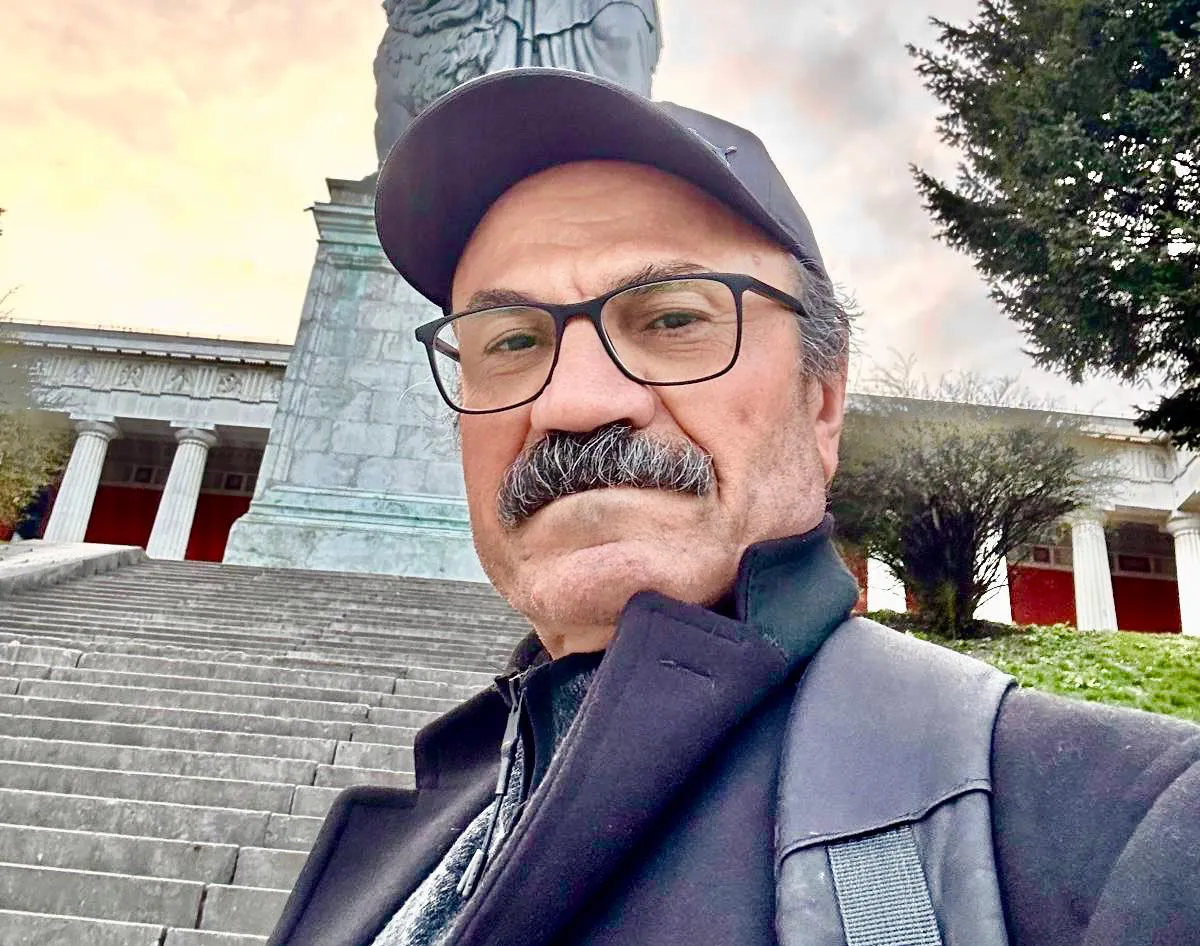
Menaf Othman (Abdelmonaf Othman) is a Syrian-Kurdish writer and painter, born in Hasake in 1965. He studied geology in Damascus and was interested in literature and painting from an early age. He was arrested and tortured in Syria because of a book of Kurdish poetry. In the 1990s, he fled to Turkey, where he was arrested again for alleged propaganda and sentenced to life imprisonment. After 31 years, he was released in 2024, deported to Malaysia and later came to Munich, Germany with a scholarship from PEN. Osman has published nine books to date, including novels, short stories and a play, as well as translations into Kurdish - including The Count of Monte Cristo, The Little Prince and One Thousand and One Nights.
I can say without hesitation that the deepest source of joy and hope in my life has always been my childhood. And among the unforgettable heroes of those early years was my grandfather Hussein.
May God rest his soul, my grandfather owned the only orchard in our village. It was filled with fruit trees of every kind. Along its four edges stood rows of almond trees that encircled the whole place. Yet, despite their abundance, my grandfather would never allow anyone to eat their fruit. What made it stranger still was that he did not pick them himself either. In no more than two months, all those tender, delicious green almonds would harden into woody shells, wasted and untouched.
But we children could never keep quiet about such nonsense. Silence, in matters like these, was a virtue reserved for grown-ups alone. As for us, we refused to submit to my grandfather’s petty commands or accept them without protest.
So, on beautiful spring evenings, we would gather a little gang of three or four boys and take our orders from the eldest among us, who was usually the most experienced in secret operations. Once the plans were set, we would wait impatiently for nightfall—for darkness to draw its curtain over the world and over our peaceful village.
Then, when the moment was right, we would raid the almond trees, eating until we were full and stuffing our pockets with as many almonds as they could hold, before returning home like victorious conquerors carrying spoils of war.
Still, getting into the house at such late hours was never easy. We would slip inside in silence and creep into bed with the strictest caution, pretending to be asleep so as not to attract the attention of our families.
At such times, my grandfather would usually be presiding over a lively evening gathering in his summer house, while everyone listened to his endless adventures of crossing the mined border between us and Turkey.
These lively gatherings of my grandfather’s provided the perfect cover for our nightly operations and adventures—mischief that was no less bold than his own exploits. But if we were discovered and word reached him, our end was never a happy one. What awaited us was punishment, beginning with my grandfather’s furious assault on our parents, whom he accused of failing to raise us properly. Theft was considered the gravest moral offence in our village, a place proud of its upright values. Even so, we had grown used to enduring all those scoldings and penalties in exchange for carrying out the grand plans that whirled through our young minds.
On one occasion, the struggle between us and my grandfather over the almonds grew especially fierce. Someone had betrayed our plan and informed him that a band of amateur thieves was up in his trees, looting his almonds. And so my grandfather—who seemed to care for little else in life—suddenly turned his full attention to those trees. Why, I still do not know. I have thought about it often: he neither benefited from them himself nor allowed anyone else to do so. All he ever did was tend them, water them, pull the weeds from around them, guard them, and protect them from us children.
When he learned of our latest plot, my grandfather changed tactics. With the help of three traitors from our own ranks, he laid a hidden ambush for us so that we might be caught red-handed.
These little collaborators knew our plan in every detail. They knew where we would go, how we would proceed, and exactly what we intended to do. My grandfather had promised them handsome rewards if they succeeded in capturing us in the act, so that we could be delivered to our families and then receive the great slap of punishment awaiting us.
As usual, the treacherous trio consisted of Khairu, Jamo, and Maho. Fortunately for us, their scheme failed this time, unlike on previous occasions—and we owed that to Shirin, Khairu’s kind-hearted sister, who was close to me. How delighted we were when that ambush came to nothing!
On the evening of the operation, only a few hours beforehand, Shirin—the well-behaved girl who was in our fifth-grade class—came to warn us that my grandfather had discovered our plan and prepared a counter-ambush. We had to change course at once and abandon all thought of almonds that night. And so we did, escaping the trap unharmed.
Yet anyone who had tasted the almonds from my grandfather’s orchard could never truly give them up. So on one beautiful summer night, we returned once more to steal almonds. It was late, and as I climbed one of the trees, I found a sparrow sleeping beside me. My God—it did not fly away. It seemed almost drugged. I reached out and caught it in my hand. Then, as I looked more carefully around me, I saw many more of those intoxicated little birds all around. My God, there were so many of them!
Suddenly, an idea flashed into my mind: why not catch these birds instead of chasing after almonds we ate every day?
I called out to Aliko to leave the almonds aside and start catching birds as well. Then I told Amr the same, and together we began the hunt. How easy it was to catch birds at night! By day, we would set hundreds of traps and run thousands of metres just to catch one sparrow—or perhaps two. Yet that night, catching two birds took no more than a couple of minutes. How foolish we had been. Why had we never thought of this before?
But after a while, we ran into a problem: we had brought no knives with us to slaughter them.
We did not even have a sack, a bag, or anything else to carry them in. So we agreed to tear the birds’ heads from their bodies and throw them beneath the tree. But Amr objected, insisting that such a thing was forbidden. Amr was always like that—kind-hearted and sincerely devout, pure in character like his mother.
I scolded him and assured him that I had heard with my own ears and seen with my own eyes how Mullah Bashir had once issued a ruling when Abdo the hunter asked whether, in the case of birds, it was permissible to separate the head from the body while hunting. The Mullah had said yes. And were we not hunters too, doing what hunters do? Surely it was permitted for us as well.
That was how fatwas were given in our village—and how they were given in our own small world of children.
So, in only a few minutes, we managed to catch some thirty sparrows, perhaps even more. We twisted their heads off with our bare hands, mercilessly, and tossed them under the tree. Truly, it was swift hunting—and profitable too. We ought to do this every night, we thought. Though it was a new experience, it was far better than stealing almonds. In the end, we divided the spoils, and each of us carried home his share in a joy beyond description.
But when I returned home, I was met by something I had never expected. My calculations had been wrong—or perhaps no calculation could have predicted what happened next. Each one of us received severe punishment and endless scolding from our families for the terrible way we had cut off the heads of those innocent birds.
Worse still was what our mothers did afterward: they threw every bird we had caught to the dogs and would not allow us to eat them, claiming they had not been slaughtered in the lawful manner. What a disastrous venture it had become. How it pained me to watch my mother throw the bodies of my sparrows to the dogs. It was fine meat I never tasted, and I could not understand why our religion forbade it. At that moment, I wished I were a Yazidi or a Zoroastrian.
Yes—had I been a Yazidi, I would have eaten every last one of them. The Yazidis, it was said, allowed such meat, and in some cases even ate and drank from the same vessel as dogs and beasts. Once, when we were visiting their neighbouring village of Khirbat Jamal to offer condolences, my mother asked them how they could drink from the same place as dogs and animals.
One of the women answered quite simply: “My dear friend, we all have red tongues, and there is no difference between us and our animals. Our tongues are red, just like those of dogs, sheep, and donkeys. So what harm is there if we drink from the same place? God created us this way.”
My mother’s face tightened at those words, yet she said nothing in reply. As for me, I found myself leaning toward the woman’s view. In any case, there was no use discussing such matters any longer, since all the birds’ meat was already in the dogs’ bellies.
May God have mercy on you, Grandfather. Ah… how many strange memories I have with you. But why all these questions now? What does the past matter to me anymore, and why must these painful memories return?
And why all this effort now, this stubborn attempt to summon the past in such a way?
Nothing matters to me today as much as the news of my father’s return from town. I wait for him with unbearable impatience, as though I were sitting on fire. I strain my ears for any sound from outside—or rather, for any sound from Warda, our dog, who never knew how to keep quiet.
No one could enter our village without her foretelling their arrival, even if the person came from within the village itself. The arrival of anyone at all was always announced by Warda’s barking. In that respect, she was the villagers’ alarm bell.
My father is late this time. It is Thursday, and tomorrow is Friday—the feast day. Yet he still has not returned. What will become of me before the boys of the village if he does not come and bring me the new trousers and shoes he promised? But he did promise me. Yes, he promised me trousers and shoes. He swore it. My father does not break an oath—that is, to me, his finest and perhaps only virtue. Though, truth be told, he did not swear when he mentioned the shoes.
Still, what matters most is that he comes today. Otherwise tomorrow will not be a feast for me at all. For two days now, everyone has spoken of their new clothes and the gifts their fathers brought for the holiday—all except me. Everyone, including Khairu, has been flexing his pride, boasting of new trousers, leather shoes, school satchels, notebooks, and coloured pens. I know they mean to provoke me with it all.
But I hear nothing. I bury myself in silence and lock everything inside me, hoping my father will return by evening. All the pain I feel now is because of him. Ah, Father, why do you not come? Why do you let a boy like Khairu look down on me and insult me when he still does not understand addition, subtraction, or division, though he is already in the fourth grade? Curse this age that allows someone like Khairu to mock me.
Khairu, who is punished every day for his mischief, his filthy hands, and his foul smell. Let it be so. Mock me now, Khairu, proud owner of the handsome satchel. Soon enough we shall return to school, and then we shall see your cleverness when the teacher asks for your homework. Only a few more days. Then you will come to me begging for help. How will you solve arithmetic problems or write compositions without me? Have you forgotten that you cannot even put two proper Arabic words together?
Yes, you will need me, Khairu. You will come to me with lowered head, pleading—and then I shall know how to deal with you.
But... but first my father must come today. He must come and bring me trousers finer than Khairu’s. Yet trousers alone are not enough. All my classmates will be wearing shiny leather shoes. My God. Father never truly promised me the shoes. All he said was that if he had money left over, he would buy them. That was always his familiar phrase, the one he used with all my brothers whenever he wanted to postpone buying them anything.
What will become of me tomorrow if he brings neither shoes nor trousers? Am I really to wear new trousers with those ridiculous plastic shoes of mine? To hell with it. Perhaps it would be better if he did not come at all. At least then I would have an excuse with which to defend myself before the others. Yes, that would be better. I would simply say: Father could not come because of urgent matters, otherwise he would certainly have brought me beautiful trousers and black leather shoes.
But... what fault of mine is any of this? Curse it all. I do not know how to escape such a life. Perhaps if my father were rich like Khairu’s father, everything would be different now. But how is he to become rich when all he knows is how to preside over circles of gossip and endless talk?
The work he does amounts to only a few days each year. He plants a few dunams of land, then spends the rest of the year occupied with his tobacco, his smoke, and the great mills of talk—those empty stories he tells the villagers in our large room so they may pass the long winter nights.
And yet I remember well how poor Sheikho’s father was only two years ago. Then he went to the city, and afterward he began returning with money, clothes, shoes, and biscuits.
Even Sheikho, his youngest son, owned three fine toys and had been writing with an ink pen since the second grade. As for me, I am already in the fourth grade and still write my homework in pencil because I do not own an ink pen to this day. I have only a single pencil, and when it is worn down I must borrow pens from my classmates for two or three days until another comes my way. Ah, if only I had an ink pen.
But it seems my father will never do what Sheikho’s father did and become rich. According to him, he cannot bear hard labour. My mother asks him again and again to go to the city and work there, to earn more money and bring some home. But he refuses, and most often the two of them fall into quarrels that last for hours. Sometimes it even comes to blows.
Curse the blows. Curse the fighting. If only we lived in the city... the city.
They often speak about the city and all the many things it contains. They say that there are many people there, many children, markets, and shops for everything imaginable—even shops that sell nothing but shoes… Ah, ah… where are my shoes?
I once asked my mother about the city’s shops.
She said, “My son, the shops in the city are somewhat like Aunt Badria’s shop, but they are larger, wider, and contain more things.” Aunt Badria was a divorced woman—or more precisely, a woman whose husband had left her two years earlier after a dispute between her and his second wife, who was famous throughout the village for her extreme stinginess. So much so that she would spread used tea leaves under the sun to dry them, then reuse them again. She was the very symbol of stinginess in our quiet village.
I was still thinking about the city when I heard our dog, Warda, barking, warning us of the arrival of new people to the village. I rushed out eagerly, and there I saw the red motorcycle that my brother Alaa used, with my father behind him carrying bags we had been waiting for for hours and long days! What joy! The whole house suddenly came alive with astonishing energy.
As my father was about to enter the house, I held his hands tightly and kissed them, asking him whether he had brought me the trousers and the shoes I had been hoping for. “Did you bring them for me, father? Tell me, I beg you!” The question kept repeating itself on my tongue again and again, as I waited anxiously for an answer. But my father paid no attention to me at all. He did not even look in my direction. I cannot describe the deep heartbreak I felt at that moment.
A flood of scattered thoughts filled my mind. I tried to imagine how Khairu and Sheikho would face me tomorrow in their new trousers and shiny leather shoes, while I would be wearing these old patched trousers and worn-out plastic shoes. How could I look them in the face in such a state? Ah, Sheikho… ah! Do you want to mock me when you are the only lazy one in our class? Very well then, Sheikho… tomorrow I will show you how one mocks the top students of the class with your new clothes! Tomorrow I will show you… I will destroy you, tear your new clothes apart, and spit on you and your shoes! Tomorrow you will see everything… damn you, you lowlife!
All of this was swirling inside my small mind, and waves of intense emotion overwhelmed me—like the raging waves of a stormy sea. And my father, meanwhile, paid no attention to my state at all. He was busy answering the questions of the adults who were asking him about everything, big and small, concerning the city. Those were very heavy moments for me.
Afterwards, I hurried to my mother, who had gone into another room to look through the bags and see what my father had brought from the city. My curiosity pushed me to feel the bags before she opened them, just to guess what was inside.
My mother opened the bags… There were many things: a dress for my mother, another for my only sister Zozan… a shirt for Nasri, and a jacket for Saif… and then—my trousers! Oh God, how beautiful they were! Go to hell, you jealous Sheikho! They were truly beautiful, but where are the shoes, mother?
My mother paid no attention to my question at all. When I repeated it stubbornly, she replied, clearly annoyed by my insistence about the shoes:
“What will you do with shoes, my son? You already have shoes, and these new trousers are enough for Eid. Do not forget that we are poor, my son!”
Damn poverty! What do I have to do with poverty if you are the poor ones! I only want shoes! Just shoes, mother!
But no answer ever came. And what use would an answer be anyway, when the city is far away and tomorrow is Eid?
How deep my sadness was in that moment, after my joy over the trousers had lasted only a few seconds. Ah, how short-lived you are, moments of joy! And how long you are, moments of sorrow!
Tears fell quietly and warmly from my eyes as I sat in a corner of the house, sighing deeply. Yet no one in the house asked about me. Everyone was busy with themselves—my father, my mother, my siblings… no one cared. It was as if everyone had become accustomed to my state.
“He is just a child, and it is natural for children to cry and become upset. He will calm down after a little while and return to normal,” they always said about me.
Yesterday, I argued with them over school notebooks. Two days before that, I argued with them over a school bag that I still had not received, even though my father had once told me that if I passed to the third grade with good marks, he would buy me a beautiful, high-quality school bag.
But he did not keep his promise, and now I am in the fourth grade. And now he says that when I finish the fourth grade, he will buy me the bag. And perhaps tomorrow he will say, “When you finish the fifth grade…”
I no longer trust him at all. Every year he promises me things—many things—if I achieve first place in my class, but he never fulfills his promises. Yet I have never broken any promise I made. He is always postponing his promises from year to year, and I chase after them as one chases a mirage.
It is not only my father. I no longer trust anyone in the house at all. I have also lost my desire to study, even though I once loved it very much. It was my only chance to strengthen my knowledge and prove myself to everyone.
Yes, a few days ago the schoolteacher came to our house. I still remember how he spoke to my father about my excellence at school, praising me in front of the villagers. The teacher would gently pass his hand over my head, reminding my father and urging him to take good care of me, saying: “Take good care of him, for I foresee a brilliant future for him…”
I did not fully understand what the teacher was saying, yet I felt comforted by his words. I would breathe a sigh of relief and hold my head high in front of all the pupils and acquaintances. I can say that the only reason that made me continue my studies with such seriousness was that moment with my teacher—a moment I have never forgotten, and I will never forget for the rest of my life.
Dawn was not far away, nor was the day of Eid. When the sun began to rise, everyone had to prepare themselves for Eid. It was the day we waited for an entire year, the day we were meant to celebrate together and put aside all our disputes and everything that troubled us.
Everyone was waiting for Eid with indescribable joy. Eid was the only day of happiness in our harsh village life. It was the only day that carried real meaning in the life of the village—and in our lives as children as well.
But I was not well, and I was not happy either. I felt no joy on that day, no happiness worth mentioning. I was sad, avoiding everyone, hiding in corners so I would not meet the other children. I preferred to sit among the adults, because they did not talk about clothes or new shoes or such things. Instead, they always spoke about farming, sheep, and other trivial matters, and they would enjoy their conversations until the evening.
In the evening, everyone would say that Eid had passed quickly. Yet for me, Eid was the longest day of my life. At times, I even wished that there was no Eid at all, because that would have been better for me.
Eid is not for people like me who cannot wear new shoes. It is for those who wear new clothes and shiny leather shoes, for those who have satchels, beautiful notebooks, and fountain pens. Eid is for people like Khairu and Sheikho.
And yet, I was certain that a day would come when I would be happier than on any Eid I had ever known. But by then, I would have left childhood far behind me…
+++
Did you enjoy this text? If so, please support our work by making a one-off donation via PayPal, or by taking out a monthly or annual subscription.
Want to make sure you never miss an article from Literatur.Review again? Sign up for our newsletter here.
The Kurdish original can be downloaded here: