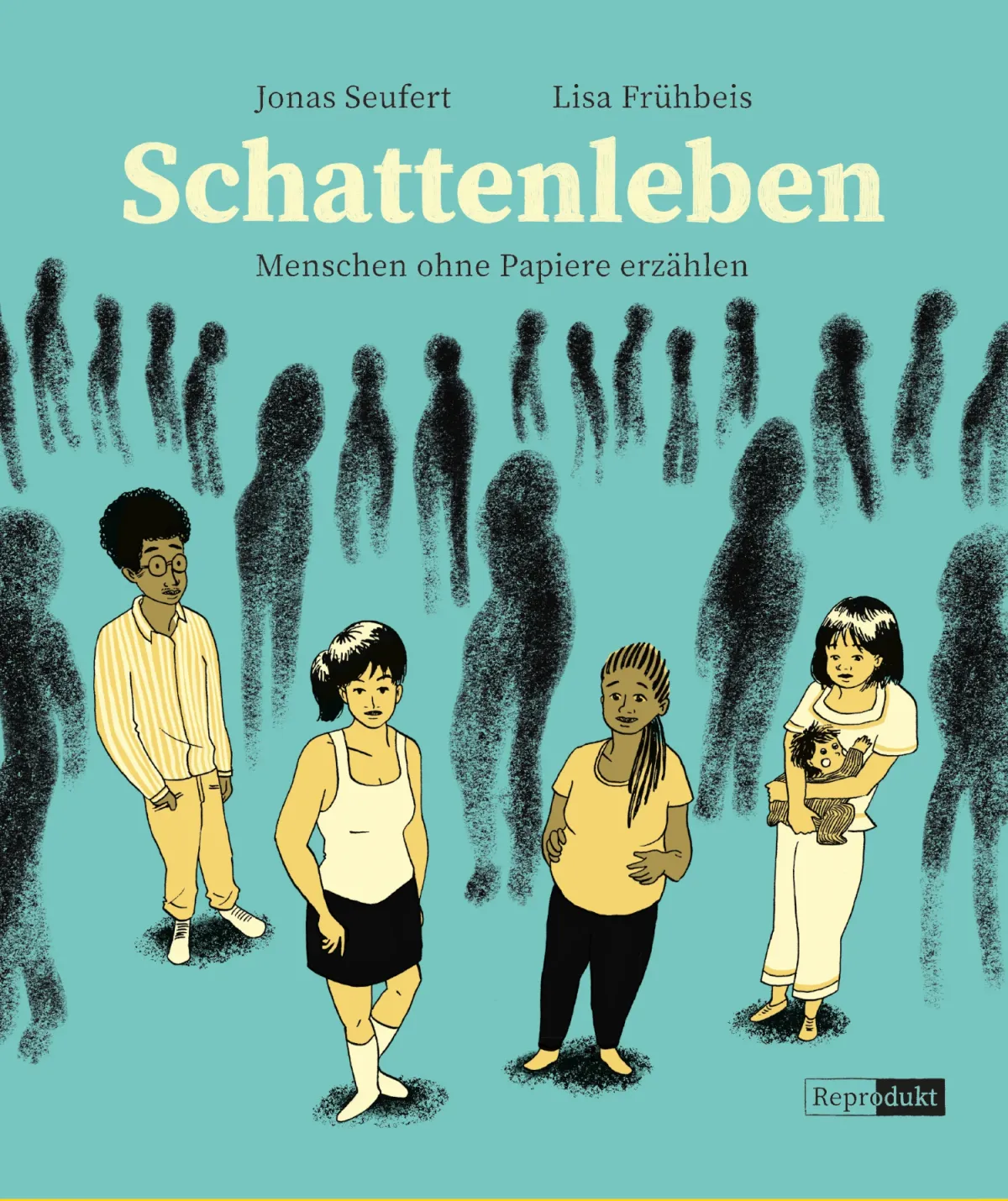
In "Schattenleben" (Shadow Life), Lisa Frühbeis and Jonas Seufert give four undocumented people a face and a name – names they are not actually allowed to have.
Jonas Seufert, Lisa Frühbeis | Schattenleben | Reprodukt Verlag | 160 pages | 24 EUR
There is one sentence that features in almost every review of Schattenleben, because it so succinctly captures the cruelty of the situation depicted: ‘Only those who are not seen can stay.’ This sentence lodges itself in the reader’s consciousness like a barbed hook. It turns the usual logic of visibility on its head. Like a criminal, a spy, a leper: to achieve one’s own goals, one must not draw attention to oneself, must not show one’s face, must avoid being seen. For people without valid residency status, every visit to a government office, every doctor’s appointment, every traffic stop can become a trap. Invisibility here is not a marginal phenomenon, but a survival strategy. This is precisely where Lisa Frühbeis and Jonas Seufert begin with their comic reportage: they aim to make visible what must remain invisible in order to survive.
Reprodukt Verlag
Paneling 1
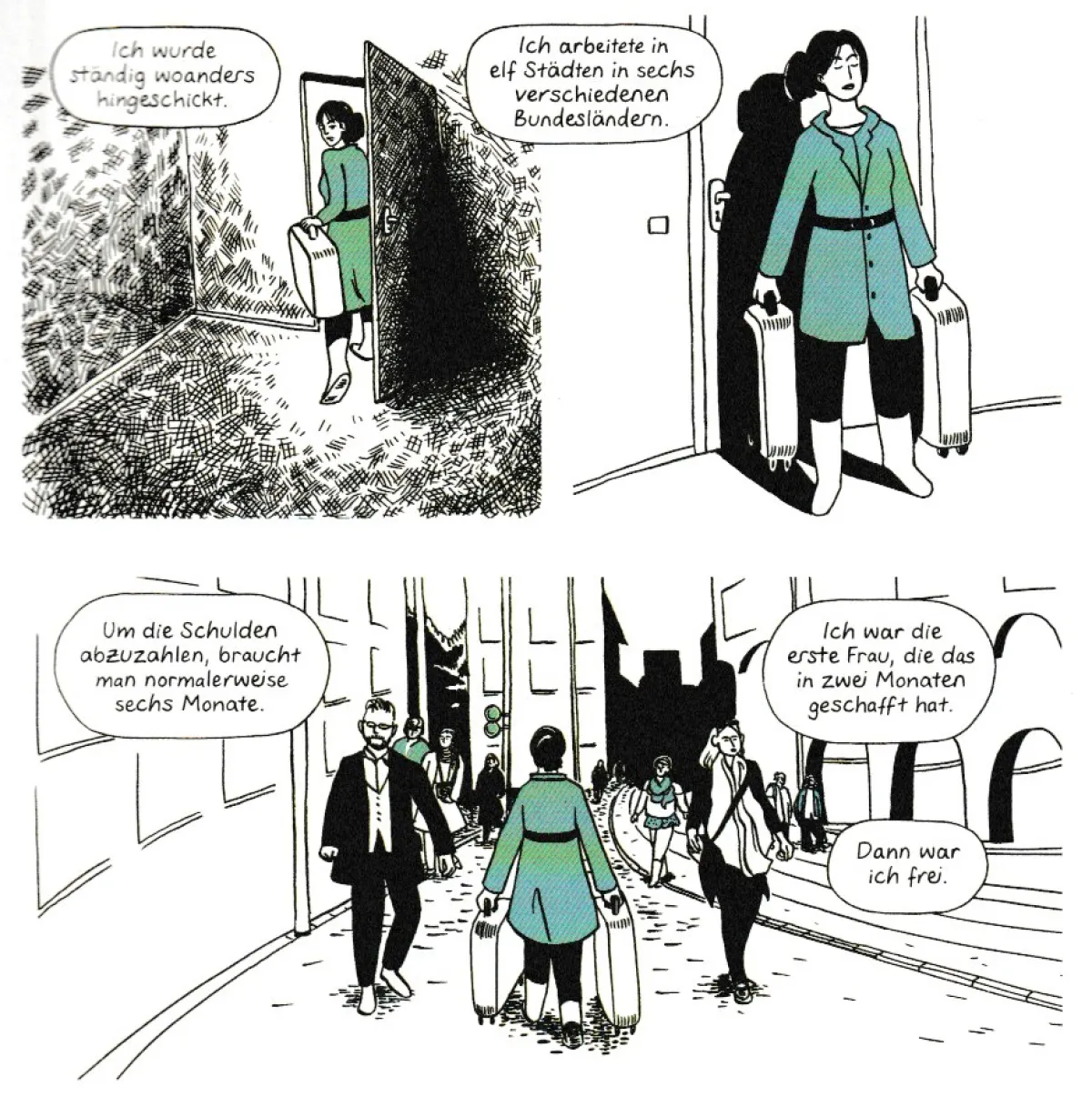
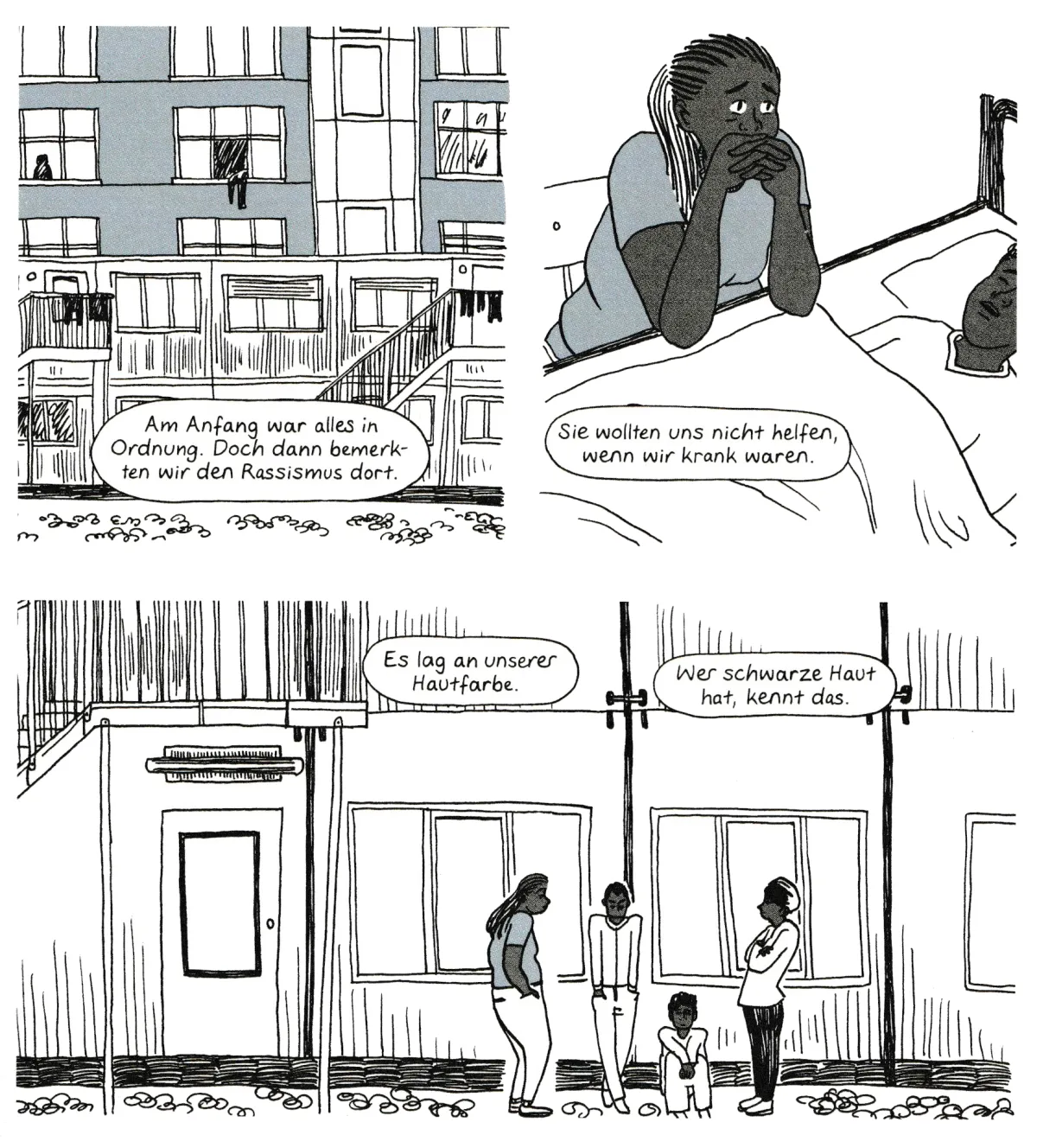
Bringing what is hidden into the light is a delicate undertaking. The fact is that anyone who steps from the shadows to have their story told risks precisely what they have hitherto sought to protect themselves from: attention that may turn into scrutiny by the authorities. What's more, any journalistic exploration of another person’s fate carries the risk of turning compassion into voyeurism, or of subordinating the story of those affected to one’s own narrative agenda. The fact that this book succeeds in this regard is down to its clever structure. Four people recount their lives as undocumented migrants in Germany, each with a completely different background. There is Brienne, a trans woman from Thailand who managed to free herself from forced prostitution, even taking her former pimp to court. There is the young Vietnamese woman Dâu, whose parents mortgaged their own farm to fund her studies in Europe; the money was never enough, so she has since been scraping by with undeclared work to prevent her family back home from falling into complete poverty. Then there is Charlotte from Cameroon, who was abused by her uncle and subsequently disowned by her own family. After her asylum application was rejected, she lived for years without fixed abode, even avoiding going to the doctor, for fear of discovery. And finally, there is Nasir from Somalia, who has spent almost his entire life in Germany and yet repeatedly finds himself thwarted by the lack of a birth certificate: Without this one document, no authority formally recognises his right to residency, and in the end, his tenancy was terminated and he found himself on the streets.
Four life stories that have nothing in common except for one shared experience: that of one’s own body becoming nothing but a file, to be shunted from one authority to another, whilst ultimately being denied any right to exist. Frühbeis and Seufert deliberately avoid any sentimentality. Interspersed between the individual life stories are short, factual information pages on work, healthcare, deportation practices and the paths to regularisation. These contextual pages are never merely supplementary: they broaden the perspective and repeatedly challenge their own positions on the respective central theme, rather than simply reiterating what has been said. Through the inserted images, Frühbeis takes the reader on a journey to places directly linked to the fate of the person being portrayed – thus ensuring that the reportage remains tied to a specific life, even in its most analytical passages. It is no coincidence that these shifts between intimate narrative and sober factual information are reminiscent of the principle of the classic graphic novel reportage, as popularised, for example, by Joe Sacco in the field of international comic journalism: the personal never becomes a mere illustration of a thesis; rather, the thesis emerges from the power of the personal. German-language non-fiction comics are also already familiar with such approaches to flight, exile and exploitation: Reinhard Kleist, in “Der Traum von Olympia” (2015), retrospectively gave a face to the fate of the drowned Somali runner Samia Yusuf Omar, and Birgit Weyhe, in her Max und Moritz Prize-winning “Madgermanes” (2016), distilled countless interviews with Mozambican contract workers in the GDR into three fictional composite characters. *Schattenleben* therefore differs less in the subject matter than in the approach: Whereas Kleist recounts a biography that has already come to an end, reconstructed from second-hand sources, and Weyhe fuses real voices into composite characters from a historically concluded episode, Frühbeis and Seufert accompany four people using their own names, who are still in the midst of their precarious present – told through direct conversations, not through reconstruction or retrospective synthesis. At the same time, both refrain from taking any kind of simplistic stance. Indeed, at a public launch of their book, Frühbeis and Seufert themselves emphasised that they did not wish to engage in immigration politics – and in fact, the volume never reads like a pamphlet, but more like an insistent invitation to take a closer look.
Reprodukt Verlag
Paneling 2
This approach also characterises the drawing style of Lisa Frühbeis, who, in her previous work – such as the comic strip collection “Busengewunder”, which won the Max und Moritz Prize – has primarily explored power dynamics from a feminist perspective. In “Schattenleben”, she refrains from any caricatural exaggeration. The page is often structured in triads, with the panels frequently left frameless, so that the individual images are not forced into a rigid grid but can breathe alongside one another. The size of an image is never left to chance, but reflects its emotional significance: a moment of despair may dominate the page, whilst smaller panels alongside it depict the bleak, resigned present or noticeably accelerate the plot. The colour scheme, too, does not follow a rigid pattern, but instead sets deliberate, recurring accents – sometimes on the protagonists’ skin and clothing, sometimes on the scorched earth of a war memory – which link individual visual motifs together associatively. The visual language remains predominantly concrete and figurative; only in a few, all the more striking, instances does Frühbeis depart from this: black areas or abstract forms created by wildly sweeping ink strokes suggest exhaustion or threat; here, the story is told through patterns rather than facial expressions. The drawing style itself thus becomes, entirely without an explanatory word, the silent compass of the narrated experience.
Christian Hueller
Jonas Seufert
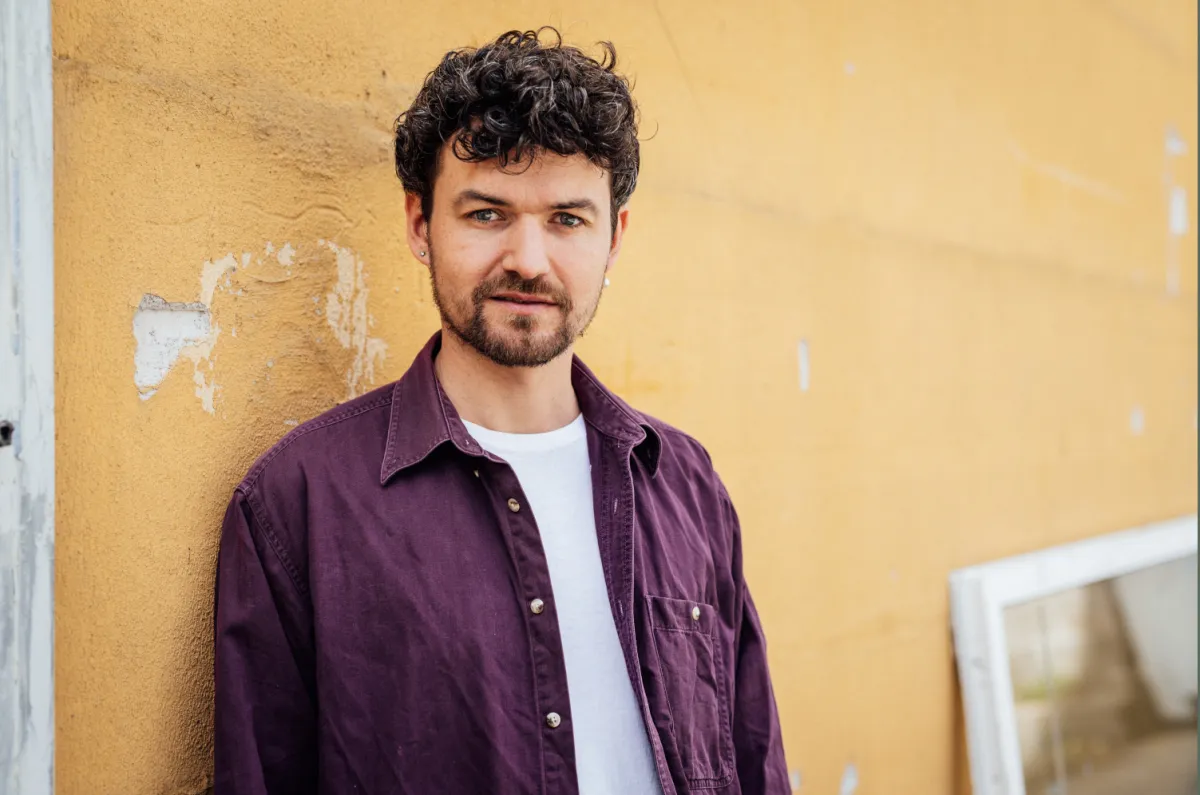
It is also striking how well the different backgrounds of the two authors complement one another in this interplay between imagery and journalistic research. Jonas Seufert (pictured right) has worked as a freelance reporter for publications including DIE ZEIT, the Süddeutsche Zeitung and CORRECTIV, focusing primarily on social inequality and precarious work; this attention to factual accuracy is evident in the interspersed background pages. Frühbeis, for her part, brings a narrative empathy that lends the four stories their emotional depth without exploiting them. This volume is the culmination of five years of intensive research and countless conversations – and it is precisely this unhurried approach, this taking of time for four individual biographies, that sets *Schattenleben* apart from the fast-paced headlines of the current migration debate.
Ultimately, the book remains unsettling, precisely because it offers no solution, nor does it heroise or glorify its protagonists. Their own inadequacies and shortcomings remain unaddressed, yet are not glossed over. These four people work, love and hope right here amongst us – and yet, in the eyes of the state, they do not exist. And we too, in our daily lives, overlook them and turn a deaf ear, precisely because their invisibility is both desired and structurally engineered.
Schattenleben thus demonstrates that invisibility here is never a characteristic of the individuals themselves, but rather a product of the society that produces them. In the end, therefore, we are left with a realisation that is as simple as it is uncomfortable, one that quietly turns the sentence with which it all began on its head: the shadow in which Brienne, Dâu, Charlotte and Nasir are forced to live is not cast by them. It is cast on them – by us.





 © Reprodukt Verlag