



An Afro-Cuban voice that envisions new horizons

 Penguin
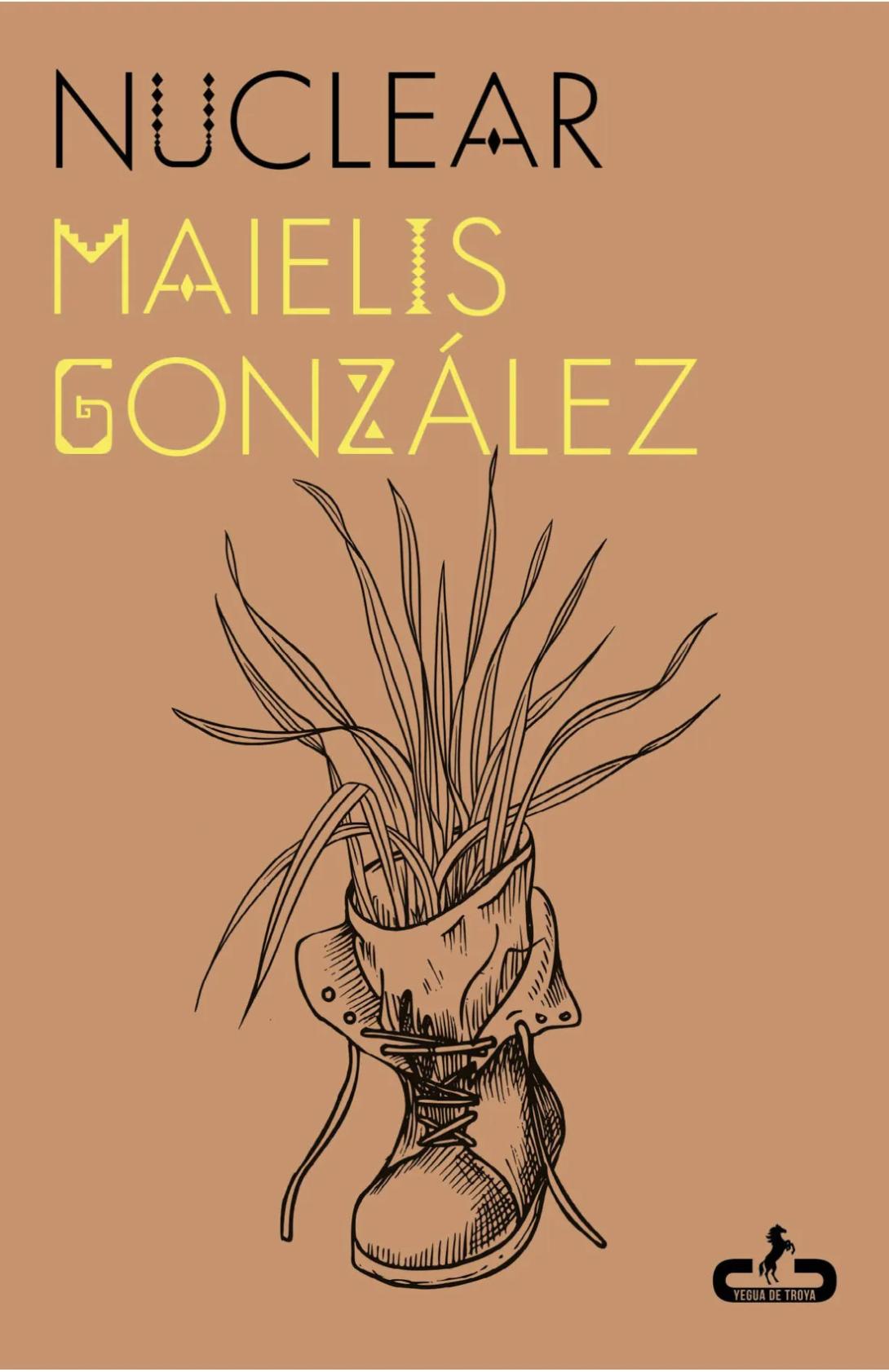
Maielis González | Nuclear | Penguin | 192 Pages | 15.10 EUR
There is a sense of symbolic victory when a Black woman occupies a space not intended for her. For decades, science fiction constructed white futures and technologies serving a humanity in which racialised bodies had no place. For more than a decade, Maielis González Fernández has been dismantling that exclusion from within through an increasingly ambitious body of work that places the Black and Caribbean experience at the heart of contemporary literary speculation.
Born in Havana in 1989, González graduated with a degree in Literature from the University of Havana in 2012 and taught at the same faculty between 2012 and 2016, when she emigrated. She now lives in Madrid, where she teaches creative writing at the Escuela de Escritores, translates, conducts research, and writes. Her academic background is in Cuban and Latin American science fiction, which means she approached creative writing with a very clear understanding of the genre’s traditions, its silences, and its political possibilities. This dual role - as both researcher and storyteller - permeates her entire body of work.
In 2016, she won the Eduardo Kovalivker Short Story Prize, which led to her book Los días de la histeria (Colección Sur).That same year, she also published Sobre los nerds y otras criaturas mitológicas (Guantanamera Ediciones). It was a direct critique of one of the most persistent mechanisms of the hegemonic gender: that of decreeing which people and which regions even have the right to imagine the future. González responded to that exclusion with humour and precision. Three years later, in 2019, she served as a consultant on the translation of the novel Hija de Legbara, by the Jamaican writer Nalo Hopkinson, for Apache Publishing. This translation work was also a political gesture: that of bridge-building between Black Caribbean voices that, for decades, have been constructing futures from the wound of colonialism.
Throughout her career, she has received significant recognition. In 2014, she was awarded the Caballo de Coral creative writing fellowship from the Onelio Jorge Cardoso Literary Training Center, and that same year she won the Óscar Hurtado Prize for an essay on Borges and the Fantastic. In 2016, the Eduardo Kovalivker Short Story Prize led to the publication of her second book, Los días de la histeria. In 2020, in collaboration with writer Sofía Barker, she created the podcast *Las Escritoras de Urras*, dedicated to promoting the work of female authors in the fantasy genre, which won the Ignotus Prize in 2021 and 2022. These are signs of a sustained and growing presence within a genre that, historically, has preferred to avert its gaze from where she now looks.
Emigration marked a turning point in her awareness of racial identity. Living away from Cuba forced González to view differently something that may have been taken for granted on the island. The racism that exists in Cuba - and it certainly does exist, with all its historical complexity - becomes more apparent from the perspective of the “other,” from the everyday experience of being perceived as a stranger in Madrid, as a migrant, as a Black woman in spaces that weren’t expecting her. That experience did not distance her from writing but rather made her more aware of what she wanted to say and why.
Nuclear (Yegua de Troya, Penguin) is her most ambitious novel and the one that has placed her centre stage in the Latin American literary debate. The story unfolds across two different locations and characters. Benicio remains in Cuba while his generation emigrates en masse. His obsession leads him to the ruins of the abandoned Juraguá nuclear power plant in Cienfuegos, an unintended monument to the collapse of a promise. Claudia writes from the south, from the Paraná Delta, observing from a distance the island’s drift and the lives left suspended in a future that never materialised. Between these two spaces, the novel constructs a fragmentary narrative structure of memory, abandonment, and the future, where science fiction functions less as escapism than as a means of understanding the present.
Benicio’s story takes place in a Cuba that is now suffocating. Since 2020, more than two and a half million Cubans have emigrated, equivalent to a quarter of the total population. Eighty-nine percent of households live in extreme poverty, and seventy-eight percent express a desire to leave the country. Power outages last up to twenty hours a day in some areas, and the economy has ground to a halt. The island that González knew, and that shaped her writing, is now experiencing a suffocation whose severity surpasses even the worst moments of the Special Period. In this context, the figure of Benicio - the one who stays, who does not emigrate, who searches for ghosts among the ruins - takes on a political depth that goes far beyond the plot. He represents all those who persevere in a country that the world is abandoning, constructing meaning where there is no longer the infrastructure to sustain it.
The Juraguá nuclear power plant is one of the most revealing episodes in recent Latin American history. Fidel Castro pushed for its construction in the 1980s with Soviet support. The Chernobyl accident in 1986 set off alarm bells. The collapse of the USSR in 1991 brought the project to a definitive halt, with the first reactor only 90 percent complete and the second barely started. What remained was an unfinished city, by then home to thousands of people who decided to stay and live in that land with no future. González makes those ruins the backdrop for a question that concerns all of us who have inherited broken promises. There is a certain irony in the fact that the Cuba now struggling with power outages of up to twenty hours a day is the same Cuba that once aspired to be a nuclear power. The future that was promised never even got off the ground.
Critics speak of a writing style that does not shy away from historical and emotional wounds, capable of fiercely narrating what still resonates today. They recognise in González a new point of reference for Latin American literature that not only speculates about the future but challenges it, with an approach known as “necromodernist.” They highlight her quantum imagination in the face of the ever-changing nature of territories and languages, even regarding her as an intersection between Borges, the Strugatsky brothers, and quantum physics. These views confirm that Nuclear is not a genre novel in the narrow sense of the term. It is literature that uses the resources of speculative fiction to do what the best literature always does: expand our capacity to see.
At Afroféminas, we understand this type of writing as part of a broader tradition. Afrofuturism has been arguing for decades that the future is not neutral territory and that imagining futures that include Black people is a political as well as an aesthetic act. González takes the same approach, enriching the global debate with her Caribbean and Latin American perspective. She does not write about Cuba by highlighting its exoticism or with a certain nostalgia, but as someone who knows from personal experience the texture of what is lost when a utopia fails, and the people that inhabited it are left without a narrative.
Her next book is titled Palenque. A palenque was a community established by escaped slaves on the borders of the colonial order; a space for life beyond oppression. Black women have reclaimed this idea of refuge and resistance in fantasy literature ever since Octavia Butler demonstrated that the genre could be an instrument of liberation. Butler’s legacy is evident in González as a shared consciousness - knowing that the futures others do not imagine for us, we must write ourselves.
Maielis González is a writer whose literary voice is still evolving, though already distinctive. As a Black woman, Cuban, and an migrant, her body of work is written from a perspective that challenges who narrates, who imagines, and who has the right to claim the future as their own. The answer her writing provides is the same one we’ve been advocating here for years. All of us. Us, too.
+++
This article was originally published at Afroféminas.
Did you enjoy this text? If so, please support our work by making a one-off donation via PayPal, or by taking out a monthly or annual subscription.
Want to make sure you never miss an article from Literatur.Review again? Sign up for our newsletter here.