



Not a lyrical medicine cabinet, more like a colourful plate

 XS Verlag
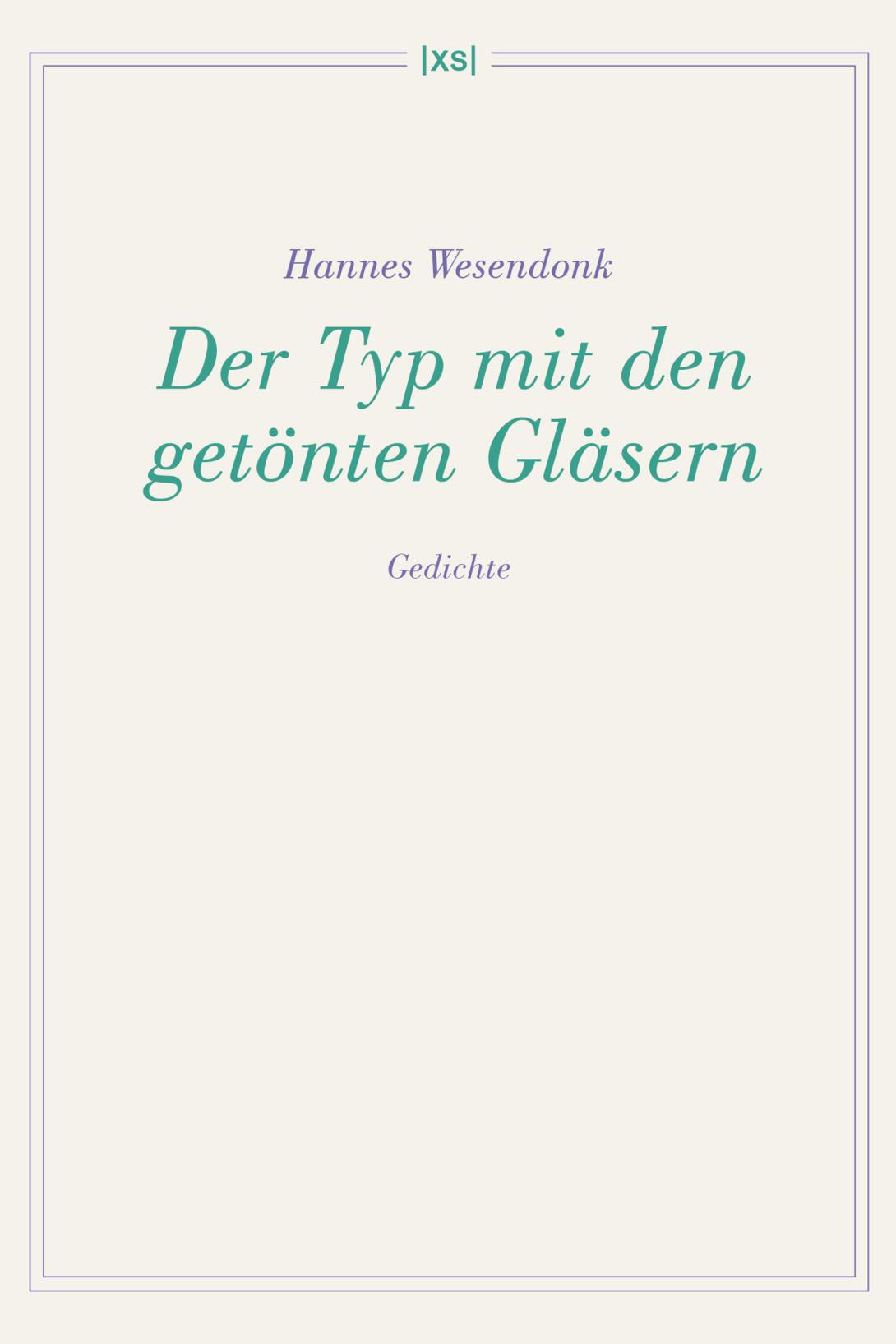
Hannes Wesendonk | Der Typ mit den getönten Gläsern – Gedichte | XS Verlag | 104 Seiten | 20 EUR
Hannes Wesendonk's poems undoubtably offer a direct glimpse into his mind, if we turn a blind eye to the objection that the lyrical self is not always identical to the author's self. Titles such as “Diary Entry” are evidence of this. Such a title suggests a certain everyday, uncensored and personal authenticity, a look behind the scenes, without filters, so to speak:
Diary entry
Good sex
Grey today
Worked on poems
Herring with potatoes
Read Hamsun
Good night
It reads as succinctly as a summary of a conversation between close friends in response to the question, ‘So, what have you been up to today?’ The language is condensed: expressions such as ‘good sex’ leave room for imagination (sex with whom? Sex alone? What kind of sex? An expression of desire or actual sex? Or simply a bold statement? Etc.), but overall one is inclined to interpret the information at face value, as lived reality, the author's authentic world. Of course, he may perhaps have read Fontane instead of Hamsun that day, or eaten pasta with his herring. Would that change the meaning of the text? In any case, it remains an unpretentious glimpse into everyday life, a condensed daily routine, a distillation. But of course, such a supposedly authentic text also represents a calling card, a stylisation, a self-disclosure, an Instagram photo. For the reader, the poem is a non-binding offer of identification. This can give rise to sympathy for the author or disinterest, depending on whether one has similar tastes or interests, or pursues similar activities (working on poems, for example). But this kind of poetry is also always a welcome invitation to make associations: delicious, herring with potatoes, I could make that again. When was the last time I read Hamsun?
According to the publisher's advertising, Wesendonk ‘plays with the forms of concrete poetry, pop lyrics and prose poetry and confronts them with the present. In the tradition of Wolf Wondratschek, he favours the mundane, the exaggerated, the ungracious’. That is quite accurate. The following poem, for example, falls under the category of concrete poetry:
Binary poem
01001100
01000001
01001110
…
As with his predecessors - Eugen Gomringer and Ernst Jandl for example - the question remains as to whether the text warrants a second, more in depth reading. Perhaps it was simply an idea that needed to be written down.
Wondratschek is reminiscent of narrative, prose-like poems such as ‘Hast du vielleicht 20 Cent?’ (‘Do you have 20 pence?’):‘Do you have 20 pence/Please, I need/something to sleep on/...’, or ‘Auf der Gangway’ (‘On the gangway’): ‘I pause briefly/as I/walk deliberately/my hand firmly/around the suitcase handle/air from another/continent/...'. Life in Berlin, the author's current place of residence, also appears here in part: ‘Back in Berlin’ is the title of one poem: ‘I'm back/in Germany's soft tissue no. 1/or capital/as the clever ones among you would say/.../Berlin belongs to the bums/no one really belongs here/...’. Social observations, everyday urban impressions and opinions jostle energetically, as in ‘Das Geräusch’ (The Noise): ‘.../I hardly ever see bums/saying anything cheeky/...I don't go out for kebabs anymore/Kebabs are still okay/but six euros is just too expensive/...’.
Assessing contemporary life through literature is always a questionable undertaking. Lyric texts are ultimately always snippets of a subjectively experienced and processed reality. But Wesendonk, born in 1986 and initially known as the singer/songwriter of the Berlin band U3000, deals – if one is looking for evidence of contemporaneity – with contemporary figures such as Angela Merkel (here he parodies the omnipresent 'Merkelisation' of life) or Heidi Klum, whom he uses as a foil for comparison in the text ‘Heidi Klum vs. my mother’: ‘My mother is not Heidi Klum/really not/My mother/is/much nicer/than/Heidi/...’ This is sometimes funny, sometimes quite banal, sometimes political, as in ‘Thuringian Election 24’, where the election results, especially the victory of the AfD, are illustrated in the style of concrete poetry.
When browsing through the texts in this poetry collection, one is particularly struck by the diversity of themes and subjects of poetic contemplation, which can seem either arbitrary or refreshingly colourful, depending on one's predilictions. For example, there is the linguistically playful ‘Der Fußballporno’ (Football Porn): ‘From the half-space/right through/His own stepdaughter/brutally substituted/gets two goals in/...’ alongside the self-deprecating ‘Poetic Genius’ (‘I'm really good at drying things off/...’), and poems about cultural heavyweights such as ‘Adorno,’ ‘For Federico Fellini,’ and ‘Richard Wagner’ that are accessible to everyone .
The text that gives the entire poetry collection its title, ‘Der Typ mit den getönten Gläsern’ (The Chap with the Tinted Glasses), is a mocking and ironic reckoning with the baby boomer generation, who ‘slowly but surely won the Cold War in their minds and bred good taste like black racehorses.’ In comparison, the lyrical narrator asks himself with feigned understatement:
What am I against it?
A poet
with a broken screen
The tone of these poems is predominantly humorous and ironic, succinct, satirical and observant, with content that is sometimes critical of society or the media, sometimes private and/or biographical, such as the text ‘38’ ("I have stood in front of graves/and in empty discos/bathed in dirty pools/and walked through forests/…/ I tried out sports/had my eyes tested/drove for 8 hours straight/and pissed on the corners of houses"). Here, as in many of Wesendonk's other texts, the play between banality, seriousness and nonsense is striking. We can look forward to new publications from the poet with the broken screen!
Did you enjoy this text? If so, please support our work by making a one-off donation via PayPal, or by taking out a monthly or annual subscription.
Want to make sure you never miss an article from Literatur.Review again? Sign up for our newsletter here.