


German colonial crimes in Namibia

 C.H. Beck
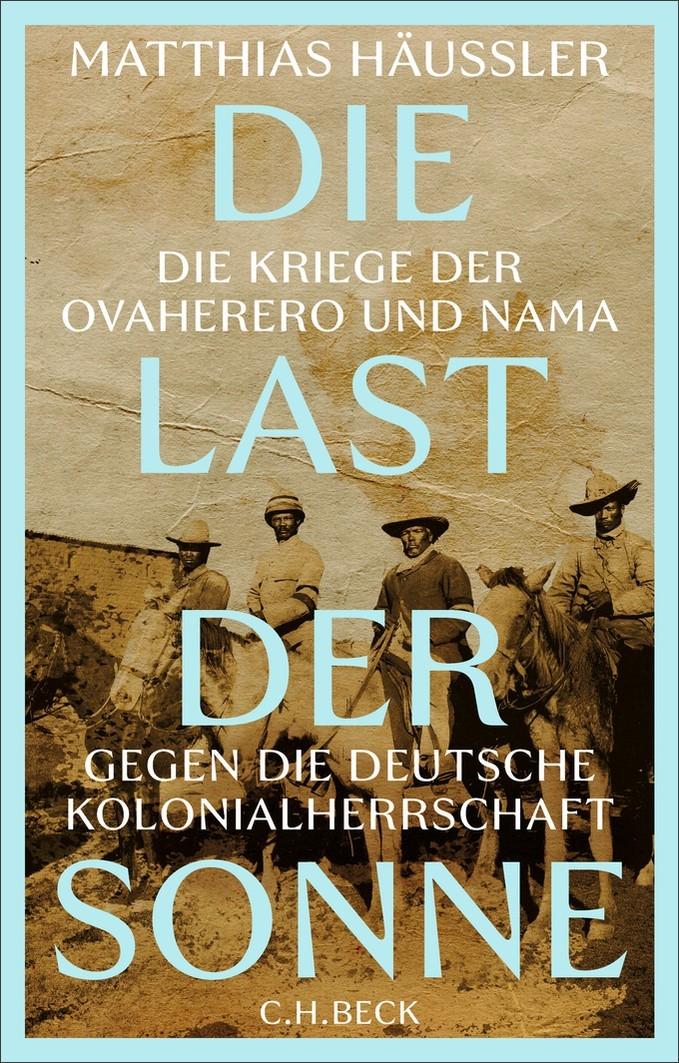
Matthias Häussler | Die Last der Sonne | C.H. Beck | 316 pages | 32 EUR
This was never going to end well. On one side was a newcomer: the fledgling German Empire had no colonies of its own prior to 1884. At the so-called Congo or West Africa Conference of 1884–85 in Berlin, the European states divided Africa amongst themselves. Even before the conference began, the German Empire had laid claim to South-West Africa, officially declaring the land of the merchant Lüderitz a German protectorate. This marked the beginning of German colonial policy, which ended with their defeat in the First World War.
Germany was never again as strong and assured as it was in the period between the founding of the nation state in 1870/71 and the outbreak of the First World War. This ancient cultural nation had been rapidly catching up with the more industrialised countries, even before the founding of the German Empire; now, it began to establish itself as a world leader in many fields, not least in colonial policy - the Germans were eager to make up for their previous neglect in this department. The country was brimming with vigour. ‘The world shall be healed by the German spirit’ was a common saying. It was an embellished version of a line from a poem that promoted national unity as a remedy for fragmentation into sometimes tiny individual states. It was used, contrary to the intention of the poet, Emanuel Geibel, to posit Germany’s general superiority. Amidst the flourishing racism of 19th-century Europe, the self-identification as ‘Herrenmensch’ ('master race') was, for many Germans, an unquestioned norm.
In Namibia, these Germans encountered very self-assured Africans. The north was dominated by the Ovaherero, who had conquered and ruled the land in the 16th and 17th centuries and took great pride in this. Matthias Häussler describes how they looked back on a golden age. The south was dominated by groups who had fled South Africa to escape white oppression. They were often people of mixed heritage who spoke, read and wrote Afrikaans. They used firearms, ox-drawn carts and maintained international trade networks. These groups, known as the Oorlan, arrived in the country before colonisation as warlords, robber barons and marauders, and over time merged with the indigenous Nama. The Ovaherero and the Nama fought over the fertile grazing lands of central Namibia and stole each other’s cattle.
Matthias Häussler writes about both ethnic groups:
“They needed weapons, gunpowder and lead to perpetrate violence, and had to perpetrate violence in order to acquire weapons, gunpowder and lead.”
This was the backdrop against which the Germans took land from the Africans, failed to regard them as independent citizens, and denied the subjugated people any culture or civilisation. The settlers viewed them as fair game. Any white person could shoot an African without prosecution. Eventually though, enough was enough. ‘Better to die than to go on living like this’ was the rallying cry with which the Ovaherero were the first to resist the Germans’ violence. The Nama joined the fight a few months later. The year was 1904.
Matthias Häussler, the author of the book Die Last der Sonne: Die Kriege der Ovaherero und Nama gegen die deutsche Kolonialherrschaft (The Burden of the Sun: The Wars of the Ovaherero and Nama against German Colonial Rule), published in 2026 by C. H. Beck in 2026, is a research fellow at the Institute for Diaspora and Genocide Research at Ruhr University Bochum and is considered one of the leading experts on Germany’s colonial past in Namibia. He holds a doctorate in philosophy and history. In every chapter of his book, he successfully restores the human dignity of the Ovaherero and Nama, which was so radically denied them and suppressed by the Germans. He examines in detail the wars between 1904 and 1909. He describes the individual German figures as well as their adversaries and concludes that, ‘by today’s standards’, the actions of the German military and administration following the end of the wars – in the concentration camps to which most of the survivors were sent and left to die – can be described as genocide. ‘By today’s standards’ is also the official position of every German federal government. Reading the book, one is tempted to replace ‘can’ with ‘must’. Matthias Häussler writes at the end of his book:
“It was the officials who sought their salvation in the destruction or, as it was more euphemistically termed, the ‘dissolution’ of these groups, which they carried out not on the battlefields, but nonetheless with relentless consistency. […] That is why genocide in German South-West Africa must also be considered independently of the war. The genocidal policy outlasted the war – and probably German rule as well.”
The Ovaherero and Nama proved to be formidable opponents for the German army, both tactically and strategically, and were never fully defeated. Ultimately, their downfall was due to lack of technical resources, military discipline and the barrenness of the land, where control of water sources could be decisive in battle and determine life or death. The German army, under the command of General Lothar von Trotha, deliberately exploited this latter factor, not merely to defeat the Ovaherero, but to annihilate them.
(1) ‘Autochthon’ means that something originally belongs to a particular place or is native to it. The term describes people whose ancestors have lived in a region for a very long time.
What Matthias Häussler describes reads like the extermination of autochthonous (indigenous) (1) people, compressed into a few decades, similar to that carried out over three centuries against the North American Indians. As a German, it was not easy for me to write about this. Whilst reading, I constantly had the extermination of the Jews carried out by ‘us’ in the back of my mind. And also an assessment by the German writer Ernst Wiechert, who wrote following his experience in a Nazi concentration camp: ‘The veneer of civilisation is probably quite thin among all peoples, but among the Germans it seems to be particularly thin.’ Asal Dardan’s Traumaland: A Search for Traces in Germany’s Past and Present covers this topic and points out that more people with a migrant background have been killed in Germany than in any other European country – a fact that can hardly be explained solely by Germany’s comparatively large population.
Note:
There is a second, highly recommended book on the history of the wars waged by the Ovaherero and Nama against the German colonialists. It is the novel Morenga by Uwe Timm. It was published in 1978 and has been translated into English, French and Turkish. To mark the author’s 80th birthday in 2020, a new edition was published by dtv, which has since been reprinted several times.
Did you enjoy this text? If so, please support our work by making a one-off donation via PayPal, or by taking out a monthly or annual subscription.
Want to make sure you never miss an article from Literatur.Review again? Sign up for our newsletter here.