



Between the lines
 Mubi
MubiPaweł Pawlikowski | Fatherland | 82 minutes | Poland, Germany, Italy, France | Our Films, Extreme Emotions, Nine Hours, Chapter 2
Certain subjects seem to defy any form of expression, and Thomas Mann is, without doubt, in this category.
Not only because of his body of work, but also because of the bewildering kaleidoscope of his personal world, family, exile, politics, sexuality, literature and German history that surrounds him. Any attempt to narrate this universe risks becoming either an encyclopaedia or a collection of anecdotes.
Colm Tóibín’s novel The Magician already suffered from this. Tóibín is normally an author who favours omission. His best novels thrive on the fact that feelings are never fully articulated and that meaning accumulates in small gestures; in his poetry, it is no different. Yet with Thomas Mann, the sheer abundance of material seemed to overwhelm him. The novel attempted to tell the story in its entirety: family, emigration, politics, homoerotic desire, the Nobel Prize, children, wars, friendships. Time and again, stages of life were merely noted rather than developed. The grand narrative threatened to become a chronology; the condensed account, a Wikipedia entry.
In his drama, which won the Best Director award at Cannes, Paweł Pawlikowski responds to this problem by taking almost the opposite approach. He tells us almost nothing. Or to be more precise, he covers only a few days, drawing only loosely on Tóibín’s novel.
In 1949, Thomas Mann and his daughter Erika travel through devastated post-war Germany to be honoured in Frankfurt and Weimar on the occasion of Goethe’s 200th birthday and to deliver their speeches. In between lie roads, hotels, encounters, silences and the news of Klaus Mann’s suicide.
That is all Pawlikowski needs.
For Fatherland is less a film adaptation of Tóibín’s The Magician than an ascetic distillation. The black-and-white imagery reduces the world to light and shadow; the staging to a few rooms, a few movements, a few glances. Hanns Zischler’s Thomas Mann speaks little and observes a great deal. Sandra Hüller’s Erika is at once her father’s daughter, secretary, ally, protector and moral counterpart. A peculiar intimacy develops between the two, one that is felt rather than explicitly stated.
To achieve this focus, however, the film does rework the historical facts somewhat. In reality, Thomas Mann was not accompanied by Erika on his 1949 trip to Germany, but only by his wife Katia. Although Erika Mann had accompanied her parents on other trips around Europe at that time (and, for instance, had learnt of her brother Klaus’s death whilst with them in Stockholm), she refused to take part in the actual visit to post-separation Germany in 1949, deliberately boycotting it. In his film, however, Pawlikowski places Katia in the USA, thereby removing her from the centre of this trip. This is no casual inaccuracy, but a far-reaching dramatic decision: by having the wife absent, the film is able to make the relationship between father and daughter its almost exclusive emotional focus. A family trip thus becomes an intimate drama for two. Erika thereby takes on a role that historically also fell to Katia: she organises, mediates, protects and controls this famous man, whose public authority would be almost inconceivable without the domestic work of the women. At the same time, Pawlikowski transforms her into a kind of embodiment of the entire family. Her closeness to Thomas, her grief over Klaus and her own experience of exile bring together the tensions that the film does not seek to explore in detail.
This historical reinterpretation thus creates the very intensity on which Fatherland succeeds. Yet it also reveals the risk inherent in this approach: complex family dynamics are not merely condensed but rearranged to fit the film’s rigorous aesthetic structure. And it is precisely here that the film reveals its greatest strength: for Pawlikowski possesses an extraordinary faith in what remains unsaid. He does not explain. He simply lets the silence speak. He trusts that faces can convey what dialogue would only undermine.
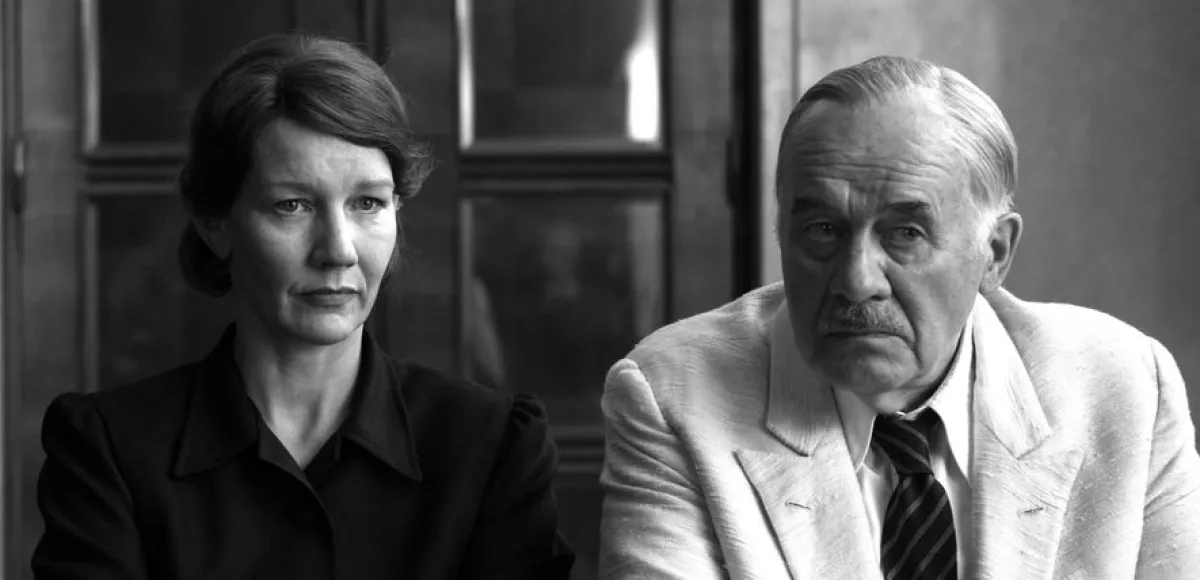
Thanks to the magnificent ensemble cast, these are often great cinematic moments, such as the silent exchange during the opening press conference (see the film still above this text) or the film’s closing scene in a half-ruined church accompanied by organ music. Hanns Zischler portrays Thomas Mann with impressive reserve. He does not play the literary titan, but an old man who has learnt to conceal his feelings behind discipline, irony and public decorum. Even his stiff posture betrays just how much this man has moulded himself into a figure of public standing: a Nobel Prize winner, the German conscience, an author who, even in private, can scarcely stop playing the part of Thomas Mann. Sandra Hüller, for her part, finds in Erika that blend of loyalty, impatience, hurt and biting irony which prevents her from becoming merely her father’s companion. Her face is the film’s more expressive sounding board. Where Thomas Mann closes himself off, Erika reacts. Where he represents, she remembers. Where he encapsulates historical responsibility in well-crafted sentences, she carries the family cost of this stance with her.
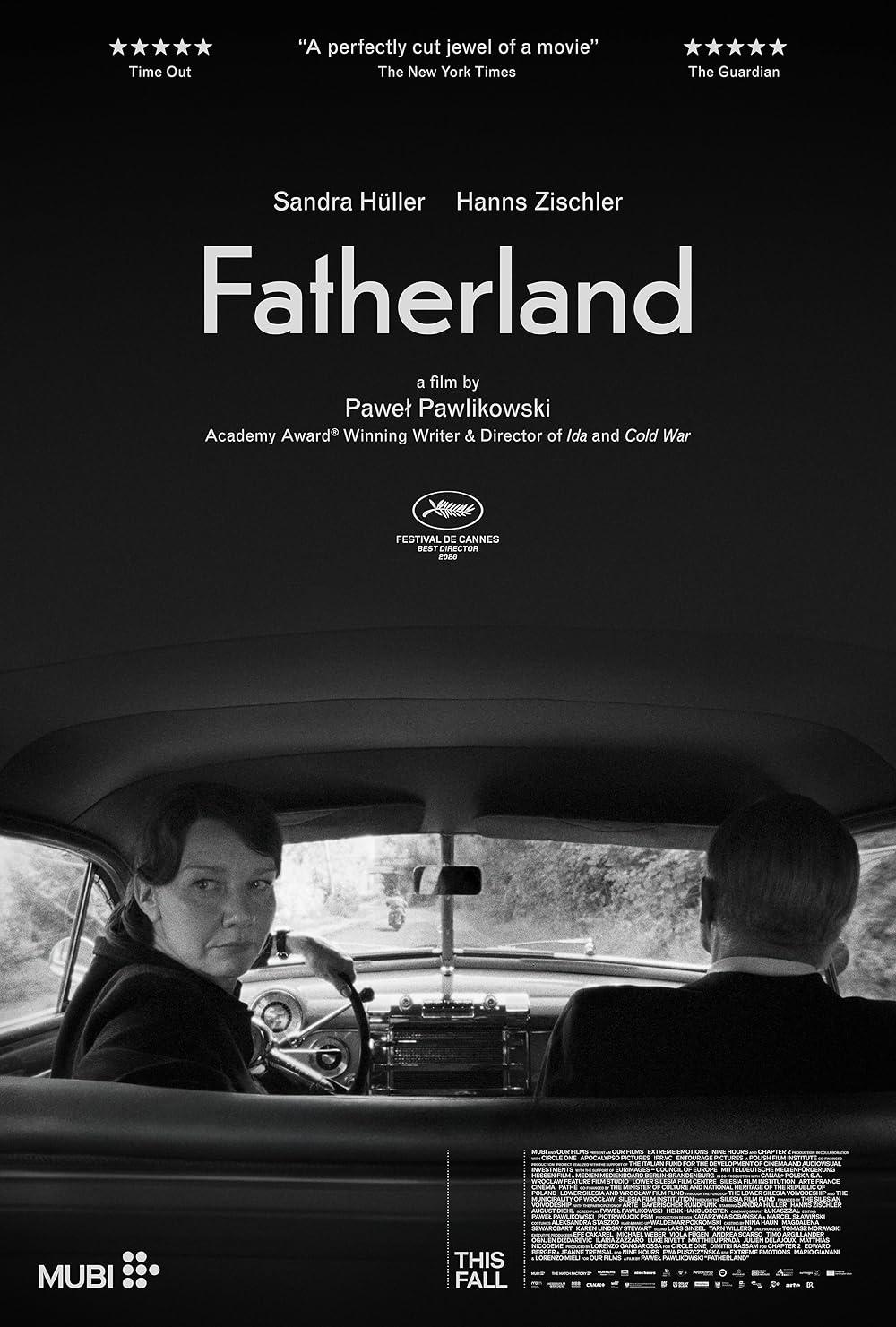
Time and again, this gives rise to images of great beauty: a black Buick on Germany’s damaged roads, faces behind window panes, ruins and empty landscapes, amidst which are these two people, returning home and yet strangers in their own country.
The car journey alone has something ghostly about it. Thomas and Erika travel through a country that was once their homeland but now feels more like a crime scene. The Germans welcome the world-famous returnee with that peculiar mixture of admiration, appropriation and repression that characterised Thomas Mann’s actual journey. The émigré is expected to become a German poet once more, preferably without dwelling too long on what drove him to leave Germany. The title Fatherland thus acquires a productive ambiguity. It refers to the devastated Germany to which Thomas Mann returns. But it also refers to the father’s domestic realm, in which the children struggle for recognition, closeness and freedom. Political and private authority mirror one another: Germany wants its prodigal son back, whilst Thomas Mann himself was never quite able to release his children from the gravitational pull of his own greatness.
Precisely because Pawlikowski observes rather than illustrates, the journey acquires not only a ghostly aura but also an almost dreamlike quality. Yet at some point, this aesthetic consistency becomes its opposite. For gaps only work where the viewer can at least guess what is missing. At times, however, Fatherland relies almost exclusively on prior historical and biographical knowledge. Characters appear and then vanish again. Names, relationships and traumas flash by without being able to develop fully. Anyone unfamiliar with the complicated dynamics of the Mann family is likely to experience some of these moments less as ambiguous omissions and more as mere obscurity. This includes, for example, the brief ' lively exchange’ with Gustav Gründgens, brilliantly and ironically portrayed by the great German actor Joachim Meyerhoff. But it is particularly noticeable in the case of Klaus Mann and his role in this film. August Diehl embodies him with a nervous vulnerability born of a life permanently scarred. Yet the film presents Klaus primarily as a symbol: homosexuality, drug addiction, exile, conflict with his father, self-destruction. All of this has a biographical basis, but is touched upon so briefly that the character is given scarcely any opportunity to escape these all-too-familiar attributes. The news of his death is intended to form the emotional crux of the journey. Yet because Klaus until then exists more as a ghost than as a real person, the grief, too, remains strangely abstract. It is visible, but not always palpable. Here, abridgement occasionally becomes oversimplification; the void becoming formulaic. This reveals the film’s central paradox. Whereas Tóibín allowed too few gaps in his novel, Pawlikowski adds almost too many to his film.
The novel seeks to capture every life, every relationship and every historical milestone. The film allows family members to disappear, alters relationships and relies almost entirely on the resonance of a few moments. Tóibín records what Pawlikowski omits. One sometimes falters under the sheer volume of material, the other under the rigour of his selection.
Both possess their own beauty and have their strengths. But both also come at a price.
Perhaps, however, this is precisely where the true and distinctive quality of Fatherland lies. Pawlikowski is less interested in historical reconstruction than in memory itself. Memory is never complete. It consists of fragments, glances, snippets of conversation, places and images that can no longer be pieced together seamlessly. In this respect, the black-and-white imagery does not feel nostalgic, but rather epistemological. It reduces the world; not, however, to its detriment, but to bring its contours into sharper relief.
The result is a film that systematically rejects biographical completeness, which can occasionally prove narratively unsatisfying. Some characters remain too vague, some conflicts too subtly suggested, and some historical changes demand more justification from the film than it is prepared to provide. Yet it is precisely this openness that ensures Fatherland continues to resonate long after its images have faded. Pawlikowski seeks out that narrow space between history and memory, where people define themselves less by facts than by glances, silences and tacit guilt; he has the courage not to fill every gap for the viewer, even if, in doing so, Pawlikowski occasionally forgets that not every gap is necessarily a void.
Did you enjoy this text? If so, please support our work by making a one-off donation via PayPal, or by taking out a monthly or annual subscription.
Want to make sure you never miss an article from Literatur.Review again? Sign up for our newsletter here.