



"Then you'll have to write it yourself."

 Catalyst Press
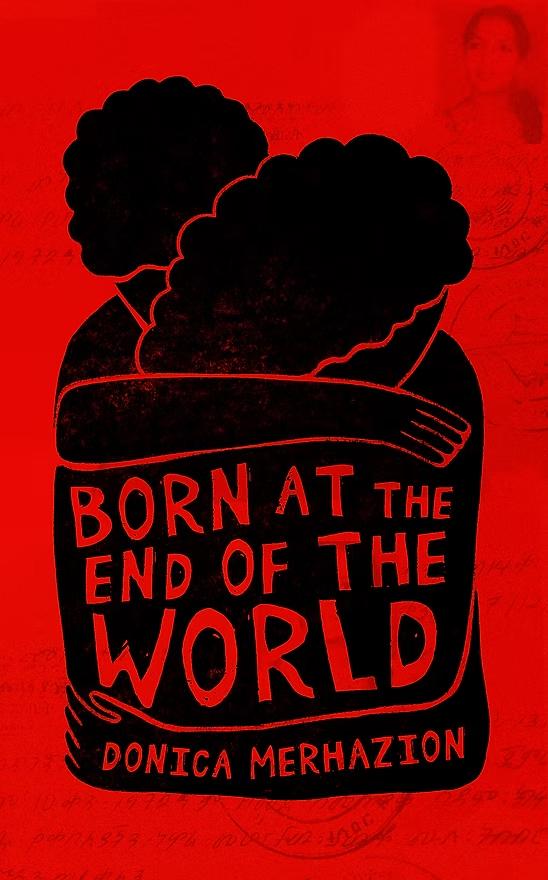
Donica Merhazion | Born at the End of the World | Catalyst Press | 376 pages | $21.95
“If there’s a book that you really want to read, but it hasn’t been written yet, then you must write it.” It's this 1981 quote from Toni Morrison that Donica Merhazion refers to when explaining why she wrote her novel Born at the End of the World. The author lives in Kenya and is originally from Eritrea.
Indeed, there is very little literature about the thirty years of the Eritrean War of Independence and the terror of the Ethiopian military government. Baalu Girma’s 1983 novel Oromay gives an insider's view of the Ethiopian campaign in Eritrea, but it was banned, and shortly afterwards, the author disappeared. Maaza Mengiste’s novel Beneath the Lion’s Gaze from 2010, on the other hand, is set in Addis Ababa in 1974. It tells the story of how a family experiences the fall of Emperor Haile Selassie amid political violence and social upheaval. However, the Eritrean independence movement remains a secondary plot in the novel.
Not only are there no literary accounts of these events, but there are also no official records or other written testimonies of the political violence. Relatives often only learned of the death of a detainee when the Ethiopian military regime demanded payment for the ammunition used. What remains is oral tradition. But the generation able to bear witness to these stories is now disappearing. They knew Asmara—today’s capital of Eritrea—as an open city before the 1974 military coup.
Donica Merhazion is among those who directly absorbed and witnessed this oral tradition passed down by their parents’ generation. She was born in 1979 in Addis Ababa, at the Alem Bekagn Central Prison. Its name can be translated as “I’ve had enough of the world” and inspired the title of her debut novel. Her parents fled to Nairobi in 1980. When, as a child, she told her classmates about being born in prison, they teased her; from then on, she kept her background secret. It wasn’t until she had children of her own that she began to delve more deeply into her parents’ story. She conducted lengthy interviews with both of them and, at the same time, researched the historical events; this included a visit to the Red Terror Martyrs’ Memorial Museum in Addis Ababa, together with her mother. A facsimile of her mother’s pass is printed on the book's inside cover, confirmation that Merhazion's novel is based on a true story.
The novel tells the story of her parents between 1957 and 1980, beginning in Asmara, a city that the Italian colonial power nicknamed “Piccola Roma.”(Little Rome) Since 1890, the Italians had developed Asmara as the capital of their Colonia Primogenita: railways, industrial facilities, wide avenues, an opera house, the Cinema Impero, and the aeroplane-shaped Fiat Tagliero gas station, a UNESCO World Heritage Site since 2017. Merhazion initially tells the story of this Asmara from the perspective of two teenagers - both her parents had come to the big city as young people, seeking their fortune. This is how we meet the street urchin Girmai, who is based on the author’s father. He is always running from municipal officials, who trample the street vendors’ baskets so that the city centre remains presentable, in case Emperor Haile Selassie arrives from Addis Ababa. In another scene, we observe with him the numerous office workers drinking cappuccino at street cafés during their morning break.
Elen is based on the author’s mother. At thirteen, she flees from a village in northern Ethiopia to Asmara to escape an engagement to a much older man. In Asmara, she initially works as a waitress and learns Amharic. Her role model is Aunt Tsehay: she has achieved financial independence by brewing her own beer, owns apartment buildings, and has never married. On the one hand, Asmara appears as a city of great contrasts, where tin shacks without running water exist alongside magnificent villas. At the same time, however, the city is open and full of opportunities for both parents: Girmai, a street kid, gradually builds up his own knitwear business, and Elen buys her own bar in an emergency sale, which she then runs independently with the support of her siblings.
Both, then, owe their social advancement to life in the city. Merhazion vividly recounts how Elen and Girmai eventually become embroiled in the political underground struggle, while also highlighting the differences in their personal journeys. As a child, Girmai accompanies his father to the deathbed of a distant uncle who is missing his right hand and left foot. After the Battle of Adwa in 1896, the victorious Ethiopian forces mutilated some eight hundred captured Eritrean Askari as high traitors. In that battle, the Ethiopian army had defeated the Italian colonial army. The victory made the country an icon of Pan-Africanism, but also drove a deep wedge between Eritreans and the Ethiopian central government. Thus, Girmai learns early on that this divide has historical and political roots. Later, he is particularly influenced by the speeches of the Eritrean politician-in-exile and journalist Woldeab Woldemariam, who spoke out against all forms of oppression, whether it stemmed from a European or an African power.
For Elen, however, the path into the political underground is a slower one and initially takes place mainly through observation and listening. When she first hears men arguing about the Eritrean cause, she barely understands the terms they use. But she recognises a theme from her own life story: here, too, people refuse to simply accept the status quo. That is exactly what she herself had done when she boarded the bus to Asmara to escape her engagement. Ultimately, the decisive factor in her commitment is the massive violence that erupts in Asmara following the military coup. She sees a boy die right on her own doorstep, simply because he had exceeded the curfew by a few minutes. She does not want her children to grow up in such a system.
Both of their lives are thrown off course by the coup of September 1974. A military committee had deposed Emperor Haile Selassie; it called itself Derg, the Amharic word for “committee” or “council.” Merhazion depicts this turning point through the changes her characters observe in the city. The curfew brings checkpoints and soldiers who are getting younger and younger. Asmara is divided into kebeles, which are neighborhood committees with their own administration, and even a trip across a district boundary costs money or requires connections. The university closes, foreign embassies evacuate their staff, and the number of customers at Elen’s bar dwindles until no one comes anymore. In late December 1974, forty-five schoolchildren in Asmara are strangled with piano strings; in the novel, a professor dies in the same way because he had continued to teach in Tigrinya.
Even in her depiction of the underground struggle, Merhazion consistently maintains the perspective of her two characters. The Cold War and communist ideology are only mentioned in passing, and this is consistent, since the experiential horizon of many of the movement’s participants likely did not extend beyond that. In the end, however, it is the Soviet airlift of 1977 that forces the retreat of the Eritrean Liberation Front. For many of its members, this costs them their lives or leads to imprisonment and torture—including Elen and Girmai. Elen is three months pregnant at the time of her arrest.
The depictions of violence are precise and told without pathos. The narrative style becomes more conventional when it comes to the couple’s love story. This is understandable, as the family history is viewed from the perspective of the loyal daughter. She knows that without her parents’ courage and perseverance, she would not have survived the cruel conditions.
The fact that the Eritrean People’s Liberation Front was so appealing to many people at the time is not solely due to the violence of the Ethiopian Derg regime. The movement also saw itself as a social vanguard. Its internal newspaper, which is also mentioned in the novel, was aptly named “Vanguard.” The equality it promoted and the overcoming of social differences—including those between men and women—held great promise. As a result, about 30 percent of the fighters were women. This hope for a more just social order likely played a particularly significant role for people with life stories like those of Elen and Girmai.
After its victory in 1991, the Eritrean People’s Liberation Front established a one-party state. It now forces its population into what is effectively indefinite national service. Under its rule, nearly 18 percent of the population has fled abroad. Merhazion’s book does not cover this development; it ends in 1980. But it preserves the hopes and experiences of the people from the time before.
Did you enjoy this text? If so, please support our work by making a one-off donation via PayPal, or by taking out a monthly or annual subscription.
Want to make sure you never miss an article from Literatur.Review again? Sign up for our newsletter here.