



The Bitterness of Proximity
 Graywolf Press
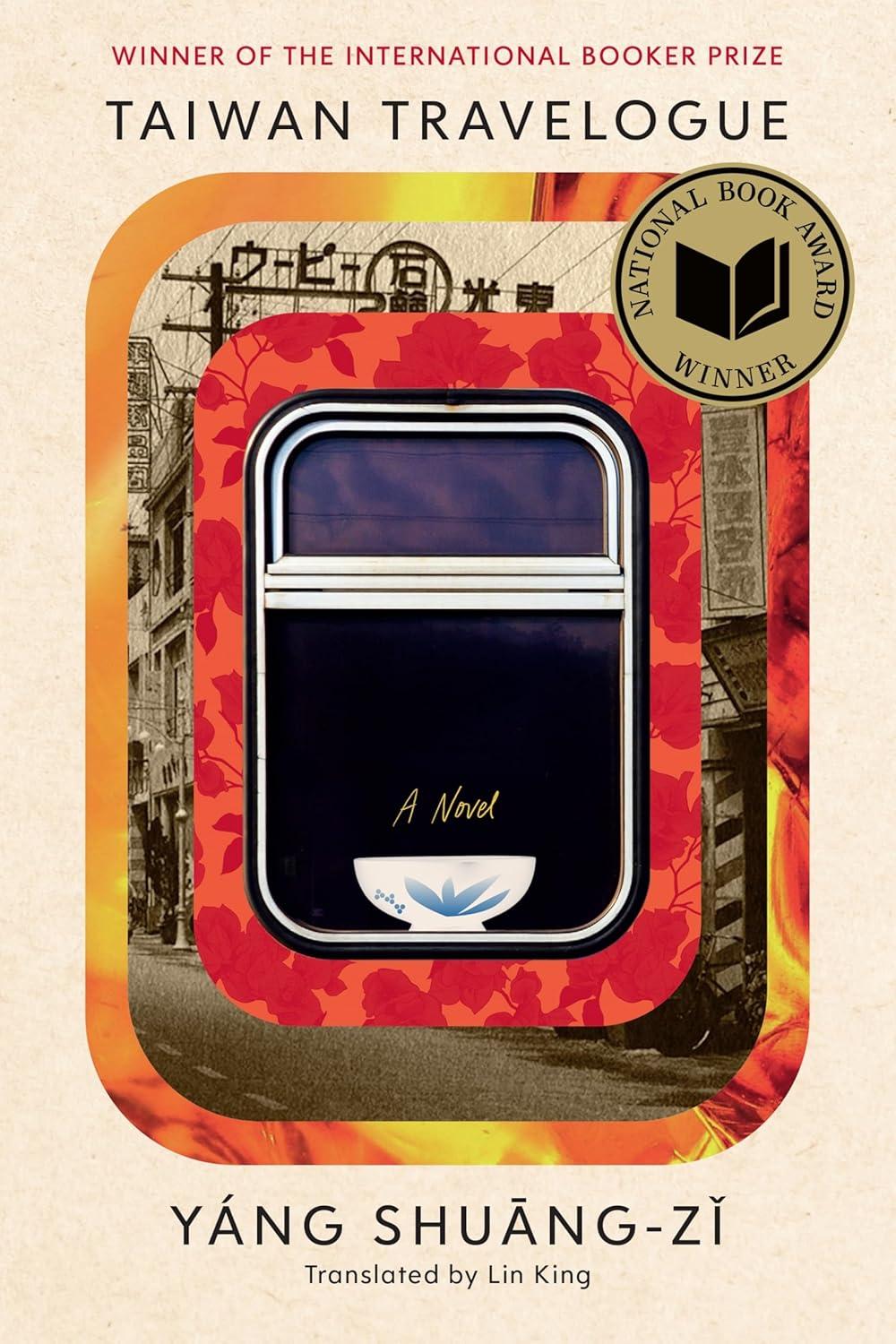
Yang Shuang-zi | Taiwan Travelogue | Graywolf Press | 320 pages | 18 USD
Anyone reading Yang Shuang-zi’s Taiwan Travelogue should not begin on an empty stomach. Not because this novel is merely mouth-watering prose, nor because it revels in the very culinary exoticism that it so ruthlessly dismantles, but because here, food is never just food. Every soup, every fruit, every marinade, every banquet carries history within it; not as a side dish, but as a slowly simmered stock in which colonialism, desire, language, translation, class and gender bubble and stew together until it is impossible to distinguish where the personal ends and the violence of history begins. Taiwan Travelogue is a novel that invites its readers to the table, but not to fill their stomachs. It serves up an awakening of consciousness in dishes that are sometimes delicate, sometimes bitter, sometimes full of that deceptive sweetness that only begins to irritate the throat much later.
Yet it all begins, seemingly quite innocently, with a research trip. The Japanese writer Aoyama Chizuko arrives in Taiwan in 1938, during the Japanese colonial period. She is there to travel, observe and write. At her side is the Taiwanese interpreter Chizuru, Chi-chan, a woman who translates, accompanies, explains, evades, and withdraws, and in doing so, becomes increasingly central to the novel. A closeness develops between the two women that one might call love, were it not for the fact that this word is too vague and laden with meaning to capture the complex texture of this relationship. For Yang Shuang-zi is not interested in love as a fantasy of salvation. Instead, she asks: Can friendship exist when hierarchy dictates the seating arrangement? Can tenderness remain untainted by colonialism? Can a Japanese woman love a Taiwanese woman, without at the same time observing, interpreting, possessing, protecting, or exoticising her?
The novel does not pose these questions programmatically, but with the sophistication of a kitchen where the real work takes place before serving: cutting, pickling, fermenting, reducing. Yang Shuang-zi has written a novel that presents itself as a document found by chance, translated and annotated; as a literary forgery; as a rediscovered travel book by a Japanese author, supposedly retranslated and republished in the 21st century. This metafictional game could easily remain a cold, intellectual construct. Yet the fictionalised prologue and epilogue, along with the editorial voices, lend the novel an unexpected emotional depth. Although one knows this is fiction, the text feels like a message in a bottle from another era. Rarely is it made so clear that translation means not merely transposition, but also a new life.
Yang Shuang-zi recounts Taiwan’s colonial history not as a history lesson, but as an ongoing exploration into taste and power. Aoyama is no crude imperialist. On the contrary: she rejects propaganda, is suspicious of the rhetoric of war, and scoffs at the notion that writers must wield their pens like weapons. She is rebellious, intelligent, non-conformist, and acutely aware of misogynistic expectations. And yet, despite all of this, she is still part of a colonial gaze. It is precisely here that the novel’s psychological precision lies. Yang Shuang-zi does not simply portray the 'bad guys' on one side and the ‘good guys’ on the other. She shows how superiority can also disguise itself in sensitivity; how benevolence becomes a sauce that coats everything; how protection can become a form of possession.
One of the novel’s most powerful scenes is when Chi-chan reproaches Aoyama for not appreciating Taiwanese tastes as such, but merely as curiosities. What to Aoyama is meant as admiration sounds to Chi-chan like the gaze directed at an exotic animal. This is a devastating moment because it touches on an entire ethic of observation. Who is allowed to marvel? When does wonder become appropriation? When does interest slide into intellectual arrogance? And what does it mean when the colonised must explain to the well-meaning colonial subject that even kindness can harbour violence? There is nothing in the world more difficult to refuse than self-righteous benevolence: this sentence is one of the novel's keys. It applies not only to Aoyama but to our entire present, in which power has long since learnt to speak in a solicitous tone.
The fact that Yang Shuang-zi addresses these questions through food is not a decorative literary device, but the novel’s central political grammar. Taiwan is not merely a backdrop here, nor a colonially modernised exhibit. Taiwan is a kitchen, a market, a scent, a bitter brew, a pickling technique, a knowledge of Hakka and Hokkien traditions, of marinades, of food for the gods, of poverty, pragmatism, waste and the avoidance of waste. When Chi-chan explains to Aoyama that in ‘her’ language there are several words for 'marinate', whereas in 'Japanese' only one, this is no folkloric footnote. It is a small linguistic philosophy of sovereignty. A culture that knows so many nuances of preservation, seasoning and infusing cannot simply be placed in the empire’s display case.
It is particularly lovely how the novel rehabilitates the taste of bitterness. The jute soup, muâ-ínn-thng, is not a feel-good dish, not a tourist delicacy, not an easily consumable promise of authenticity. It is labour, heat, stained fingernails, sweat, a process of picking, kneading, boiling and braising. It cools the body, but it tastes bitter. This bitterness becomes the antithesis of that colonial sweetness which seeks to make everything foreign immediately palatable. Taiwan is not there for Aoyama to taste. It tastes of itself. And that is precisely why it can, must, and should become political.
This is particularly evident in discussions about regional culinary traditions. What at first appears to be casual table talk turns out to be a lesson in history, language and cultural self-assertion:
I’ve heard people say that most Hakka dishes evolved from food originally made for worshipping the gods. Hoklo food’s origins are quite different. In Tainan, there is something called a-sià dishes ... Hakka food is more pragmatic, with a wide variety of pickled and cured dishes—vegetables, seafood, foraged foods—I’ve heard that there are hundreds of options. I’ve heard that whereas Hoklo people only use one word for marinading, sīnn, Hakka people have four or five words, each with different nuances.
What is at stake here goes far beyond mere cuisine. The novel reveals that identity is not forged in grand political programmes, but in the practices of everyday life: in the techniques of pickling, fermenting and preserving, in regional terminology, and in the words a language uses to describe flavours, preparations and textures. Colonialism thus appears not merely as domination over territories, but as an attempt to standardise such differences. Every dish thus becomes a small act of cultural resistance.
This becomes even clearer in the novel’s grand banquet narrative. When Master A-Phûn, who initially refuses to cook for the Japanese, finally prepares a meal, this is not an act of submission, but a demonstration of culinary sovereignty. At this table, Aoyama realises that there is an independent, developed and nuanced Taiwanese cuisine – not a hybrid, not a colonial product, not a quaint variation on Japanese, Western or Chinese techniques. The novel expresses this with unusual directness:
I’d been invited to countless banquets ever since I arrived in Taiwan in the spring, including many Taiwanese banquets tailored for Mainlander guests, and initially I’d disliked such banquets for being designed to draw tourists. But Master A-Phûn had completely upended my impressions of a Taiwanese restaurant banquet. A sense of wonder was born within me. When Chi-chan made me the curry feast, I’d felt the existence of a distinct ‘Taiwanese cuisine,’ but I saw in hindsight that it had been but a superficial feeling. It was there at Master A-Phûn’s table that I understood, profoundly, that while Japanese, Western, and Shina cuisine all constituted techniques that had been developed and honed through centuries of imperial dining, the colonial land of Taiwan did indeed have its own nuanced, established, unique, and finely crafted Taiwanese cuisine.
In fact, this passage marks the true political turning point of the novel. It is no coincidence that this realisation occurs not in a government building, nor in a university, nor even during an ideological debate, but at the dinner table. Colonial power claims to shape, modernise, indeed define Taiwan. The cuisine proves the contrary. It already exists,with its own traditions, techniques, concepts and culinary archives. The colonial perspective thus appears as a fundamental misjudgement: it views as incomplete what has long since been fully developed, and as provincial what in reality possesses a highly sophisticated cultural autonomy.
That is precisely why Taiwan Travelogue feels so relevant today. In this novel, Japan’s colonial history is not a closed chapter of the past that can be neatly compartmentalised in historical terms. It resonates powerfully with the threats Taiwan faces from China today, whilst at the same time allowing us to draw parallels with other colonial and neo-colonial histories, such as that of India, where imperial rule likewise operated not only through weapons, borders and administration, but also through language, education, taste, social codes and the right to describe the world on behalf of others.
However, Yang Shuang-zi does not write a thesis novel, but she demonstrates that coloniality always begins where a centre believes it can explain the peripheries better than they can explain themselves. Colonialism is, fundamentally, delusional: it claims to create order where order already exists; to bring culture where a finely nuanced culture has long been established; to polish rough stone into jade, when the stone appears rough only because the colonial gaze cannot interpret it.
Aoyama’s self-corrections are a good example of this. She recognises much, but never enough. She opposes the empire as long as her protests remains consistent with her self-image. She abhors assimilation, yet she realises too late that her own gesture of preservation is also problematic: coming to Taiwan to document the island’s condition ‘before its transformation’ can itself be a colonial act, an aesthetic preservation of the Other. Chi-chan’s simple objection – that Taiwan has long since gone down this path – cuts through Aoyama’s emotional pathos like a sharp knife through something overcooked.
The novel’s central question of love or friendship is therefore distilled into an almost casual sentence: If you consider us to be friends, then I will do the same. That sounds generous, but is actually an unreasonable demand. For it shifts the responsibility back to Aoyama. It is not Chi-chan who must explain whether closeness is possible. Aoyama must ask herself whether she is prepared to conceive of a friendship that does not depend on her definition, her protection, her perspective. The answer remains painfully open. It is in this openness, in this ambiguity, that the true strength of this prose lies.
The fact that this book – which won the National Book Award for Translated Literature in 2024 and the International Booker Prize in 2026 – is so compelling as literature is due not least to the fact that it never hides its own construction, whilst at the same time never becoming rigid within it. This intricacy is not mere ornamentation, but a form of insight. Like a dish whose depth is only achieved through multiple stages of cooking and subtle nuances of spice, this novel unfolds layer by layer: travelogue, love story, colonial novel, culinary archive, translated fiction, a queer ghost story of modernity. The language oscillates between pleasure and analysis, between sensual richness and political detachment. One reads this with delight, whilst increasingly realising that this pleasure itself is questionable. Am I allowed to enjoy this? What am I enjoying when I read about colonial violence in such beautiful, magnificently chiselled language? And when does literary taste itself become a form of complicity?
Taiwan Travelogue offers no definitive answer to these questions. It invites us in, yet eludes us. It smells sweet, but tastes bitter. It speaks of closeness whilst revealing the distance that persists within it. It portrays Taiwan not as a landscape of victimhood, but as a complex, speaking, eating, remembering culture, whose distinctiveness needs no proving and yet shines anew in every scene. Yang Shuang-zi has written a novel that is historically sophisticated, politically astute and which resonates with emotional depth. That it is, of all things, the fictional editorial voices that ultimately evoke such sorrow – indeed, move the reader to tears – is testament to great art: the story seems to have been passed on, from hand to hand, from language to language, like a recipe that no one possesses in its entirety, yet which survives only if someone cooks it again.
Did you enjoy this text? If so, please support our work by making a one-off donation via PayPal, or by taking out a monthly or annual subscription.
Want to make sure you never miss an article from Literatur.Review again? Sign up for our newsletter here.