


Beuys don't cry
 Avant Verlag
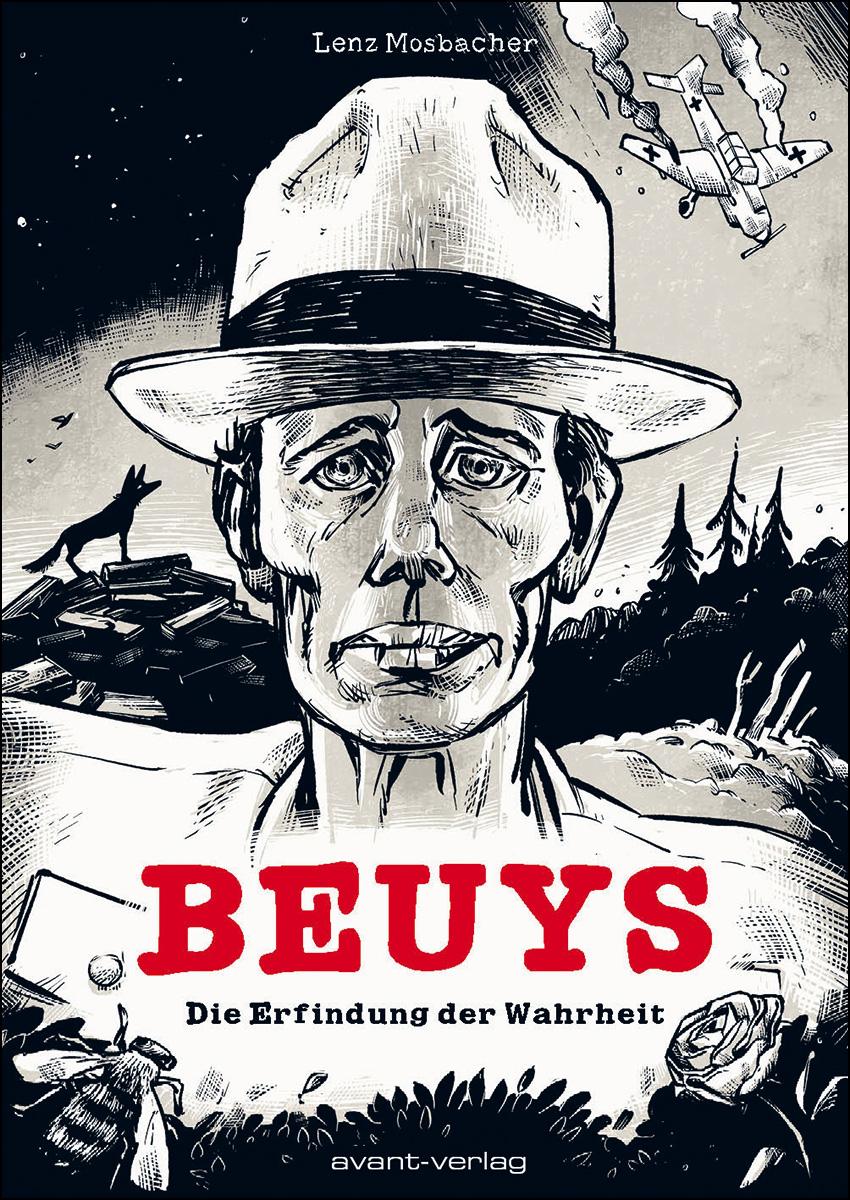
Lenz Mosbacher | Beuys - Die Erfindung der Wahrheit | Avant Verlag | 264 pages | 30 EUR
Opinions are divided on Joseph Beuys (1921-1986): for some he was an overrated and somewhat ostentatious politically engaged artist, for others a visionary innovator of a comprehensive concept of art. Regardless, his works still command high prices today, and there is no shortage of international exhibits and shows (for example in 2021/22 in Osaka). Dozens of books have been written about him, but none before in graphic novel form. Perhaps we should begin by listing what this new graphic novel is not: a chronological biography, an overview of Beuys' creative periods, a collection of scientifically proven data, a colourful and accessible read that conveys basic art knowledge. For that, we recommend instead the short volume by Willi Blöss and Bernd Jünger (Joseph Beuys - Der lächelnde Schamane, 2004).
Instead of organising and neatly illustrating the complex life of the artist for the reader, Lenz Mosbacher creates additional confusion by inventing fictitious encounters, adding to the myths already surrounding Beuys' life. He fills any gaps arbitrarily, wrapping the whole thing in a serious, existentialist and roughly stylised retro black and white. What kind of reader does Mosbacher, born in Vienna in 1993, have in mind? He says in an interview that he wants readers "who take their time. I think it would be nice if someone stopped in the middle of a book, closed it briefly and simply looked out of the window." This rather poetic, thoughtful and participatory approach is certainly the most rewarding way to read this work, which courageously and originally cuts a path through the jungle of material available in the media.
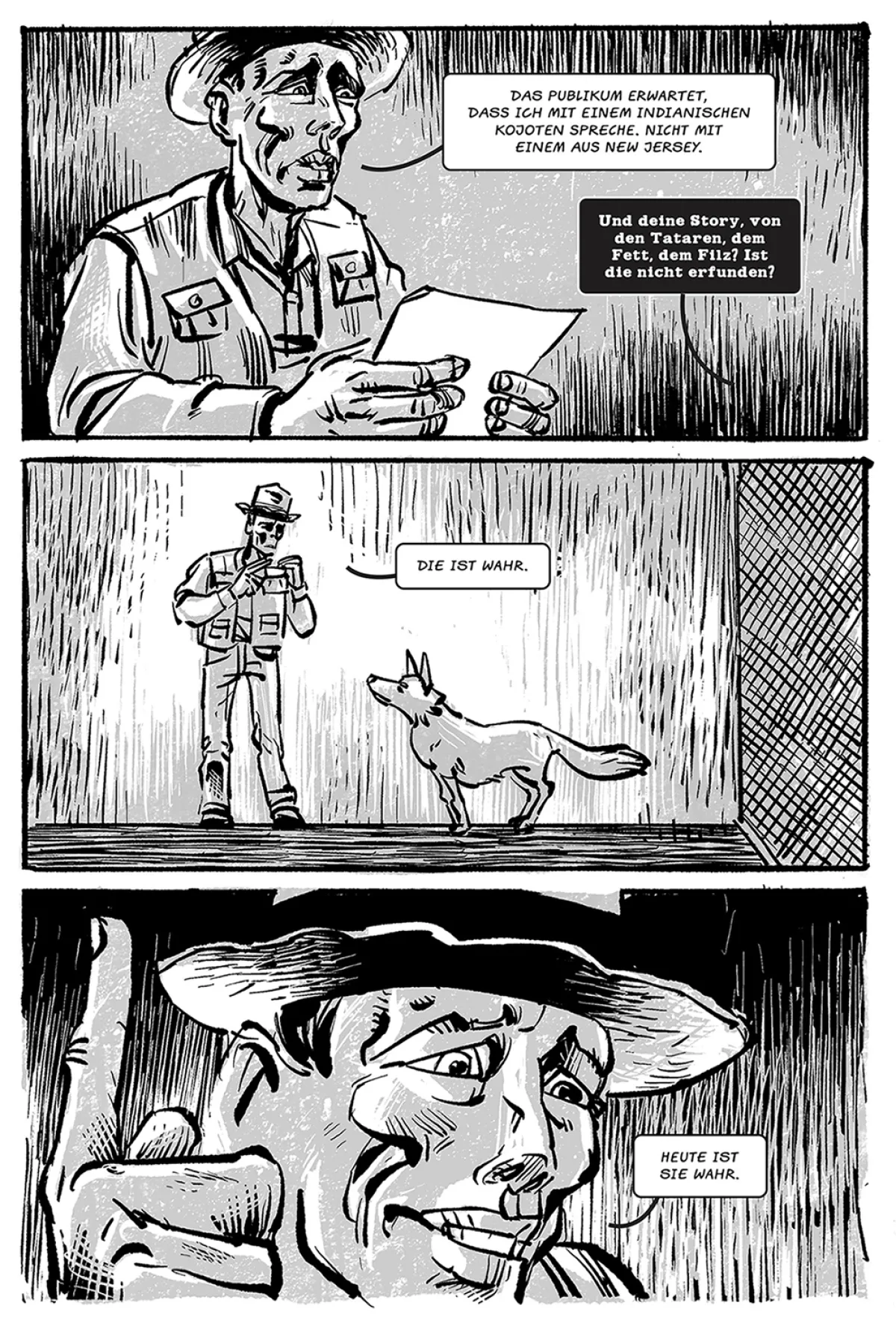
The introduction takes us right back to 1974, to the "I like America and America likes me" campaign, when Beuys spent three days with a coyote in the rooms of René Block's New York gallery. At first, we only see felt carpets, a room, newspapers, a coyote and a walking stick on individual panels. Then a hand rises into a flaming background and finally Beuys emerges from a mountain of felt, like a phoenix from the ashes. Dramatically, it is impressive and the panels, some of which are full-page, are designed with great artistic power and impact.
The book is divided into six chapters, each preceded by an introduction. The last chapter includes explanations by the author, a glossary, and work data on Beuys. The subtitle "The Invention of Truth" is clearly to be understood as a leitmotif in this graphic novel, as Mosbacher takes great liberties in illustrating his view of Beuys. His originality lies in his choosing of five female protagonists, each a different kind of counterpoint to the artist: the coyote with whom Beuys talks in the first chapter represents the shamanic aspect of his work, while for Beuys' early years, he creates an independent figure in the form of his first life partner, who is still unknown today. Mosbacher condenses the intellectual discourse, but also everyday chat, through a fictional pen friendship with Susan Sontag; the political Beuys, on his way to election campaign appearances in 1978, talks to his driver Ulrike Meinhof ( although this historical figure died in 1976) and the environmental activist Biene, who clashed with police in the Hambacher Forst in 2021, has a friend who admires Beuys (and dresses like him) and with whom he discusses the documenta 7 action "7000 Eichen - Stadtverwaldung statt Stadtverwaltung". In this way, the artist's work remains an inspiration for future generations.
What may initially seem arbitrary in the choice of protagonists proves on closer inspection to be a sustainable and sound idea; the graphic novel thus becomes a work of art in its own right instead of regurgitating familiar ideas and information. For example, Beuys' 1976 quote "The system is criminal, the state has become the enemy of man!" and his admiration for the anarchist Anacharsis Cloots (1755 -1794), who is also given his own short biography here, provide starting points for the idea of introducing Ulrike Meinhof as a potential interlocutor for Beuys.
In the aforementioned interview, Mosbacher says about working on this project, incidentally his graphic novel debut: "For me, progress also means getting entangled in Beuys, getting lost." In fact, there is no question of getting lost. Despite the number of original ideas and subjective "inventions of truth", which certainly take up space and narrative time in the book, the author has been able to incorporate a lot of Beuys' motifs, actions and thoughts. There are his references to Romanticism, expressed in a Novalis episode, or the forewords by Friedrich Schlegel and Novalis. But important Beuys symbols also have their place visually, be it the rose, the felt, the hare or the cross.
The reader approaches the life and work of Joseph Beuys through strongly narrated images, episodes and highlights and, with their curiosity piqued, can then set off on their own research and exploration of this complex activist, social and environmental politician and artist, whose thoughts and ideas - as this graphic novel makes clear, particularly in the fifth chapter on Hambach Forest - can still inspire, interest or perhaps even make us smile today.
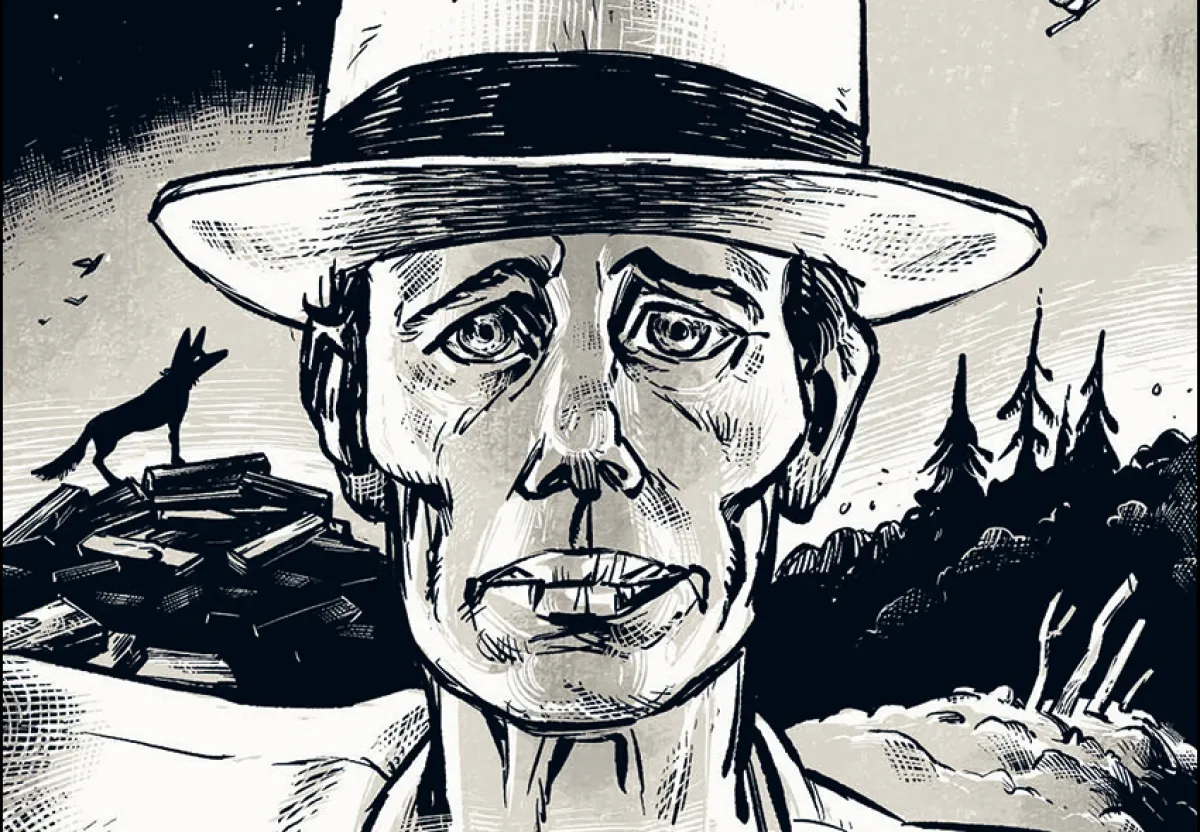
The graphic novel is characterised above all by the angular face of Joseph Beuys, whose expression is further emphasised by the drawing technique, reminiscent of woodcut or linocut, and the use of black and white. The full-page images in particular, for example the juxtaposition of Ulrike Meinhof with a machine gun and Beuys with a rabbit in his arms, invite readers to linger, look at and delve deeper into the book and encourage several deep readings.
In this way, the author's courage and years of in-depth study of the famous artist's work give us this fresh, intellectually original and artistically memorable approach to Joseph Beuys.
Did you enjoy this text? If so, please support our work by making a one-off donation via PayPal, or by taking out a monthly or annual subscription.
Want to make sure you never miss an article from Literatur.Review again? Sign up for our newsletter here.