


"We Carry Culture in Our Bodies"
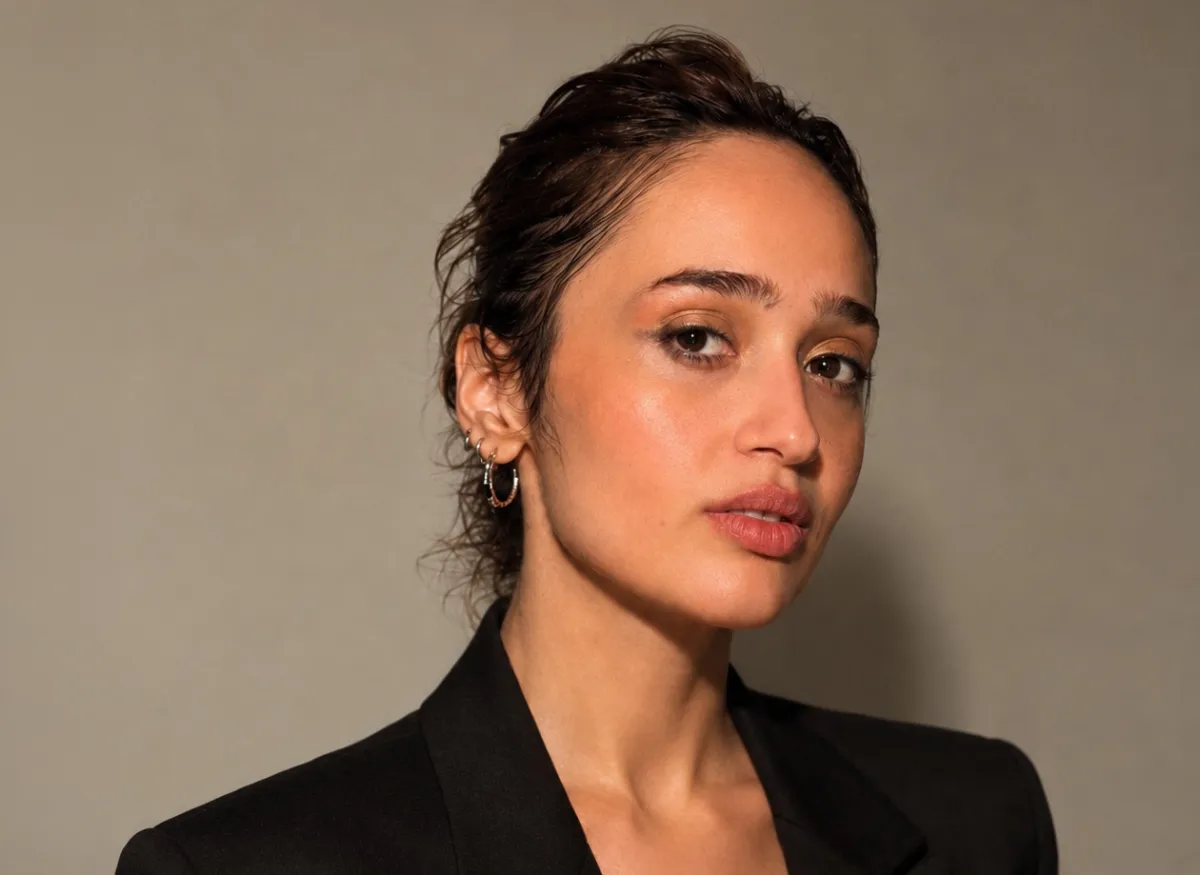
Saharnaz Omran is a Tehran-based writer, multidisciplinary artist, and researcher working across literature, performance, visual arts, film, and sound. Her work explores memory, displacement, language, political violence, and the ways in which history becomes inscribed in bodies and places. Her literary practice encompasses fiction, essays, playwriting, and experimental writing, while her artistic work ranges from theatre and performance to installation, moving image, and sound. Her writing has appeared in the Writing Climate Resilience Anthology, iExile Magazine, and independent Persian-language publications. Omran has also worked in production, set, and costume design for independent films, including Ramy, Between Us, Childless Land, and Bye Bye Garbage. In 2026, she received the Best Costume Design award at FICIMAD for Ramy. She lives and works in Tehran.
Mbizo Chirasha is the founder of the Writing Ukraine Prize and a UNESCO-RILA affiliate Artist. He has held fellowships and residencies in Germany, USA, Zambia, Ghana, Tanzania, and Sweden. He edits and curates several literary platforms, including Time of the Poet Republic and Brave Voices. Author of A Letter to the President, his works appear in over 200 journals worldwide, including The Evergreen Review, Poetry London, and FemAsia Magazine.
Mbizo Chirasha: Who is Saharnaz Omran, and how long have you been writing?
Saharnaz Omran: Who is Saharnaz Omran, really? Honestly, I have no idea. This is a question I keep asking myself while trying to survive the particular chaos of time, place, and whatever else went wrong along the way. Occasionally, I even step outside myself, take a good look, and wait for some kind of answer to arrive. Nothing. Apparently, I am expected to provide one anyway.
Saharnaz was born in a small town in northern Iran. When she was born, her father, a writer and researcher of Persian literature, was in exile in a distant city and could only see her two weeks later.
Although they had chosen my name before I was born, on the day my father went to get my birth certificate, he put the name Mina on it. Twenty-six years later, lying on a hospital bed, he finally told me why: he had taken Mina from Mina and the Leopard, a folktale from Mazandaran. It is a love story.
Mina had red hair, and the people of the village believed she was a witch. Perhaps she was. But she secretly helped the villagers. She was a lonely girl, rejected by the village, who went into the forest to sing. One day, a leopard fell in love with her voice, and that was how their love story began.
When my father finally revealed this secret twenty-six years later—the secret that had been a question for all of us—he had not seen me for six years. My hair was red.
I don’t know what happened that made me, Saharnaz Omran, a writer. I always wrote. As far back as I can remember, I was writing.
Before my adolescence, my father spent weeks teaching at a university in the southernmost part of Iran while I was growing up in the north. I spent that time in his small study with its high ceiling, reading, imitating his posture, and writing.
My adolescence was more rebellious than my time. I spent part of it in my room and part of it by the river near our house. My father never came back. And this was the first deep wound of my life, the one that made me write.
I wrote so much that I would not lose my point of connection to my father.
This is the story of my writing. I still don’t know whether I am a writer or simply a wanderer in the geography of words, who deliberately lost herself somewhere between the time and weight of sentences—and apparently forgot to ask for directions.
Tell us more about yourself, your talents, and your work.
I have never been very good at keeping my work inside one discipline. Apparently, my questions keep escaping, and I stopped trying to catch them.
I am a writer and multidisciplinary artist. I work with literature, theatre, performance, visual art, film, and sound. Most of my work comes from the things that stay unresolved for me—the questions I cannot answer, and the answers that create another question.
There is also a pain I carry that never really leaves me. It happens in me again and again, and every time it happens, it becomes the first sentence of an essay I have to write. I can be walking down the street and hear something that refuses to leave me alone. It changes the rhythm of my walking and exaggerates the smell of the street. Someone tells his daughter, “Be strong.” And this is where my brain starts being eaten alive. I go back to my desk as quickly as I can and start writing. My world keeps changing, and I have to write.
My friends end up in prison. A boy who is still a teenager is executed. And then, about two years ago, six of my friends died by suicide. Less than two years. Six people. In two nights, thousands of people die. These things don’t stay outside me. They enter my work. Sometimes they become an essay. Sometimes a performance, a sound piece, an image, or something I don’t yet know how to name.
I think of my practice as a lifelong project made of these things. I don’t usually start with a medium. I start with a question, an obsession, a memory, or something I cannot understand yet. Then the work chooses the medium by itself. Sometimes it becomes writing, sometimes an image, a performance, a film, a sound, or something somewhere in between.
So I work in different media not because I wanted to collect them all, but because some questions simply refuse to stay in one place.
What themes do you explore in your writing?
Genre and thematic territory are probably the hardest things for me to define.
Usually, I have a desire to become someone for a while. I might suddenly want to be a mathematician who is curious about geology, so I start reading papers, theses, and whatever I can find about it. Somewhere in the process, a persona appears, and inevitably a place starts forming around them. Then a story, an essay, or something else begins to happen.
I usually don’t know what genre it is supposed to be. The work decides that for me.
But there are things I keep circling around: absence, displacement, belonging, folklore, and the ways history enters the body without asking permission. Sometimes I write about a mountain, a river, a dead father, a woman, or a forgotten language, and somehow they all start talking about the same thing.
There are also certain rooms in my mind that seem to have rented themselves permanently. I have to keep going back to them. Memory is one of them. I am interested in what happens when memory stops behaving like memory—when the past enters the present, when identity becomes unstable, or when a person can no longer tell whether they are remembering something or inventing it. My characters often live somewhere between what happened, what could have happened, and what they wish had happened.
And then there is cognitive science, linguistics, history, mythology, mathematics, geology, philosophy, and whatever else manages to occupy my mind for a while. I don’t really know where one subject ends and another begins.
So I don’t think I have one thematic territory. I have these rooms, and I keep visiting them. Sometimes they become a story. Sometimes an essay. Sometimes I don’t know yet what they are.
Do you also write about gender and human rights?
Human beings have political shame. Historical shame. And because there are borders, we have national shame. How can I not write about these things?
How can I see death, executions, people trying to endure something they were never supposed to be able to endure, and simply move on?
These things enter me and settle there.
This is also why I write about gender. I have seen how violence becomes ordinary for women. How a woman is told to be strong, to be careful, to stay quiet, and how, after violence, the question can somehow become what she did wrong. I wrote about this in The Rules of Being a Girl.
I write about the dead, the disappeared, memory, and witnessing because I don’t know what else to do with what I know. In The Living Archive, I was already asking what it means to be a witness. Can I call myself a real witness when I cannot even say exactly how many people died? Does it change what happened if I cannot count them?
In Sovereignty Over the Dead, I was thinking about the body after death, and about a power that still wants to decide what happens to it. Who can take the body? Who can bury it? Who is allowed to mourn?
I don’t know how to separate these questions from writing. They are already there. They enter my work whether I invite them or not.
So how could I not write about human rights?
How does your country treat artists, writers, poets, and human rights activists?
The government?
Even though I know you may think I am stupid, exaggerated, or whatever you are going to think about me, I will give you my honest answer.
Here we live in a forced camp.
Yes, I used the word “camp.” The same word that others don’t use about Iran and instead look for statistics and numbers and documents.
Statistics and numbers and documents in this country are a parody of the structures governments use to provide documentation.
Here, neither we nor those intellectuals outside Iran have, even after all these years, been able to give a correct reading of what the Islamic Republic is.
How do we deal with it? I don’t know.
Some people surrender to the Islamic Republic and become its Mephisto-like soldiers. Some publish with permission and perform with permission and have their films screened in cinemas and believe that this is the only way to confront the Islamic Republic. Some are in prison. Some work independently and underground.
The possibility of working? I still have doubts about this possibility.
Is there really a possibility of working within the structure of the Islamic Republic, which is spider-like and has still not become a modern state and a modern nation?
And I assure you, this is not religious despotism.
This is a despotism that, with the usual readings, we simply pass over. We live in a postmodern despotism where all the questions and answers have lost their identities.
If luck is on our side, we are not in prison.
Everything is possible.
Maybe the best answer is in a conversation between me and my friend after seeing an underground performance:
“Girl, if they raid the house tomorrow, or even tonight, and arrest us, we don’t even know what our crime is anymore. I can’t even count my crimes…”
Which festivals have you attended, and what have those experiences been like?
I haven’t really been to literary festivals yet. Most of my festival experience has been through short films, working in production design, set design, costume design, and the art department.
I have worked on films such as Ramy, Between Us, Childless Land, and Bye Bye Garbage, which have been selected for different international festivals. Ramy also received several awards, including Best Costume Design for me at FICIMAD 2026.
So far, festivals have mostly been part of my experience through filmmaking. With literature, I am still entering that world through publications, anthologies, and literary magazines.
How has the recent war affected your writing and artistic career?
First, I am not from the Persian Gulf. I live in Tehran.
But we experienced the war in Tehran too. My home is very close to the Supreme Leader’s compound, and the day it was bombed, I will never forget that air and that sky.
That day was the freest and happiest day of my life.
But you know what happens after that? The death of innocent people comes after you. And suddenly you are left alone with history.
Writing about this from here is difficult for me. I could probably write a whole essay to answer this question, but right now the impact is too strange, too large, and too serious for me to easily write about it.
Everything has become complicated. Even the power to desire has disappeared. And in a moment like this, how does a person deal with their profession?
I wrote this question myself, and I still need a whole essay to answer it.
So let me not answer this question. I am apparently not qualified to interview myself about this yet.
Where have your stories and other writings been published?
My published work includes A Body That Became the Rain in the Writing Climate Resilience Anthology and The Sound Money Makes in iExile Magazine. I have also published work through IHRAM Publishes.
I also write in Persian. Some of my work has been published through independent and underground publications, sometimes even under another name. I also publish my Persian writing on social media.
Some of my other work has been accepted and is still awaiting publication, including The Metamorphosis of a Miniature for IHRAM Literary Magazine.
Have you received any literary or artistic awards or other recognition?
My artistic work has received recognition mainly through film. I received Best Costume Design at FICIMAD 2026 for Ramy. The film was also selected for and recognized by several international film festivals.
My literary work is more recent, so I haven’t received a literary award yet. For now, the recognition there has mainly come through publications, anthology selections, and literary platforms.
What are your favorite foods and drinks? And what role does food play in your cultural memory?
I don’t know if I have a favorite food. I remember food through places.
I remember sitting on construction sites, when I was working as a master craftsperson, eating omelette with bread and drinking tea. Sometimes the tea tasted like cement. I don’t mean this metaphorically. I was working with cement all day, so apparently even my tea had decided to participate.
Maybe this is what food is for me. Not a recipe, but a place.
I grew up with Persian food, and I still eat it in Tehran. But culture, for me, is not only what is on the table. It is also what happens around it: the dialect people speak, the way they sit together, the stories they tell, and the rituals they keep repeating even when they have forgotten why.
Years ago, during a secret journey with my brother to the snow-covered mountains of northern Iran, I went to see the Barf-Chal ceremony, an old local ritual connected to storing snow for the warmer months. Dozens of people were digging into the accumulated snow, and for a moment everything became completely silent. I remember watching human bodies working against this enormous weight of snow and mountain and suddenly feeling that time had stopped.
I think that was one of the moments when I understood culture less as something we inherit as an idea and more as something we physically do. We carry it in our bodies, our food, our dialects, our rituals, and sometimes in the strange things we continue doing together.
Tea is probably the closest thing I have to a constant. We drink it while working, talking, waiting, mourning, remembering, or simply sitting there. Sometimes I think we don’t drink tea because we want tea. We drink it because we need an excuse to remain somewhere a little longer.
And yes, I still eat Persian food in Tehran exactly as I always have. Apparently, whatever else in my life has become complicated, my appetite has remained surprisingly stable.
Did you enjoy this text? If so, please support our work by making a one-off donation via PayPal, or by taking out a monthly or annual subscription.
Want to make sure you never miss an article from Literatur.Review again? Sign up for our newsletter here.