



The Theatre of Resistance and South Africa's Unfinished Story
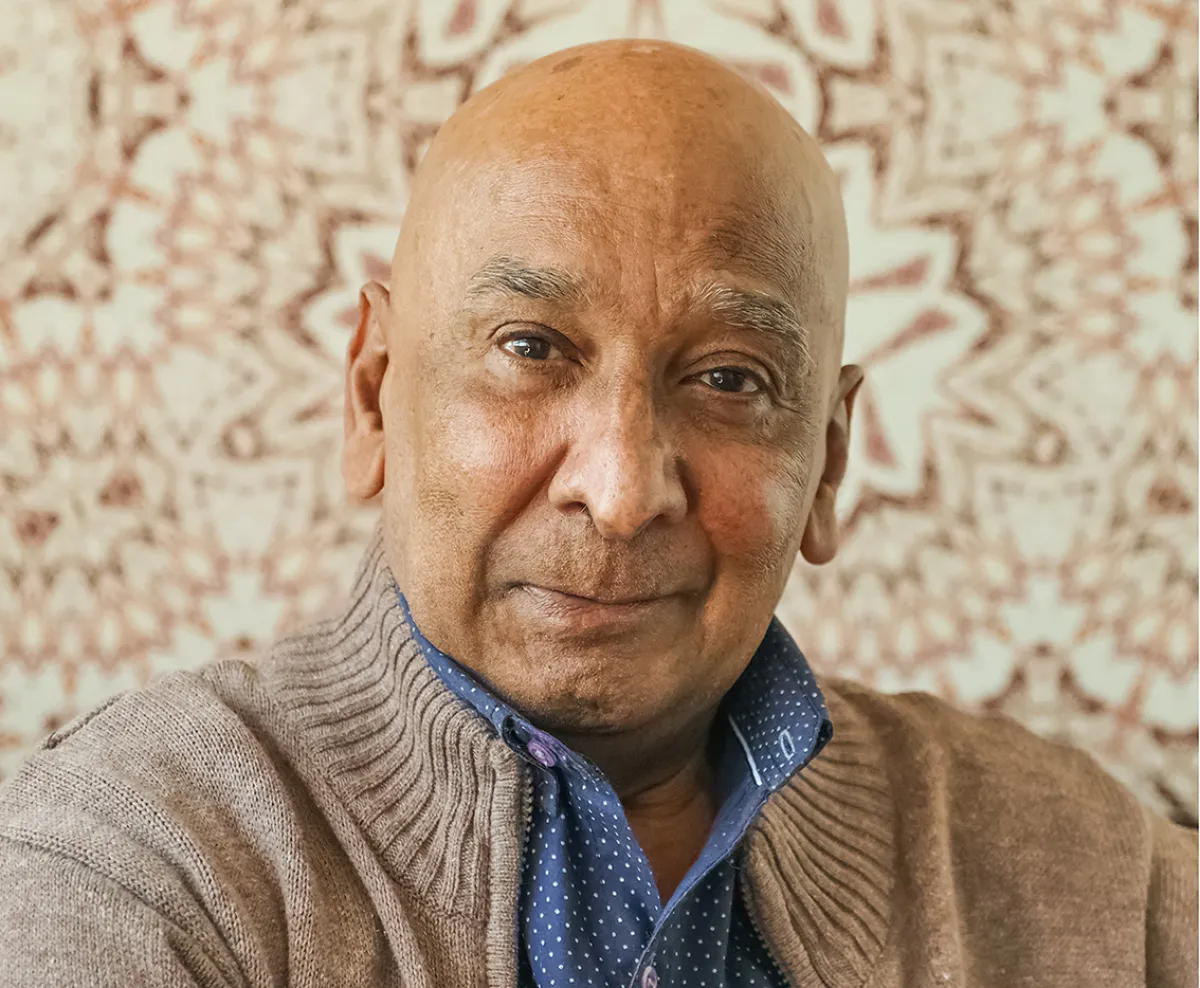
Shafā’ath-Ahmād Khān (77) is a South African playwright, actor, and poet whose works confronted the injustices of apartheid. His plays When You Mix White with Black and Abdool and Jane were banned in the 1970s for allegedly “undermining the reputation of the police and inciting revolution.” In the 1980s, his evocative lamp- and candle-lit solo performances — Labour of Love and Spirit of Man Speaking — presented in chains and black rags as symbols of oppression, earned him the reputation of “a modern-day messiah for the dispossessed.” Fearing reprisals during the 1986 State of Emergency, he withdrew his political play Betrayed Beyond the Rubicon and later worked as a media journalist and performer across radio, television, and film. His “searing” and “disturbing” poems, praised as “masterpieces of controlled verse,” appeared in Return of the Amasi Bird and Contrast (South Africa) as well as The Poet and Prophetic Voices (USA). After a long self-imposed hiatus, Khān continues to contemplate a creative return.
Mbizo Chirasha: Who is Shafā’ath-Ahmad Khān and how long have you been writing?
Mbizo Chirasha is the founder of the Writing Ukraine Prize and a UNESCO-RILA affiliate Artist. He has held fellowships and residencies in Germany, USA, Zambia, Ghana, Tanzania, and Sweden. He edits and curates several literary platforms, including Time of the Poet Republic and Brave Voices. Author of A Letter to the President, his works appear in over 200 journals worldwide, including The Evergreen Review, Poetry London, and FemAsia Magazine.
Shafā’ath-Ahmad Khān: I am an ordinary human being observing everything happening around me and the world generally. The (now out-of-print) all-embracing avant-garde black magazine, Pace, defined me in the Eighties as “a man of many words; of all ideologies”, adding: “Above all he is a man of all races. In short, he does not conform to the pre-set ideas of a racially divided South Africa.” And, in the Nineties, Weekend Star (now Saturday Star) observing that I was “a human rights activist and actor on the side of the angels”. I have been writing poetry since my boyhood days at high school, but only on issues of interest to youngsters, naturally. Later, as a teenager, hurting seeing and experiencing injustice under South Africa’s apartheid system, propelled me to write protest poetry. I’ve gone on since then into my sixties, subsequently suddenly stopping for some time, and now, in my late seventies, I’m trying to bounce back into the literary world.
How many books or stories have you published so far and how are they received in your country?
I have not written any books. One story, Labour of Love, about an activist impregnating his lover and seeking an abortion for her, however, was written and published in the (now out-of-print) South African literary journal, Writers’ Ring, in the late-Seventies. It was included in my well-received theatrical recital of the same title in the Eighties. Another, The Resigned Son of Allah, stressing the arrest and detention of a young student by apartheid-era police from the Special Branch, formed part of my much-acclaimed recital, Spirit of Man Speaking, by lamp- and candlelight of some of my published and unpublished prose, poems, stories and a play and excerpt from another, also in the Eighties. And, perhaps, I could mention that two playlets, It Was All a Misunderstanding, a cynical observation of racial subtlety and pretentious (mis)representation, and What’s the Diff, Let the Man Hum, depicting an inept political pawn on the chessboard of a duo of taxi drivers, was published respectively in the late-Seventies and early-Nineties in (now out-of-print) Staffrider, a platform for community-based writers challenging racial oppression, and (now out-of-print) Taxi Mate, a commuters’ travelling companion. And also, in the early-Eighties, I might add, a small collection of a variety of my poems, under the title of In Fury, was self-published as a pamphlet inserted in The Rising Sun, a community-based rag.
What are your literary thematic areas?
South African politics, human rights in general and, from time to time, aesthetics and nature and aphorisms.
Would you describe yourself as a multi-genre author?
I’d like to think I am. I’ve attempted writing essays and have some ideas for short stories. Of course, I wrote two plays in the Seventies, When You Mix White with Black, about love across the colour line, the first work by a South African – black and white – to be banned under the Publications Act, 1974, and Abdool and Jane, revolving round a platonic association, also across the colour line, that the apartheid South African censors cruelly banned. And, in the Eighties, I penned Betrayed Beyond the Rubicon, about two guerrillas planting bombs in a city shopping complex and escaping to a neighbouring state where they get arrested after being framed by a South African police spy. I withdrew the play after several performances, fearing reprisals during South Africa’s second State of Emergency in 1986.
How is the book industry in your country?
Pretty sound, I’m inclined to think, inspite of the obstacles we’ve had to face in just over thirty years of hard-earned democracy. Every now and again, black interest publishers and others usher in new books in the sphere of the South African environment by new authors.
Do you write anything on racial equity, social justice, gender rights and other human rights?
All the time, even now after a prolonged voluntary hiatus, on just about all of them.
How are writers and artists appreciated or treated in your country?
I sincerely believe equity and equitability and respect for all are prevailing.
Do you have spaces that promote creativity, literary arts, books and writing in your country?
A good few, I’ve been made to understand. I’d, however, very much like to see continuing outreach to school-going children (of all races) in the sphere of the culture of the real people of the land.
Have you ever attended literature festivals, fellowship programmes and bookfairs, how has been your experience?
Not many, like innumerable others, I have to admit, due to financial and other constraints – not surprisingly to the acquainted knowledgeable of social conditions in South Africa. Yes, however, it would not be idle for me to recall I was invited in 1978 (and so humbling that was) to recite my poetry at the first Capital Living Arts Festival together with South African luminary Douglas Livingstone, protest poet Mafika Pascal Gwala and English literature academic Peter Strauss at the then University of Natal Pietermaritzburg campus and the Pietermaritzburg branch of the South African Institute of Race Relations organising that event. Four years later, at the invitation of the Central Islamic Trust in Johannesburg, I presented The Leveller, a play around the solution for racial antagonism I’d conceived and developed with a cast representative of all the races in South Africa, and Love All Creatures, a children’s play about what the title obviously suggests, at South Africa’s first Festival (of all faiths) of Body, Mind and Spirit (also held in other parts of the world) where I additionally recited (the third time in my theatrical career) world renown Pakistani philosopher-poet Professor Sir Dr. Muhammed Iqbal’s illuminating epic, Complaint and Answer (of a Muslim and of God respectively). Both these events impacted greatly on me in different ways. Some of the university’s students joined a commemorative march later in 1978 that a student-poet-artist (who was to become a lawyer and Cabinet Minister several times in our current democratic government) and I, manacled, co-led, mourning and honouring the victims of the Soweto 1976 students’ uprising against the teaching and use of the oppressors’ Afrikaans language in black schools. Many (white) university students particularly attending my presentations at the Festival of Body, Mind and Spirit had asked pertinent questions, and hopefully absorbed the negative effects racism had on South Africans as a whole and pondered over wholesome solutions beneficial to all the races of South Africa.
How many awards / accolades have you received since you began literary arts activism and writing?
Awards – none at all, except the ones from the apartheid censors that I really didn’t deserve! Accolades – aplenty, especially for my Labour of Love and Spirit of Man Speaking recitals, and comments about me, the poet, playwright and actor on whom Shaan, an out-of-print lifestyle and entertainment and cultural magazine of interest to those of Indian origin, noted, “you won’t say so much has been heaped”, and, among a host of others, Sowetan Sunday Mirror and Sunday Times nationals respectively “man of many targets” who “has done every aspect of theatre and entertainment” and “unusual … a river in flood … many-talented”.
Could you tell us about your hiatus, exile moments? How do you earn money and you’re living since you’re going into hiatus and up until today?
Up until my self-imposed literary exile in the early-1990s, I was a frequent contributor to several dailies and weeklies as a freelance and an occasionally commissioned reviewer of the arts in general, theatre and film. I was also, for a while, attached to a news agency syndicating to media go-betweens in Africa and other parts of the world during that time. Up until 2006, however, I resumed my career in radio-, television- and film-acting. Not long after that, as is universally customary, I embarked on accepting a state gratuity, rewarding retirees of senior citizen status, which is still in progress. Unforeseeably shortlisted for the 2025 African Narratives Against Poverty in Africa Poetry Prize, thanks to the African Narratives Writing Program adjudicators’ regard of my submission, has been both greatly humbling and a timely added string to my hitherto inactive literary bow, spurring me to a greater extent, on the heels of years and years of voluntary writing exile, to submit work for publication consideration. Grant me this opportunity to express my plaudits to the victors and those poets mentioned for exceptional merit. Every participant has been an epitome of Ma-Afrika. The best to all of them, comrades in the art of devoted poetry.
What is your take about today's hard-earned democracy and the current South African situation?
It was long-time coming. You didn’t have to be a rocket scientist to arrive at that judgement. I must hasten to admit the reality that South Africa is today, without an iota of doubt, a far cry from the apartheid rule of yesterday, although not completely flawless. After just over thirty years of democratic rule, however, the previously disadvantaged populace, in my humble opinion, still do not have the self-determination they should have been accorded that the previously advantaged general public still enjoy now as before they, no doubt, did during the draconian rule of segregation. My own guess (and I hope I’m terribly wrong) is that they are bearing provocation patiently. That’s a lesson to be gleaned from history worldwide. Once again, I daresay, one needn’t be a prophet! Much sincere, relevant effort has to be put in several crucial spheres to ensure we emerge powerful and get the support of long-suffering citizens who, in the first place, previously overwhelmingly voted for the administration, now dwindled, but, at times, precariously heading a broadly not much-endorsed Government of National Unity. I am articulating my drawn-out opinions as a true patriot who’ll never betray his country or her people. I am a son of Azania, one of the children of God-given Ma-Afrika – after all.
Do you think the current situation is of great success and more or less depressing?
Only partially so, if I have to be very direct. The better part of South Africa’s population, most certainly the prior downtrodden, of course, has been quite content to be able to move about and make so many choices freely at long last with the apartheid monolith crumbling as it did, but service delivery, as is its inalienable right to be accorded, in the reserves most of them still occupy is continually appalling. Deplorable amenities and the such additionally in the townships have to be demoralizing and disheartening – to say the least. Much-needed attention, too, has regrettably not been paid to rural South Africa’s population, again the earlier very oppressed, for its want of way into democratic urban benefits. Primary health care, early childhood development and primary and secondary school education, among several others, are undeniably not the most noteworthy they could be due to the lack of wherewithal – to observe the least. And unemployment is unnerving, as is food security, amongst the poorest of the poor. Nobody confirming what I am verbalizing should deem I’m selling out my country – no, I dote profusely on my beautiful motherland! … Lest we forget, I have to once again hurry, in all fairness to the ongoing (fair game) government in power, to emphasize pointedly that apartheid’s been a persistent ripple mark of inherent damage and destruction still pre-eminently demanding the redoubtable responsibility of significant reparation, albeit three decades (and a bit) later. South African creatives, though, must resolutely resume their creditable stand for the fitting freedom of the neglected in this picturesque space. It is our moral obligation! Tell it, à la the assertion of a renowned source in the media writing faction, as it is! For the mend! For all of us, no matter who or what we are, to cudgel our brains!
Are you respected, honoured or appreciated for your fight against apartheid, do you think the apartheid is still a Southern Africa story or it's a story of yesterday?
I don’t really know – apart from just about vaguely recalling an academic or two here and abroad alluding, in investigative studies, to my blunt media inferences in the late-1970s and -1980s about the absurdity of racialism and the haunting ghost of Black-consciousness, a crusade against the evil of apartheid initiated by the charismatic Steve Biko who was brutally butchered to death in police detention. And, of course, right at this moment – African Narratives Writing Program / African Writers Interview Series – having become aware of late, recognising and prizing by means of this question, and picking up the pieces of my fiery opposition to the apartheid monster. Thank you! … But, then, I didn’t vehemently oppose that outrageously inhuman structure for fame or, for that matter, to be esteemed, lauded or revered. I’ve always unashamedly been a human rights advocate and cultural activist – never for personal avail. Apartheid might have been the atrocious past but, sadly, subtle relics of the abomination are still socially and politically prevalent on a private level. Thankfully, blatant, obvious discrimination is now absolutely against the law!
Did you enjoy this text? If so, please support our work by making a one-off donation via PayPal, or by taking out a monthly or annual subscription.
Want to make sure you never miss an article from Literatur.Review again? Sign up for our newsletter here.