



What does a plate of food tell us?
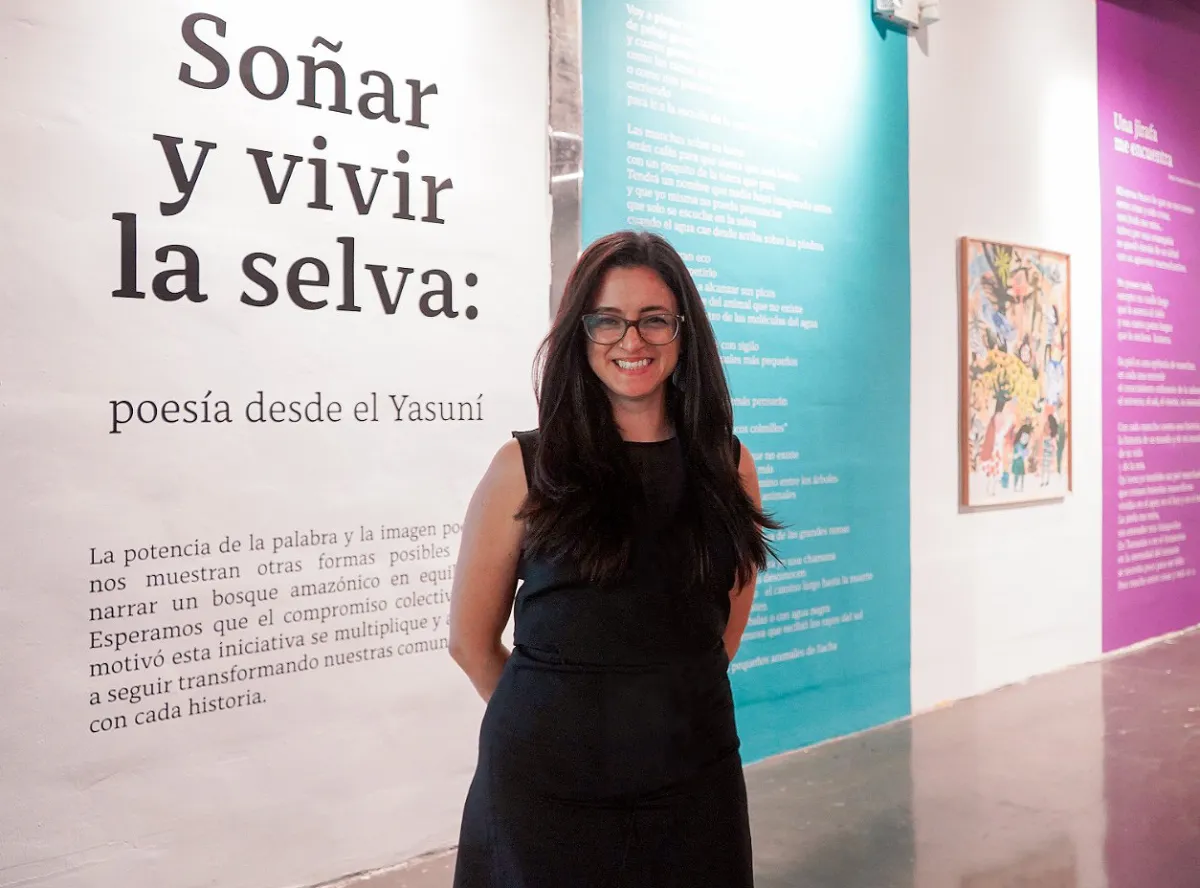
Dr. María Alejandra Zambrano is a scholar, writer, and artivist based in Ecuador. Her work focuses on children's literature, decolonial pedagogy, reading mediation, and community-based arts methodologies. She is founder of La Poderosa Media Project and author of the award-winning picturebook Aquiles y la tormenta (2024).
Introduction
What does a plate of food tell us? What memories are awakened by the daily gestures of shelling, grating, kneading, cutting, whisking, seasoning, or serving?
Gastronarrativas del litoral (Gastronarratives of the Coast) is the result of a research-creation project conducted between 2022 and 2025 in the city of Guayaquil, a project that conceives of the kitchen as a living archive of flavors and ancestral knowledges of the Afro-Ecuadorian community, and as a space for dreamagining better possible futures.
Before I go further, I want to explain how this work came into being. Although I am the one writing this essay, Gastronarrativas was co-designed alongside children, youth, and adults from neighborhoods in Guayaquil, together with artists, university students, and researchers. I will use “we” throughout this essay to honor the communal authorship. The project was funded through competitive grants from the Embassy of the United States in Ecuador, the Institute for the Promotion of Creativity and Innovation of Ecuador (IFCI), and La Poderosa Media Project, and was registered as a research project at a local public university. It was also nurtured by a two-week research stay at the Internationale Jugendbibliothek in Munich in 2023.
The project understands the cultural and gastronomic heritage of the Ecuadorian coast as a set of narratives that reveal the semiotic interaction between the culinary and literary worlds. Drawing on the work of Rocío del Águila and Vanesa Miseres, we adopt their definition of gastronarratives “as a term both to describe our object of study (the connections between food and literature) and to refer to our methodology, which consists of analyzing literary texts as aesthetic and political formulations of a culinary and linguistic sign that is, at the same time, a channel for the expression of a specific period, society, or movement”. Yet we push this framework further: at the center of our project is the creation of a recipe book-object, the production of ethnographic documentaries, and a reading-mediation program rooted in these culinary practices. Through this community-driven initiative, the cultural, political, and aesthetic dimensions that emerge from cooking/eating and reading/writing/editing together become visible. Food becomes, in this sense, a gastrolinguistic language, a way of creating memory, exercising agency, narrating identities, and imagining other futures.
In this essay, we use the concept of the gastronarrative to understand the kitchen as a living archive of resistance —what enters and leaves our mouths, whether words, songs, or flavors, reflects who we are, what we carry in silence, and what we choose to preserve. Because food is never just food: the act of eating/cooking is a system of communication through which we read power structures, racism, coloniality, and the paradoxes of modernity.
The Urgency of Memory in the Ecuadorian Litoral
In Ecuador, where diverse ecosystems intertwine with the sediments of a colonial past, the preservation of food heritage is a radical act. More than a way of relating to the land and to one’s ancestors, it is the rejection of what Arturo Escobar calls a one-world world narrative that has historically rendered certain lives invisible.
To understand what is at stake in this project, we need to look at the margins —and specifically, at the kitchens. In the suburban neighborhoods of Guayaquil, such as Cisne 2, Las Malvinas, and Isla Trinitaria, life unfolds under what the Catalan philosopher Marina Garcés calls a “posthumous condition”: the imposition of a narrative of irreversible destruction, in which structural violence and systemic racism attempt to foreclose any possibility of a future. In December 2024, this condition reached a devastating threshold when four Afro-Ecuadorian boys from Las Malvinas —Steven, Ismael, Josué, and Nehemías— were disappeared, tortured, and killed by the military. Their deaths make clear the degree to which racialized and impoverished populations, especially children, are considered disposable.
And yet communities persist. They cook, they feed one another, they remember. The violence and the economic crisis are part of it. But so is the rapid urbanization and the seduction of industrialized products, which have led younger generations to feel ashamed of the foods their families cultivated —an onto-epistemic rupture. When ancestral knowledge is devalued, identity fractures with it. The COVID-19 pandemic accelerated this loss by physically taking away the bearers of that knowledge: the grandmothers, the elders.
*a life worth living, a life of dignity
It is within this fracture that Gastronarrativas del litoral intervenes —not as an extracurricular program for children and young adults, not as a heritage preservation exercise for mostly female cooks, but as a political imperative. Because when a community gathers to cook/eat, to sing/dance, and to write/read together, it is actively constructing a livable present, a vida vivible*, a vida digna* —and insisting, against all odds, on a future.
The Carrier Bag of the Republic
The history of the Latin American republics has largely been told as stories of spears.
Military campaigns, constitutions written by oligarchies, the imposition of the liberal state over “barbarism”. Even the rhetoric of the Atlantic revolutions —the revolutions that gave us the very vocabulary of sovereignty and the common good— relied on this form: a linear, forward-thrusting narrative with a hero at its center. A story that moves from conquest to constitution, from darkness to enlightenment, from the colony to the republic. A story, as Ursula K. Le Guin would say, that ends with a spear hitting its mark and something falling dead.
In her 1986 essay The Carrier Bag Theory of Fiction, Le Guin offers a different account of what it means to be human. She begins not with the weapon, but with the container. Before the spear, she argues, there was the bag, the leaf, the gourd, the net, the sack, the pot, the container, the holder, the recipient. The vessel that allows you to gather, carry, and bring home what sustains life. Le Guin’s insight is simple: if you have nowhere to put the oats, the oats escape you. And what is true of oats is true of memory and identity.
Le Guin calls the dominant narrative the “killer story” —the techno-heroic account of civilization as conquest. She proposes, in its place, the carrier bag as both a tool and a narrative form: non-linear, unheroic, holding disparate and plural things in a powerful relation to one another. Instead of a one-way trajectory, she believes in a relational and interdependent gathering.
Son, sazón y arrullos: cocina afroecuatoriana —the recipe-object-book that emerged from Gastronarrativas del litoral— is precisely this: a carrier bag for a republic that the spear forgot to include.
The traditional archive of the liberal state operates on the logic of the document. The law, the census, the treaty —materials that privilege literacy, uniformity, and the bureaucratic apparatus. These technologies of memory, as Benedict Anderson observed, were essential to imagining the nation, but they achieved this by homogenizing difference, enforcing a singular official memory, and rendering invisible the epistemologies of those the republic had already decided were disposable.
The kitchen operates on a different logic.
In the communities of Guayas province —among women like Dominga Porozo Mina, Gloria Estupiñán Mina, and Leidis Mina Valencia— knowledge is transmitted. It lives in the body’s memory of repetition: the angle of the wrist when grating, the sound the oil makes when it’s ready, the smell that tells you when to add the seasoning and herbs. This is what we mean by the archivo vivo (the living archive). It cannot be extracted from the body that holds it. It cannot be photographed, inventoried, or filed. It must be practiced to be preserved, consumed to survive.
This is why, when this knowledge is broken —when the grandmothers are taken by a pandemic, when the young are seduced by industrialized convenience, when racialized violence removes the bearers of memory before their time— the rupture is ontological. What is lost is not a recipe. What is lost is a way of being in the world.
This is also where Arturo Escobar’s concept of disoñación —dreamagination— becomes essential. Escobar argues that to reconstitute the fabric of life, communities must not only remember but redesign: imagining and building habitable futures from the materials of their own existence. Disoñación is, therefore, a forward-facing act of collective world-making, grounded in what the territory already holds.
Son, sazón y arrullos: cocina afroecuatoriana was designed to do exactly this. It is an artisanal, chromatic, fold-out object-book, hand-woven and wrapped in fabric. And this materiality is not incidental.
The fabric wrapping transforms the book from a printed container of information into something closer to what Le Guin calls a “medicine bundle”: an object that signals, through its very texture, that what it holds is vulnerable, sacred, and requires care. You do not consume it quickly. You unwrap it slowly, the way you would uncover a pot, or prepare a table for people you love. The hand-woven binding reinstates the body into the technology of the book —the threading of pages echoes the threading of ingredients, the folding of dough, the patience of a stew. The printing press, engine of the liberal republic, runs on mechanical reproduction and the erasure of physical labor. This book insists on the opposite.
And what does it hold? The recipes of Afro-Ecuadorian women of the coast. Stenographic photographs of the neighborhood taken by children. Literary reflections on food written by university students. Illustrations by a local artist. Fragments of life, gathered. Not a monument. A carrier bag: “a book holds words. Words hold things. They bear meanings. A novel is a medicine bundle, holding things in a particular, powerful relation to one another and to us” (Le Guin).
Le Guin writes that when you put the hero in a bag, he looks like a rabbit, like a potato. The carrier bag has no interest in heroes. It holds something more useful: the tiny grains of things that constitute survival and communal cohesion.
By placing this book on the shelves of the community library alongside the hegemonic literary canon, children and youth in Guayaquil do something quietly radical: they expand the republic. They insist that the living archive of the kitchen —with all its flavors, its care, its memory, and its grief— belongs in the same space as the documents of the state. That their grandmothers’ knowledge is not folklore. It is epistemology. That what enters and leaves their mouths —flavors, words, songs, stories— constitutes a language through which they can narrate their own existence, exercise their own agency, and imagine, together, other possible futures.
This is the carrier bag of the republic. Not the spear of conquest, not the archive of erasure —but a woven, handmade, fabric-wrapped vessel that holds what the nation forgot it needed: the lives, the tastes, and the voices of those it tried to silence.
Conclusion: Reimagining the Revolutionary Turn
Gastronarrativas del litoral is a celebration of the multiplicity of saberes y sabores —knowledges and flavors— that shape the foodscapes of coastal Ecuador. This project rejects one-world world narratives and embraces dreamagination as a way of reconstituting the fabric of life —not from a place of expertise, but from an expansive curiosity that sifts through and savors the complexities of heritage and survival encrypted in every shared plate. Each element —whether a grandmother’s recipe, an ethnographic film workshop for children, or a visit to the market in search of ingredients— is part of a turn toward a world that calls us to pause, listen, and respond.
As Roberto Mangabeira Unger suggests, the revolutions of previous centuries are not over, but they require new life and new meaning. If we are to breathe this new life into the revolutionary turn, we must expand our understanding of where revolutionary action occurs. In our project, it is not confined to formal classrooms or traditional museums. It happens in the daily, unheroic, yet vital labor of care-full preservation and resistance that takes place in the family and communal kitchens of Guayaquil.
Son, sazón y arrullos: cocina afroecuatoriana and the project that produced it offer a blueprint for this reimagined republic: one built on embodied practices and alternative technologies of representation. The Afro-Ecuadorian gastronomic heritage documented here is not a relic. It is a living argument —that the foundation of a just society includes the shared commitment to feeding and sustaining one another.
*Cooking fire
In a globalized world where the public sphere is increasingly fragmented by technology and besieged by counter-revolutionary forces, the simple act of wrapping a book in fabric, or gathering around pots on a wooden stove or fogón*, serves as a profound defense of human solidarity.
Staying with the trouble, as Donna Haraway would say —this project reminds us that narrating is a form of care. That eating is never merely consuming. It is always, already, an opening toward other ethical encounters, and toward the world we are still, together, trying to make.
+++
Works Cited
Del Águila, Rocío, and Vanesa Miseres
Toward the Construction of a Latin American Gastronarrative
Food Studies in Latin American Literature: Perspectives on the Gastronarrative
University of Arkansas Press, 2021, pp. 3-18
Escobar, Arturo, et al.
Relationality: An Emergent Politics of Life Beyond the Human
Edited by Clive Dilnot, et al.
Bloomsbury Academic, 2024
Garcés, Marina
Nueva ilustración radical
Editorial Anagrama, 2017
Le Guin, Ursula K.
The Carrier Bag Theory of Fiction
1986
Pilar, Egüez, and Alejandra Zambrano
Jóvenes guardianes de saberes:
tendiendo puentes intergeneracionales a través de la etnografía y el cine
Revista PCI, vol. 1, no. 15, 2024, pp. 5-11
Revista Patrimonio Cultural Inmaterial
Unger, Roberto Mangabeira
The World and Us
London/New York, Verso Books, 2024
Zambrano, María Alejandra, editor
Son, sazón y arrullos cocina afroecuatoriana
Guayaquil, UArtes Ediciones, 2024
Did you enjoy this text? If so, please support our work by making a one-off donation via PayPal, or by taking out a monthly or annual subscription.
Want to make sure you never miss an article from Literatur.Review again? Sign up for our newsletter here.