


She didn't like jasmine or sunflowers
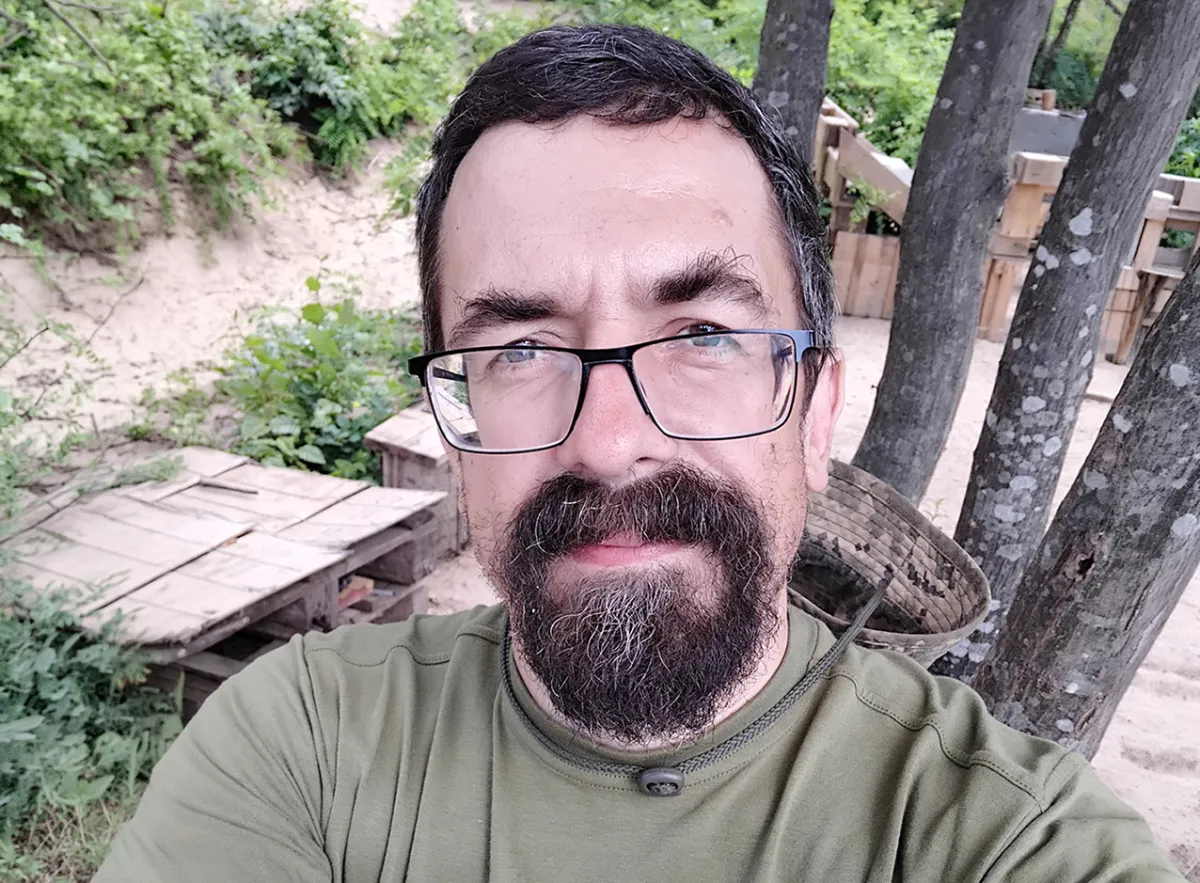
Danylo Kravchenko (born 1982) is a Ukrainian writer, playwright, essayist and soldier. His short stories are published in Ukrainian magazines and periodicals.
The scorched sunflowers beneath the window were what spoiled her mood the most. No, of course that wasn’t quite true, because the children spoiled her mood even more. Their shouting every morning. Oh! How they yelled on that sports field during PE lessons! The refuse lorry groaned like a wounded prehistoric beast, the children screamed, and the teachers shouted even louder. Every morning she tried to hide from the racket under her favourite camel-hair blanket – the one with red and white flowers – but it was no use. That’s why she hated them – the children. Because they ruined her mood. And only then did the scorched sunflowers make it onto the list. A reminder of life’s imperfection and injustice.
She didn’t understand this new world, nor did she want to: she didn’t even try to. She found it shocking, outrageous; it felt like a mockery of her whole life. Children with mobile phones, women in police uniforms, teenagers with money they seemed to have acquired from unfathomable sources, the language, everything – everything, everything. It was a mockery, and she felt like a victim. Yes, a victim! And that was unacceptable. She should have had a normal life, not all this riff-raff.
Perhaps the worst thing was that her contemporaries offered her so little support. The men were too weak, for various reasons, and died sooner than the women. The survivors tried to speak the new language, and their wives were no better than them. How she regretted not having been in Kyiv in February and March 2022. In her mind, she organised, betrayed, accused and even passed judgement. She would have brought them all in line; no one would have been able to get away with it.
She lived in a world that had long since ceased to exist, yet it was the only one she loved. It was a special kind of love, for she loved to hate, and all her other feelings could hardly be compared to anything resembling love.
You might wonder how I know so much about her. It's a fair question. One night, after the curfew had already begun and even after the air-raid siren had sounded, I looked out of the window to see if the light in the neighbouring house had been switched off, and suddenly I saw her. She crept over to our jasmine bushes – recently pruned, I should add – and began snapping off the young, vigorous shoots. Right then, it dawned on me who'd been doing this (it wasn’t the first time) and what was going through her mind. Somehow it seemed to me as though she were crying, although that was probably just wishful thinking on my part. What I knew for certain was that she was snapping off the jasmine twigs out of helplessness, because the world remained indifferent to her hatred – her hatred of herself, of all of us. She could have snapped off all the twigs if she’d had the strength, but she couldn’t change the fact that she was dying whilst so much around her was just coming to life.
+++
English adaption based on the German translation from the Ukrainian by Viktoriia Dziubenko.
+++
Author’s note: The protagonist is a collaborator who rejects Ukraine and the Ukrainian language. The repeated references to a ‘language’ or a ‘new language’ refer to Ukrainian and its growing presence in public life. The protagonist’s notion that she had ‘brought everyone to heel’ in 2022 also has a specific political background: During the Russian attack and the advance on Kyiv, it became clear that there were people within Ukraine who were prepared to collaborate with the Russian occupiers, for example by informing on others or passing on information. The narrative alludes to this form of collaboration and the threat it poses.
Did you enjoy this article? If so, please support our work a one-off donation or a monthly subscription via one of our subscription options. We’d be delighted!
Don’t want to miss any more articles on Literatur.Review? Then sign up for our newsletter free of charge!