



Hiroshima in three spellings
 Penguin
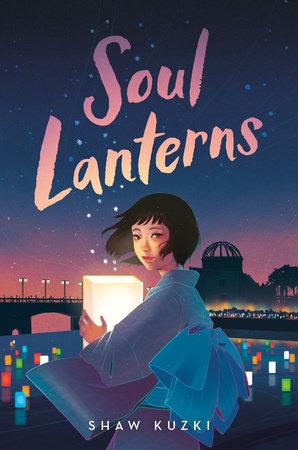
Shaw Kuzki | Soul Lanterns | Penguin | 176 pages | 8,99 USD
‘The girl in the photograph
next to the boy who died in the war
will one day be a mother.’ – Shaw Kuzki
With these three lines – a tanka, concise, concentrated, almost piercingly delicate – a resonance chamber opens up in the middle of Shaw Kuzki's Soul Lanterns, crystallising the tone of the entire narrative. The tanka, a Japanese short poem form over 1300 years old consisting of 31 syllables (or moras), captures a moment: precise, musical, unembellished. This is exactly how Shaw Kuzki works. She reveals moments that would otherwise disappear behind traditional rituals and gestures – and makes them resonate.
Kuzki's book, published in German by Baobab Books in 2025 – 80 years after the atomic bomb was dropped – and sensitively translated by Sabine Mangold (the English edition was published in 2021, the award-winning Japanese original in 2013), takes us to present-day Hiroshima, a city that is written in three ways in Japan: 廣島 for the city before the bomb, ヒロシマ for the destroyed city, and 広島 for the rebuilt city. Three characters, three eras – and yet a single rift that extends into the present day for subsequent generations.
Nozomi, twelve years old, lives in this field of tension without initially being able to name it. The annual ceremony on 6 August, the bell in Peace Park at 8:15 a.m., the lanterns on the river: all of this is familiar to her, almost a matter of course. It is only a school project, giving a voice to survivors of the atomic bombing, that causes her and her friends to feel uneasy. What really happened back then? And what does it mean for those who were born decades later?
Kuzki addresses these questions without pathos, in a restrained and clear style that is particularly moving precisely because of its subtlety. The young people's conversations with grandparents, neighbours and relatives open doors to stories long kept secret. And slowly they come to understand that memory is not a museum piece, but a living, sometimes painful web that permeates their present.
The balance the author strikes is impressive: between historical horror and an everyday life marked by schoolyard conversations, uncertainties and small joys; between the burden of a city that has become a symbol of global destruction and the quiet desire of young people to understand who they are in this shadow. The interspersed tanka poems reinforce this impression – they act as breathing spaces, moments where the narrative can regroup.
Especially today, in a world where geopolitical tensions are escalating again and nuclear arsenals are being modernised, this young adult book seems like an urgent counterpoint. While films such as Kathryn Bigelow's A House of Dynamite show how close the present is once again to the abyss, Kuzki focuses on the aftermath: on what remains once the inconceivable has happened. And on those who did not experience it and yet are its inheritors.
At the heart of the story is Nozomi's discovery of her mother's white lantern – a symbol whose significance only becomes clear later on. It is one of those quiet, profound moments in which the book reveals its full power: not seeking to explain, but to enable understanding. And in doing so, trusting young readers to approach the darkest chapters of history responsibly.
Soul Lanterns is a quiet, haunting, poetic and intelligently crafted young adult novel that lingers long after reading – like a lantern gliding across still water. It is a plea against forgetting and proof that literature for young people does not have to simplify or gloss over in order to touch the heart.
Did you enjoy this text? If so, please support our work by making a one-off donation via PayPal, or by taking out a monthly or annual subscription.
Want to make sure you never miss an article from Literatur.Review again? Sign up for our newsletter here.