



A Night at the Simurgh* Hotel
It’s summer in the Northern Hemisphere and winter in the Southern Hemisphere. That’s reason enough to bring summer and winter together on Literatur.Review. In August, we’ll feature a special edition with previously unpublished or untranslated stories from the north and south of our planet.
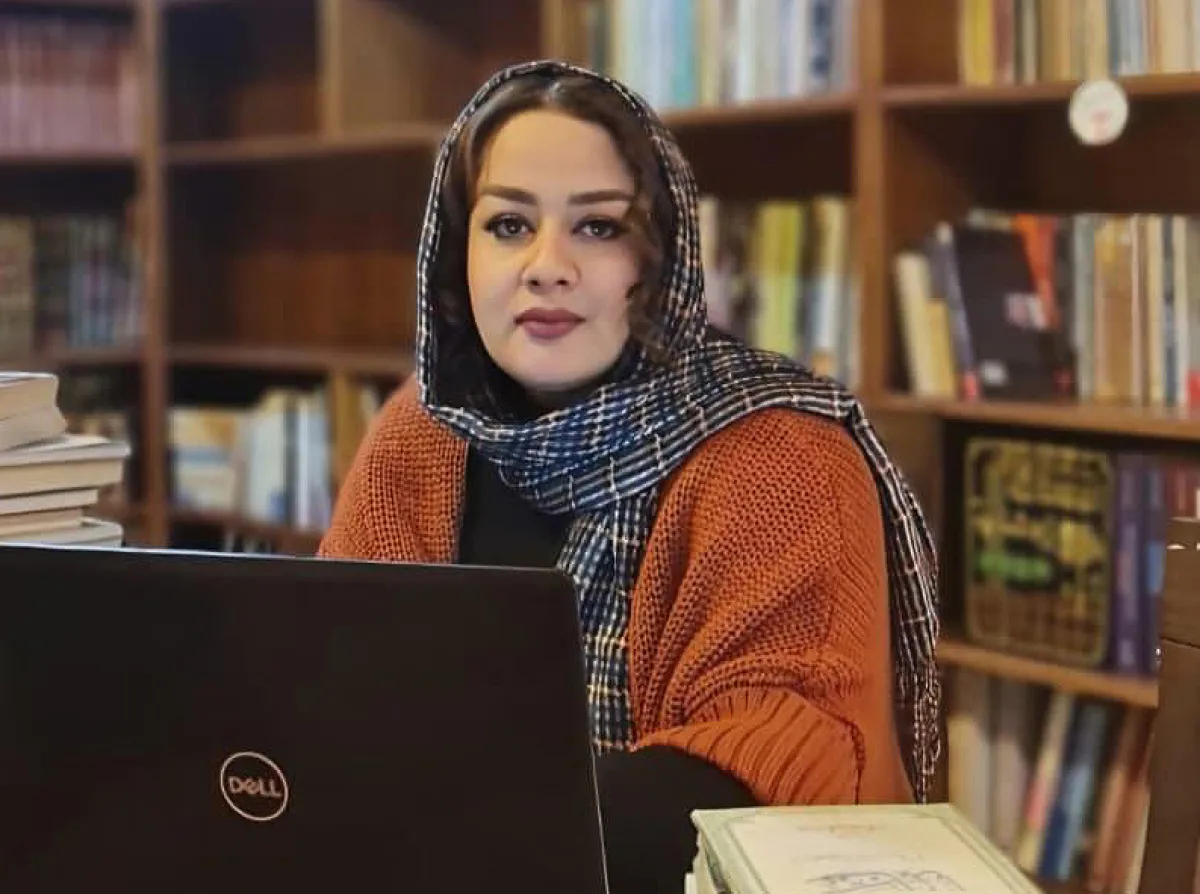
Maryam Al-Attar is a poet and translator from southern Iraq. Born in 1987, she is a member of the Union of Iraqi Writers and Poets and has participated in numerous poetry festivals in Iraq and abroad.
She has published three collections of poetry: Wa’d (2013), Shatā’im majjāniyya (2016), and Akalū rummānata katifayhā (2024).
She is particularly known for her work translating contemporary Persian literature into Arabic, through which she has helped introduce the Arabic-speaking readership to several major poetic voices.
Her translations include anthologies of Persian and Afghan poetry, as well as the complete works of leading poets such as Forough Farrokhzad and Ahmad Chamlou. She has also translated numerous works of poetry and novels, published by Arab and international publishing houses.
I am familiar with this repetition. My body, over many long years, has become accustomed to it. I stray a little, then return to the same cycle: to the love that makes me beautiful and immortal in mirrors, to the docility of my hand, and to the insistence of instinct....and its repression, so as to appear peaceful and fulfilled. I lose myself and recognise my wandering as I turn, again and again, only to find myself facing what I have already confronted.
Once, I fell asleep on the muscle of an arm and dreamed I was a star, a crystalline star in a vast expanse where no one could rebuke the heart and its missteps.
Once, I lay down on an island and dreamed I was a mermaid combing her long hair on the beach, while goldfish fretted about her fate.
Once, I opened a small window and got lost on a long street. When I returned, I discovered that my parents’ house had changed, that their phone number had changed too, and that even my father’s scent was no longer the same. I saw my books thrown onto the pavement, and realised then that I had grown up… grown up to the point that my brothers now thought of me as an old witch. Even after I washed the makeup off my face, they locked me in a room, in a house that no longer connected to my memories.
Through a gap in the clouds, the sky offered me half a sun and half a moon. From that day on, I dedicated myself to those halves, on a land that belongs to my ancestors, with its streets, rivers, cinemas, law courts, seasons, its men and children, its amusement parks and its shops.
The halves are mine. I've learnt how to make them mine through simply waiting. Yet they who wait remain silent: they do not know how to begin and have no idea how to end. Waiting freezes all desires. It can transform them into wishes, into deferred wishes, into stories that will never take place and therefore can never be told.
Waiting is the sister of original repetition. In repetition, everything is alive, even the dead. And both waiting and repetition give birth to illusion.
I, who lavish out the halves, caught in a monstrous repetition and an endless wait, carry suspended desires within me. I deserve nothing more than to be told… I want you to tell my story.
I wrote this text this morning, Youssef, as a reflection of last night’s dream. I dreamed I was in Iraq, returning from a long journey during which everything had gone against me. In the dream, I held fast, repeating to myself: “Maryam, you’re trapped in the labyrinth of a nightmare. You must wake up to fix this whole disaster.” ”
Then I woke up and realised I was far from Iraq, and that you weren’t there anymore either.
I remembered the time when you were still living there. You had adapted; resigned yourself to everything we were going through. Your dream was the theatre - staging the plays we wrote on a simple stage. And you struck me right in the heart when we saw each other a year ago. I saw you sigh, looking at me for a long time, while your fingers traced the edge of the table and glided over the white tablecloth covering it. Then you said to me:
“Maryam, I’ve given up. I may leave the country soon, along with all the other young people who are leaving these days, and I’ll never come back here again. ”
Tears streamed from your eyes. You gave a bitter smile, then recited some lines from Eliot—the ones we used to repeat back at the institute because they seemed so beautiful to us. I didn’t know that one day we’d return to them to describe our own reality:
“This is how the world ends,
this is how the world ends,
not with a bang,
but with a whimper. ”
Your voice, too, had grown low as you continued the story of what had happened to you the night before:
“It was a cursed night, my love. Those men stormed into the theatre - masked men! They destroyed the set and burned down everything my friends and I had built… I don’t belong here. I don’t know how to do anything but act, and now they’re even attacking that.”
I tried to comfort you then. I thought your leaving was just an idea you clung to in moments of despair. I didn’t know you’d actually given up, that your heart no longer had the strength to go on.
Then I heard nothing more from you. And just like that, with disconcerting ease, your presence was gone from the chairs at the café where we always used to meet.
I, too, pushed aside the idea of your presence—that presence that had been so familiar to me. I no longer wanted to face it. Then I made excuses for you for not telling me you were leaving. A few months later - perhaps because you were unable to face me - you called my sister. She was the one who told me that you’d been gone for months and were now living in a migrant camp in Germany.
In any case, I wrote the text at the beginning of this letter in the waiting room, before my interview at the embassy. I jotted it down in a hurry and decided to send it to you from here - I'd checked, the mail system is working, so it should reach you in less than a week, and you can let me know what you think.
I don’t like sending this kind of thing over the internet. You and I both know how irresistibly charming sheets of paper covered in handwriting are. Perhaps, once your situation has improved, you’ll return to the theatre and these words will be brought to life by your voice, in German.
When I entered the interview room, I saw through the glass a blonde woman with short hair sitting behind the counter. Her gaze was ordinary and her features serene.
She asked me:
— What is the reason for the invitation?
I explained my situation to her. Then she asked me about you. Raising her voice, she asked:
— Who invited you to Germany? What is your relationship with that person?
Little by little, I began to talk about you.
It’s nice to talk about you -to tell her about where you live, our constant correspondence, our postponed dreams, and the fact that I knew you before you left.
She asked:
— Where will you be staying during your visit?
I remembered how you’d described your room to me, the friend you share it with, and your talent for cooking. But I just gave her your address.
Yet, deep down, a painful feeling was crushing my heart. I knew we no longer went to sleep at the same time, that we no longer shared the same sky, that the heat here made me unhappy, while over there, the cold might be bothering you.
Nevertheless, I told her about other happy things we share - there are plenty of those… then I remembered that I shouldn’t dwell too much on details that hadn’t been asked for.
After a moment’s silence, her voice disturbed my dreaming:
“Sign here, at the bottom of this page.”
I left the building carefully, so as not to bump shoulders with the people waiting in line at the door. I decided to walk to the end of the street instead.
There was a large retirement home there, surrounded by a spacious courtyard full of trees, with an old, tall, and sturdy iron gate. But the walls were low, so I could see some of the residents strolling along the paths that morning.
I envied them.
There they were—old, frail, helpless. They no longer had to move about, travel, or fight for their lives or their dreams. How easily they had found the place destined to become their final refuge…
I, on the other hand, continued to hurtle down the slope of this street built into the mountains, rolling toward its end like a bubble close to bursting.
Today I also stopped by the old bookshop Khosro, the one we used to visit together. This man has an astonishing talent for collecting rare books. It’s as if he’s returned from a distant era, bringing his customers beloved treasures before disappearing only to return with other titles.
On one of his shelves, I spotted a book by Rilke, the poet whom a rose is said to have killed—an old copy titled Geschichten vom lieben Gott (Stories of the Good Lord and Other Tales).
I opened it and leafed through the pages with curiosity. Mr. Khosro noticed me and told me that he loved this book very much, because it had left a deep impression on him during his adolescence. Then he explained its central idea to me: death can be the culmination of the song, not its interruption.
He briefly recounted the story to me.
It was, he said, the story of a poor man, Timofei, who came from a village in Russia. He had lived peacefully, working with his hands, and singing simple songs to himself as he worked or walked along the roads.
To the villagers, his voice was as familiar as the light of day. He sang without anyone really paying attention to his words, as if his voice were an extension of nature.
As he grew older, he sensed that his end was approaching. One evening, he sat down in front of his house and began to sing a song he had never sung before. A song that contained his entire life: the fields, the horses, the baby birds, the warmth of the stove, and even the heavy clouds hanging over the plains.
As his voice rose and fell, the song became deeper than the words themselves, as if he were entrusting his life to the air and the melody.
At the end of the song, his voice faded gently, like a lamp at daybreak. He died with a smile. The village didn’t notice until the song had fallen silent.
I listened to him like a new student, connecting the threads of the story to reality, wondering how Rilke could have described life with a mysticism so profound and yet so simple, to the point of turning his exhausting journey into a simple chant, or even a song left floating in the air.
I smiled at him, because in just a few moments, he had brought us all together, in the same place - him, Rilke, old Timofei, and you.
That is the mark a book leaves on us. Neither language nor time can stand in the way of what I felt in that moment.
I was going to buy several books, but then I remembered that my stay here was only temporary. Everything was temporary. And those who live in the temporary must not weigh down their suitcases any further.
I consoled myself by imagining the best: the books waiting for us over there, the movies we haven’t seen yet, the streets waiting for us to walk down them, and a city that will, at last, be able to hold us all.
When I left the bookshop, night had fallen. I quickened my pace through the people heading home. I slipped into their whirlwind so I could imagine myself as one of them, a family and a home waiting for them somewhere.
I walked quickly, still enveloped by an intimate and wonderful nostalgia brought on by the scent of old books at the Khosro bookshop.
I returned to the hotel. I don’t remember walking through the lobby or entering the room. My only goal was to sit at the table and write to you.
And here I am, writing from a crowded city, filled with noise day and night. Here, the workers labour tirelessly, twenty-four hours a day. The schools deafening loudspeakers constantly disturb the peace of the morning .
I hear the principal’s voice warning the students, promising them a bright future if they obey him. Then the boisterous, childish voices of the boys rise up in turn.
It annoys me, but secretly I smile.
You know how much I love dawn and the morning that follows it. Here, however, I am deprived of the purity of dawn and the silence I once enjoyed.
I know I’m being unfair to this city by describing it this way. But it’s a city where nothing is familiar to me. Neither the smell of oil, wafting from factories through the streets and invading my nostrils relentlessly, nor the men and women, always deep in conversation about ways to earn more money and how to make ends meet.
And you know that I just call money 'those colourful pieces of paper covered with ugly designs'.
Tired of sitting at the table, I took what I'd written and lay down on the white bed, which smelled of chlorine, on the sheet whose texture had perhaps already covered hundreds of bodies before mine.
I turned off the lamp. That’s when I noticed the glow coming from the street and my isolation in this empty room.
Half of my body was trapped in the whiteness of the bed. Across the other half, the beam of car headlights glided at regular intervals. It passed through the windowpane, accompanied by the sound of vehicles speeding by, like a violet scream in the middle of the night.
I felt as though I had played many roles throughout that day. Roles that had stained my face and altered the tone of my voice a dozen times; the script poorly written, the facade failing to convince others.
Words from my native Arabic would slip out involuntarily every time I tried to speak their language. I had to enter my information into digital devices I didn’t know how to use, deal with the employees’ irritation, and start over and over…
A task that seems simple in their daily routine, but is extremely difficult for me.
I even thought I’d be unable to explain to a regular employee what was happening to me, when he called me by my name and I didn’t recognise it until he’d repeated it several times over the speaker.
Because, frankly, how could I tell him that I have two first names, two last names, two passports, and an ID card?
How could I explain to him that this place—which bores and frustrates them—is as strange to me as the entrance to a fantastical cave, and that I’d only arrived there the day before?
How could I tell them that, since yesterday, I’ve been memorising a phrase to introduce myself, and that I’ve been practicing reciting it while keeping a neutral expression?
Phrases that most immigrants rehearse before their interview. Fabricated scenarios known only among immigrants themselves, like a new-born language, devoid of a homeland, that has taken shape over the years among those who cross one country after another.
I remembered that damned text I’d memorised, even as my head was filled with a multitude of addresses and I was carrying more official documents than both countries combined.
Let me press, in my memory, the button that fast-forwards the reel of that day’s recording, so I can arrive precisely at this moment.
It is now midnight, and I am almost nobody.
On a night like this, in homage to all the names that have been given to me, I now have neither a first name nor a last name linking me to a lineage or to my roots.
I think about how wonderful it would be to introduce ourselves through the things we love: a list of our favourite songs, the movies that have left a mark on us, the classic stories that shaped us, the poems that filled us with such wonder that we learned them by heart.
Even the face of the person we love might say more about us than all those numbers and fingerprints.
Yet I know that what I carry in my memory and what I love are of absolutely no interest to anyone.
I turn my head toward the other side of the bed. I gaze at length at the painting hanging on the wall in front of me. It’s a reproduction of a Modigliani work: a woman leaning against a chair, with a long neck, her hand making a gesture of extreme femininity.
Ah, the eyes! They’re obviously not drawn.
I remember this quote attributed to him:
“When I know your soul, I will paint your eyes.” ”
Then my tears begin to flow, and they keep flowing for no particular reason, as if crying in a hotel room were inevitable.
A hotel is truly a strange place. Cubic rooms, temporary stays, visitors bound by the punctuality of their departures. They leave their memories here to go make new ones elsewhere.
As for me, I don’t believe in hotels. I don’t believe in goodbyes or in the justice of this world. Nor do I believe in exchanging money to get anything at all.
Take this notebook I’m writing to you in right now, for example: it would have been better if I’d walked into the bookshop and told the shopkeeper I wanted a notebook with blank pages to write to a distant love—that man from whom I’ve been separated for years and who knows almost nothing about what’s happening to me.
I would have told him that I am an immigrant and that it is my duty to document things through writing. That instead of giving him money, I could share a memory that’s important to me—a memory that drives me to write.
I would have explained to him that writing is a duty for every immigrant, because we sleep on a different pillow every night depending on the whims of the laws and leaders of our countries.
And so, quite simply, the shopkeeper would have become the one who listens and the one who rewards.
I may be a dreamer, but I appreciate the value of time and of the life I spend on this planet.
I wish that instead of remaining motionless in makeshift rooms and dirty cities, you’d now be leaning against a tree, that I’d touch the grass, that I’d watch the raven circling around me, and that, from time to time, I’d toss it a few pieces of bread, without having to worry about proving my identity.
I and so many others deserve to fill our lungs with fresh air, to spend the time we have left in a place imbued with purity and clarity.
I deserve to look down on the cities from above, as if I were a primitive bird living among the dinosaurs. I’d like to bear witness for the future to what troubles people and laugh at the effort they go to over all these worries.
I am obviously not a prophetess. But I know that this is “the last time I’m alive.”
I’m tired of being born every morning in a city where I have no memories. Tired of sleeping in ground zero, of starting over from scratch, and of seeking refuge in zero.
Zero is not a number. It cries a lot and only takes on value when another digit is placed in front of it.
My distant love, perhaps we’ll never see each other again. But I’m warning you: live.
No happiness is worth struggling for.
Happiness comes unexpectedly, just like love.
So live by loving, without struggle.
+++
*The Simurgh, the mythical bird of Persian tradition, symbolises wisdom, transformation, and renewal. Its name evokes the Persian words for “thirty birds” (si morgh), a wordplay central to Attar’s The Conference of the Birds. The Persian name was chosen in reference to both Attar’s poem and Ferdowsi’s Shahnameh, and to the Simurgh’s enduring association with renewal and rebirth.
+++
The English adaptation is based on the French translation from Arabic by Rita Barotta.
Did you enjoy this text? If so, please support our work by making a one-off donation via PayPal, or by taking out a monthly or annual subscription.
Want to make sure you never miss an article from Literatur.Review again? Sign up for our newsletter here.