


The overhead line is faulty – in the shadow of the spirit of the times

Zoltan Peter is a sociologist, author and essayist. His work focuses on social coexistence, democratic tolerance and the relationships between the individual, culture and society. His research focuses on the sociology of culture, political philosophy, and education and migration studies.
He is the author of Lajos Kassák, Vienna and Constructivism (Peter Lang, 2010) and co-author of Integration: Openness and Tolerance (Springer, 2020) and School at the Limits of Tolerance (Springer, 2026). He is currently developing a General Theory of Relationships, which examines human capacity for relationships beyond established categories such as origin, integration and collective identity. In his essays, he emphasises the importance of art, culture and critical thinking for an open, democratic society.
Elfriede Jelinek celebrated her 80th birthday on 20 October. A fitting occasion to reflect on the most recent work of one of the most significant literary and intellectual voices of our time. For Among Animals demonstrates once again the linguistic radicalism and intellectual acuity with which the Austrian Nobel Laureate in Literature scrutinises the social conditions of our present day.
Literature is the realm of subtle observations. A space where – without an explicit method, but with great linguistic precision, freedom and an openness to varying outcomes – important insights into the world and human existence continually emerge. Often, precisely the difficult and complex themes that are brought to life with great aesthetic power: war, violence and death, or, as in this play, the question of power and money – two forces that seemingly no one can escape.
The theme of money is age-old. As early as Aristophanes, wealth was the subject of his comedy; Peter Hacks revisited it in 1993 in his play Geldgott. Jelinek's Unter Tieren (Among Animals) traces a path from the modern era back to antiquity. The play engages in an intense dialogue with Plato, but above all with Parmenides. His famous statement – ‘That which is, is; that which is not, is not’ – is repeatedly varied and, at the same time, challenged. Jelinek asks not only whether money is a being, but also what it actually is, why it is so coveted, and what this desire means for human life. This brings us straight to the work’s subtitle: ‘Money or Life’. It follows on from the ‘Prologue on the Balcony’, in which the doves proclaim their peaceful messages and remind us that, behind humanity’s much-cited self-inflicted immaturity, there are still many things that require explanation – above all the question of power and capital.
Money or Life
The subtitle, however, makes it clear: money and life are two entirely different things. Time and again, the text revolves around the same question: how does a coin or a banknote become such a coveted and powerful social reality?
The text is highly complex. It defies easy comprehension, challenging the reader to active thought. The real artistic device, however, lies elsewhere. Following the subtitle – Money or Life – the animals take to the stage. From this point on, they are observers and speakers, and even a poisonous plant, hogweed, is given a platform. They thus present an unusual perspective on human existence. And perspective, the vantage point from which we observe, is always crucial, not only in art. The more focused and self-reflective our gaze, the better we understand our own point of view, the more coherent our insight becomes. Learning to see is not merely a trope; even Rilke recognised its value. Even plants, it is said today, can communicate with one another; animals certainly can. They possess forms of communication within their respective species. However, they have apparently not developed a social discourse that has a lasting impact on their environment – at least not in the way that humans do.
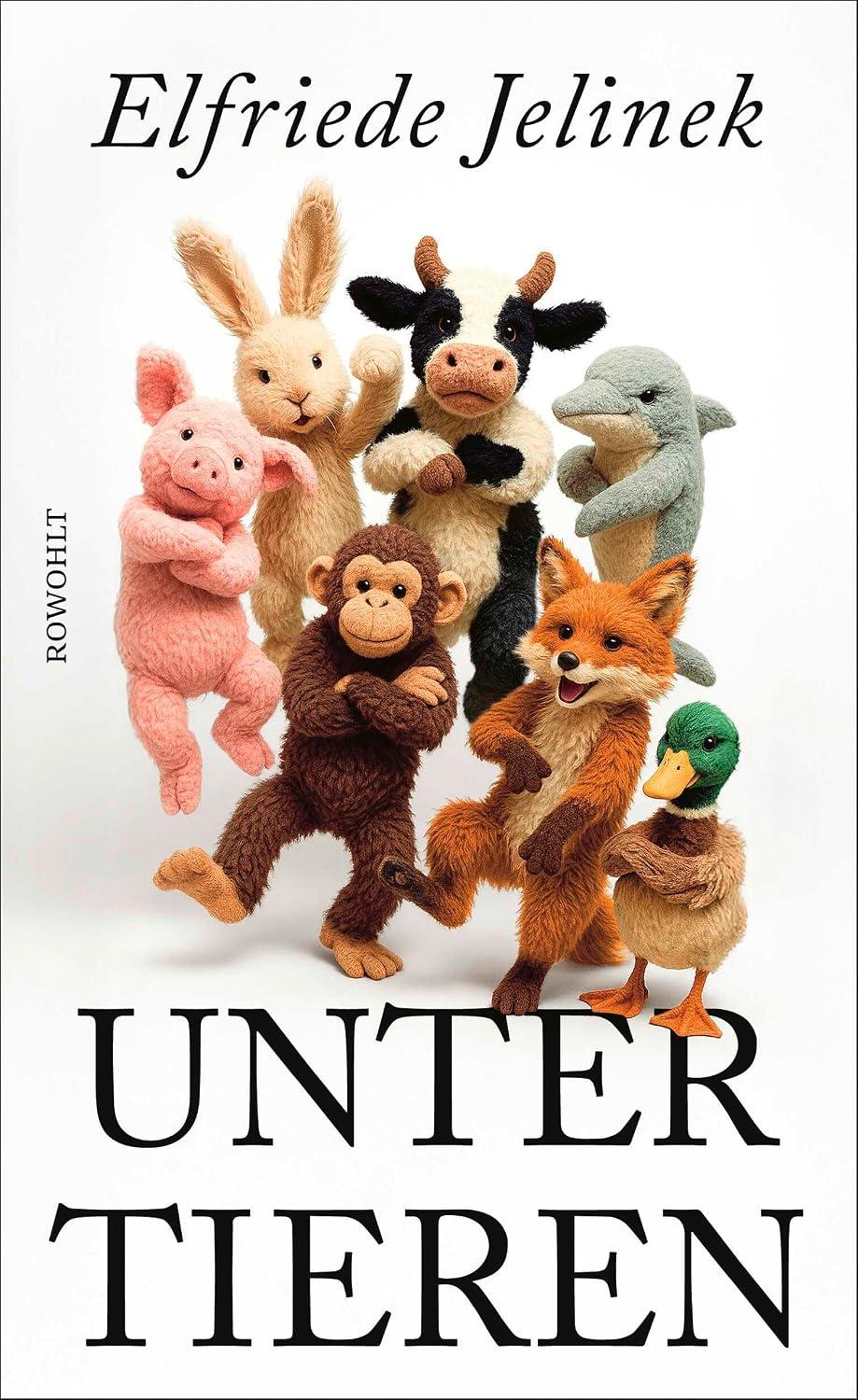 Rowohlt
Elfriede Jelinek | Unter Tieren | Rowohlt | 224 pages | 24 EUR
It is true that pets do influence us, often in surprisingly profound ways – a remarkable example of fulfilling relationships. Yet it is precisely this lack of discourse that fundamentally distinguishes them from humans. Jelinek literarily bridges this gap, and therein lies a key feature of the play. Her animals are endowed with a voice and thus a discourse, the right to speak, the impact of which – as the work’s intention can be understood – is intended to reach as many people as possible. Since they are neither integrated into nor shaped by human discourse, they can appear in the play as largely autonomous and archetypal observers and speakers.
Furthermore, animals have for centuries served as vehicles for cultural traits inherent to humans. The fox, for example, is regarded as cunning; the dove, a symbol of peace; the rat, intelligent and adaptable; and the ram. defiant. Jelinek takes up this tradition and reconfigures it. The animals take on different voices, each viewing the same subject from different worlds and perspectives. They lay bare money, religion, language and much more, endlessly revealing and concealing them.
An example of contemporary language – indeed, of a far-reaching discourse completely inundated by identity politics – is as follows:
‘We want to be a service-oriented administration for our citizens, our entrepreneurs and our businesses. That is what she says with her own mouth, the director.’
The text becomes particularly analytical where Jelinek encounters Parmenides directly. Time and again, the text asserts that money does not come from what does not exist, only for it to be produced out of nothing, a few lines later, through banks and credit. Parmenides, it seems, is neither confirmed nor refuted. The sheep perhaps puts the problem most succinctly:
‘For everything arises from what is, as is generally known, but there is nothing left; wealth – where else could it come from? There must be something there for something else to be added.”
Being, therefore, is not present, or at any rate not in sufficient measure. A decisive transformation – one that would actually fulfil the claim of Being – cannot therefore take place. At any rate, that is one way of interpreting the sheep’s remark.
The coordinated minds
Many initially interpret Unter Tieren as a play about money and a critique of capitalism. Yet the actual theme is far more fundamental: it concerns the conditions of knowledge – or, if you will, truth – namely, who can recognise it and how it can be recognised.
At this point, there is a distinct connection to Pierre Bourdieu, who, incidentally, particularly admired Elfriede Jelinek and Thomas Bernhard . On social reality, he wrote: ‘When things and minds, or consciousness, are directly attuned to one another – that is, when the eye is a product of the field to which it relates – this field, with all the products it offers, appears to the eye as imbued with immediate meaning and value.’
No social product, therefore, possesses its significance simply because it is valuable in and of itself. It appears valuable because the social order, above all the landscape of discourse, produces a habitual perception that, for a wide variety of reasons, makes such products seem self-evident to people. Here, there appears to be a remarkable poetic and sociological convergence, which is linked to the proximity of the respective perspectives on the same subject.
‘Only the dead may speak now’
The conclusion of the play alters and completes the perspective on everything that has gone before. It is no coincidence that it is now the corpse of a dog who speaks. ‘Only the dead are allowed to speak now’, it says, right at the start of the final chapter. This voice opens up a new perspective.
According to the dog’s corpse, humans lack ‘the intellect to grasp anything’. The focus of the play thus becomes epistemological. Its political aspects take on, as is so often the case with Jelinek, an intellectual function. They are intended to point far beyond the literary sphere and now also reach those who possess substantial power to shape society.
The dead dog addresses this last, powerful reader directly – the one who, almost as a matter of habit, wants to ‘be off again’, ‘off to Mallorca’, no sooner has he entered the world of the text. It is precisely to this fleeting, and possibly influential, reader that Jelinek directs what is perhaps the central sentence of the entire play:
‘The human spirit has yet to undertake a more powerful activity than thinking.’
Provided it remains mindful of its humanity, the human mind certainly possesses the ability to calm storms, preserve life and prevent destruction. However, humankind – or, more precisely, humankind alienated from itself and the world – often fails to utilise this potential, and increasingly directs its powers against itself. Firestorms, devastation and self-destruction thus appear not as a fact of nature, but as the consequences of human action.
The dead dog has by no means given up. He speaks right to the very end because he himself believes in the capacity for insight of his fleeting readers. His final warning is even directed against the book itself, which is imaginatively referred to as a ‘conduit’ and of which no one can know for certain ‘what lies within it and already seeks to rule over us once more. Conceal your inner self and be still.’
However, this self-reflexive ‘conduit’ does not merely represent the book. It also refers to the channels through which cultural currents flow. The work does not call on its readers to trust this conduit blindly. It calls on them to read it – and to think for themselves.
Unter Tieren is thus clearly far more than a critique of capitalism. It is a brilliant literary invitation to continually scrutinise the premises of thought: whether and to what extent it is ‘pure’, whether and by what it is ‘coloured’. And whether, in any given case, we are dealing with immaturity that is self-inflicted or systemic. A society’s preferences, its likes and dislikes – in other words, what the population focuses its attention on – reveal a great deal about its condition and its future. All this, however, has less to do with a fundamental inability on the part of the individual – with what the dead dog holds against humankind, namely that it is incapable of grasping anything – than with the external, structural conditions of thought. This work, and numerous other works of humankind, prove that thinking is possible. What is interesting here is that this is not, at least not entirely, a question of genius; good reasons could be found for this as well.
The title of this review – ‘The overhead line is faulty’ – derives its true meaning from this point. It is intended as a translation of Unter Tieren. Every society possesses, like it or not, such an overhead line. In my interpretation, it illustrates what Pierre Bourdieu describes as the field of power.
Over the course of history, two distinct forms of capital have established themselves within this overhead line: economic capital and intellectual or cultural capital, each possessing a specific symbolic – that is to say, difficult to discern – power to influence. These two poles are occupied by influential actors within the social sphere. However, this structure breaks down when the balance of the flows is lost and one flow overwhelms the other or permanently overshadows it.
Ultimately, Jelinek’s play does not give the impression that human beings as such are incapable of thought, but rather that economic logic is permeating ever wider areas of social life, whilst cultural, philosophical and artistic forces are increasingly losing their influence. Consequently, the capacity of a society – indeed, of the whole world – to form relationships and to think comes under pressure: its ability to establish and maintain sustainable relationships with nature, with fellow human beings, with the animal world, with other living beings and with things themselves. The causes of this disruption lie largely both in the too-quiet voice of the intellect – here in its self-imposed immaturity – and in the overpowering voice of economic discourse. That is why the play ends with the urgent warning from the dead dog:
“Drive the madness of these people from my tongue …”.
With that, everything seems to have been said. Only one question remains unanswered: why has politics failed for decades to maintain the balance between money and culture? Jelinek’s play may not answer this question but certainly, on close inspection, puts it in the spotlight.
Did you enjoy this article? If so, please support our work a one-off donation or a monthly subscription via one of our subscription options. We’d be delighted!
Don’t want to miss any more articles on Literatur.Review? Then sign up for our newsletter free of charge!