


An empiricist of terror
 Wallstein
 Wallstein
 Wallstein
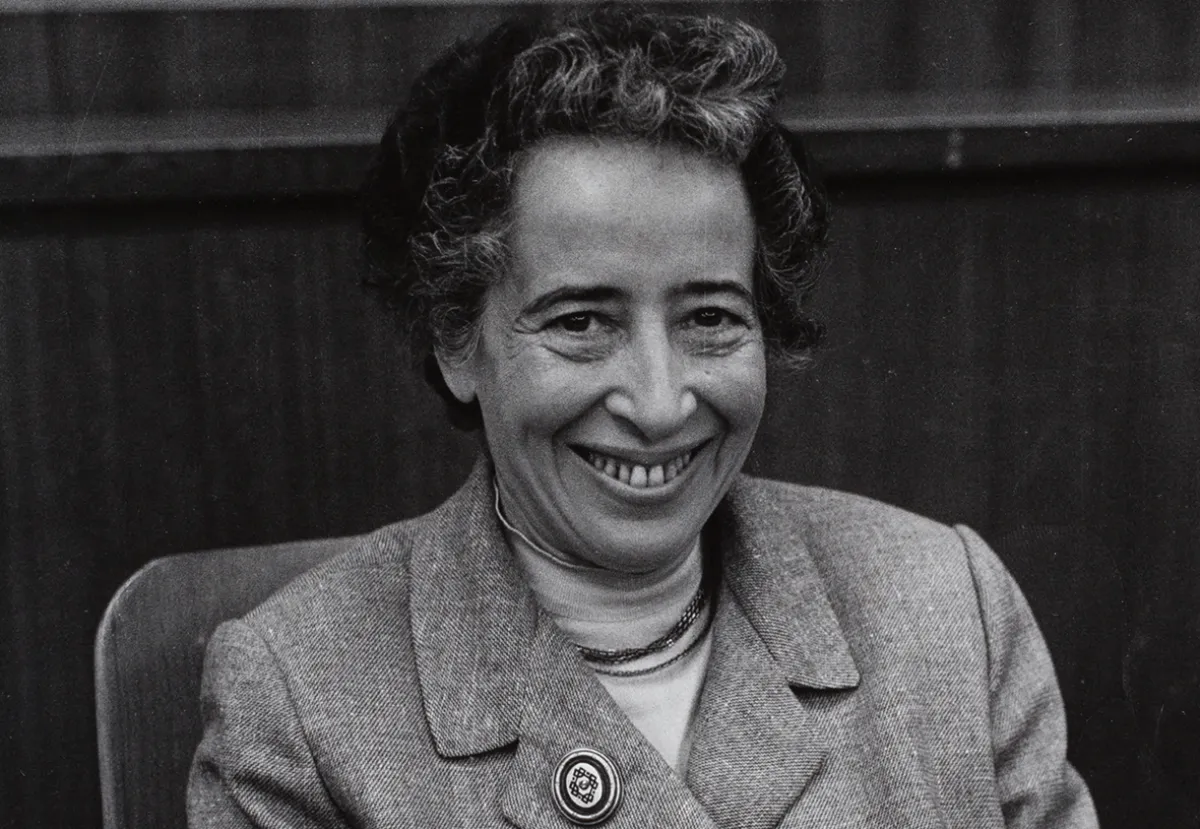
Hannah Arendt | The Origins of Totalitarianism / Elemente und Ursprünge totaler Herrschaft | Wallstein Verlag | 3106 Seiten | 128 EUR
‘Returning to Heart of Darkness: what I meant was that this character, Kurtz, truly is – and, as far as I know, for the first and only time – a “Nazi”.’
Hannah Arendt, 1943, on Joseph Conrad
Hannah Arendt was rediscovered in the 1990s: suddenly, her thinking - increasingly forgotten since the early 1970s, as unconventional and headstrong as it was radical - seemed relevant once again. Hannah Arendt was the philosopher of the spirit of renewal following 1989/90, the fall of the Iron Curtain. She was the thinker behind ‘civil society’ and a new future for politics, which was also seen in terms of its amoral autonomy; her book On Revolution seemed to have already anticipated the peaceful revolution and the establishment of a republic emerging from the public discourse of the many against ossified state institutions and authoritarianism. In Eastern Europe, Hannah Arendt was also significant because, through her focus on the individual, she was a thinker of anti-totalitarianism and, in her major work, had formulated one of the very first theories of totalitarianism.
In her reflections on the public sphere, as well as in Vita Activa, she seemed almost to have foreseen the new forms of society that were debated from the mid-1990s onwards with the advent of the internet: virtual cities and virtual communities.
The momentum of these ideas was slowed by the shock of 11 September and the growing frustration and pessimism of the 2000s that was taking hold in the West – a period characterised by the War on Terror and the 2008 global financial crisis and its aftermath. Around the same time, however, Hannah Arendt was rediscovered in two other respects: firstly, as a thinker on anti-Semitism and a Jewish critic of many of the State of Israel’s self-deceptions; and secondly, of course, as one of the earliest and most significant female thinkers of the 20th century.
The works of hers most often cited- that is, the essentially journalistic account Eichmann in Jerusalem, her shorter texts on Palestine and the Jews, and her later reflections on the public and political sphere - are, in my view, the least interesting. The political understanding unfolded within these texts corresponds to everything one could still hope for, at least 15 years ago, as the ideal of a just world: In Arendt’s emphatic view, the Greek polis was the lost paradise of a free exchange of ideas amongst free citizens. The fact that this consisted solely of men, and that their well-being and culture also depended on the labour of their slaves, was even then the still-ignored stain on such an enthusiastic, backward-looking utopia.
Of her major works, it was her book On Revolution that received the widest reception. This was, in fact, my very first encounter with Hannah Arendt, in an introductory political seminar at the Geschwister-Scholl-Institut in Munich in the late 1980s; it served as a handbook on the fall of the Berlin Wall as well as reading material on the journey to the G20 protest.
A sceptical outsider
It is astonishing that, compared with all these publications and the swathes of secondary literature that have now accumulated around Hannah Arendt, her comparatively bold magnum opus has been so little received and has only, in the last two or three years, returned to the intellectual consciousness as a result of the sobering current political developments. And yet this book addresses almost every aspect, providing a near-exhaustive overview and all the tools with which we can make sense of a present that is so largely shaped by such deplorable figures as Donald Trump, the mullahs in Tehran, Vladimir Putin and others, as well as by far-right extremists and supporters of Italian, Spanish and, above all, German fascism, by the new glorifiers of Stalinism and state communism, or by the Leninists at large in Western universities.
In relation to all of these, Hannah Arendt is, above all, sceptical. ‘I never wanted to align myself’ – this phrase, coined by Leo Löwenthal, could also be applied to her. In fact, Hannah Arendt never wanted to be part of any particular school of thought. She occasionally did, when allowed, but she never aligned herself with the academic mainstream. As a woman, a Jew, an exile and an existentialist, she was an outsider in many respects, and she herself always liked to emphasise this marginalism, this pariah status. She wrote about refugees, about displaced persons and about the marginalised; she was friends with Brecht and Benjamin – two figures who, whilst part of the movement within the 20th-century European Left, held a special status within it and refused to be dictated to, just as she herself refused to be bound by rules of conduct or linguistic dictates. One of her early books centres on Rahel Varnhagen, who for her is, naturally, a figure of German Judaism, but also a woman, a Romantic who did not deny the Enlightenment, and, first and foremost, a fierce thinker who ran her own debating club.
The desire to understand
It is this courage to be true to one’s convictions and the experience of existential marginalisation that form the starting point for the work, completed in 1949 and first published in the USA in 1951 under the title *The Origins of Totalitarianism*. It became a global success. Since then, there have been various new editions, expanded editions and translations. The most important of these is the German edition, first published in 1955. This is not simply a translation into her mother tongue produced by the author herself, but a revised version undertaken by Arendt, which has been extensively reworked in terms of both content and structure. This German edition is a work in its own right.
Even during its writing, the book was a ‘work in progress’; Arendt had already begun the ‘elements’ in the form of preliminary work whilst in exile in Paris, when she was conducting research - much like Walter Benjamin whilst he was researching for his Passages at the Bibliothèque Nationale. This accounts for the extensive passages on the history of anti-Semitism in France and on the Dreyfus Affair. Even after 1955, Arendt continued to revise and expand the work, adding, for example, a section on the Hungarian Uprising of 1956, which was later removed from the book – a very modern approach to writing, in the course of which the book evolved from a historical study into a political theory of an entirely new form of rule.
The young Parisian émigré’s fundamental motivation for writing this book was a desire she shared with many fellow sufferers: Arendt wanted to understand National Socialism, German fascism. She wanted to give form to the shock, and to question herself, her surroundings and recent history: what exactly had happened there? What did people think, hope and fear? The book’s many concrete, vivid examples, the accounts of personal experiences, but also the brief analyses of great novels, such as those by Proust and Conrad, demonstrate that Arendt is an observer and an empiricist of terror.
Arendt quickly rose to fame, partly because it was the era of the Cold War, and her thesis – developed even before its outbreak – resonated with the political demands of the time. She described the Soviet Union as ‘fascists painted red’ (Kurz Schuhmacher) – a dictatorship which, in its totalitarian nature and its quest for world domination, was no less inhuman and threatening than Nazism. For political science, a discipline that was only just emerging at that time, the clear concepts and objective criteria for comparison that Arendt developed in her book proved useful. To historians, however, who tended more towards historicism and relativism and were primarily interested in the unique nature of all phenomena, these quickly became an irritation. The theory of totalitarianism developed by Arendt has long since fallen out of favour as a scholarly approach.
Arendt’s concepts and analyses, however, are by no means obsolete.
‘We have every reason to use the word ‘totalitarian’ sparingly and with caution.’
Arendt develops her arguments in three main sections – anti-Semitism, imperialism and totalitarian rule – in which the elements of totalitarian rule take shape. Despite the groundwork laid by Franz Neumann and others, the integration of these components was innovative for her time. And it remained ahead of historical research, which tended to operate in an overly fragmented manner, right up until the 1990s. Early on, she describes how nationalism, imperialism and racism are interlinked; but she also describes how they change – how chauvinism becomes ethnic nationalism, how the ‘racial delusion’ rooted in this imperialism turns against it, and she already recognises the tendency to ‘revert nations back into races’. She posited in the mid-1940s that the ‘decline of the West’ would come about through racism, and identified a tendency towards the self-destruction of democratic societies, the description of which reads with startling relevance today.
‘We have every reason to use the word “totalitarian” sparingly and with caution,’ wrote Arendt. Her emphasis on the essential differences between authoritarian, dictatorial and totalitarian rule – despite their similarities – is therefore all the more important. Something fundamentally new had emerged in the mid-20th century, from the combination of the violence of the concentration camps, science, modernism and barbarism..
For Hannah Arendt, totalitarianism means the contempt for plurality. But without technology, this cannot be fully realised in society.
Added to this are Arendt’s reflections on the role of propaganda. Propaganda is particularly successful, she argues, where it not only distorts individual facts but can also offer a coherent world view and satisfy the need for a consistent explanation of the world. The most dangerous effect of propaganda lies not in the lie itself, but in the fact that the distinction between truth and lies loses its political significance.
A thought experiment that is constantly evolving and remains relevant
This critical complete edition is a landmark publication. For the first time, it allows us to observe the author as her thoughts develop and evolve, to compare different versions of her texts, and to trace the depth of her analysis in shorter pieces. The most important of these is Arendt’s book on the 1956 Hungarian Uprising, The Hungarian Revolution and Totalitarian Imperialism, published in Germany only once, in 1958, in which she applies her theories to a contemporary case.
*The Origins of Totalitarianism...* does not culminate in any hard and fast theses. For the most part, the book is descriptive, inquisitive – a mental exercise that remains constantly in motion, in the hope of discovering still more. The text’s fluidity enhances its power and ensures it seems hardly to have dated.
The relevance of Arendt’s ideas remains undiminished: Arendt’s most significant provocation today was not to compare Nazism and Stalinism, but to find concepts with which new, contemporary phenomena can also be described.
Thus, in contemporary Islamist circles – where hatred of liberalism and the West, a posture of moral rigour, racism and anti-Semitism, the idea of a purifying apocalypse and a cult of death all converge – one finds all the characteristics that Hannah Arendt once described:
‘The fanatical member [cannot] be swayed by either experience or reason.’
The logic is as follows:
‘to murder one’s opponent rather than refute him, to terrorise him rather than persuade him.’
The most important of the many theses in Arendt’s magnum opus is surely the one according to which totalitarianism has brought into the world a realisation that we cannot shake off, one that will now stay with us: that it is possible to do such things to people. We see this realisation every evening on the news.
Did you enjoy this article? If so, please support our work a one-off donation or a monthly subscription via one of our subscription options. We’d be delighted!
Don’t want to miss any more articles on Literatur.Review? Then sign up for our newsletter free of charge!