If only Christopher Nolan had listened to James Joyce. Instead, he transforms Homer’s fluid, ambiguous 'Odyssey' into a rigid monument of masculine pathos, plot-driven drama, and sensory overload.
Universal
“You think you’re escaping, but you run into yourself. The longest way around is the shortest way home.” — James Joyce, Ulysses
Universal
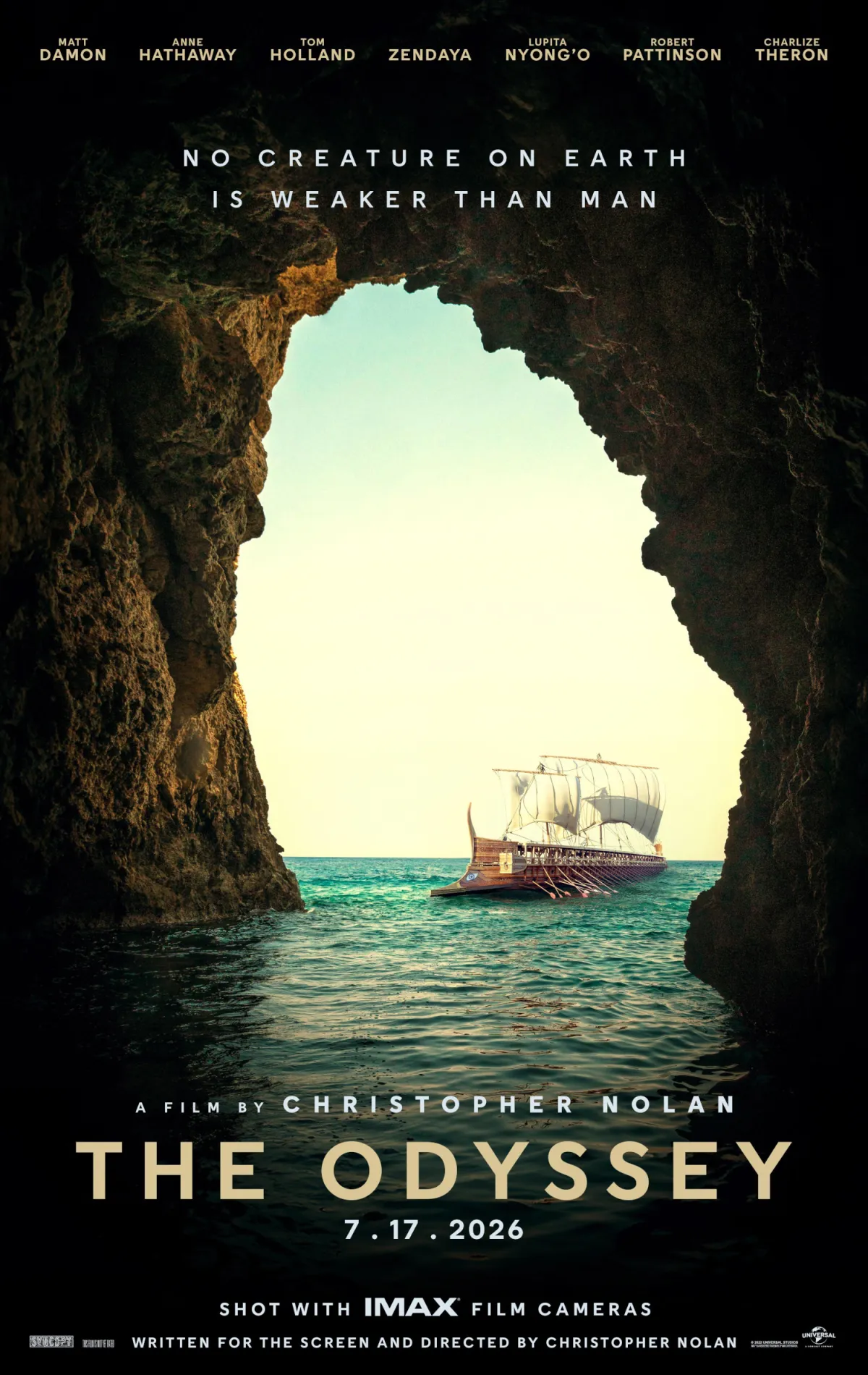
Christopher Nolan | The Odyssey | 172 minutes | Universal | UK/USA
James Joyce already knew, over a century ago, that it is only by radical transformation, not an attempt to reverently preserve, that something truly new can be created from a foundational text of European literature. His Ulysses became a classic itself precisely because Joyce does not retell Homer’s Odyssey, but rather translates it into the modern era. Homer is everywhere in it and yet nowhere at all. His motifs form an invisible framework; they are reflected, refracted, treated with irony, and transposed into everyday life. The cunning warrior Odysseus becomes the Jewish-Irish advertising salesman Leopold Bloom; the odyssey across the Mediterranean becomes a day in Dublin; the slaughter among the suitors becomes a bedtime cup of cocoa in a quiet kitchen.
Joyce thus demonstrates that great literature remains alive not by being preserved, but by being transformed. Every era must write its own Odyssey. That is precisely why Homer’s epic is one of those rare works that are never complete. It thrives on provoking new questions time and again.
Why Christopher Nolan chose this particular subject matter, however, remains a mystery. Admittedly, the homecoming theme runs like a common thread through his entire body of work—from Memento to Inception, Interstellar to Tenet. His characters are searching less for a place than for a lost state, an identity they have lost along the way. Hardly any other contemporary director circles so persistently around the question of whether a return is even possible.
That is precisely why Homer’s Odyssey should actually have been the ideal material for Nolan. But what Joyce did with Homer is precisely what Nolan does not do. He discovers neither a new present nor an unexpected perspective on the myth. His Odyssey adds little to the countless literary and cinematic adaptations of the material—except for a longer runtime, more pathos, more stars, and more decibels.
For an audience accustomed to Western culture, this is particularly disappointing. Here, the adventures of Odysseus are part of the basic cultural heritage. Generations have grown up with them: in children’s books, at school, in radio plays, and in film adaptations. Nolan’s version therefore very quickly evokes a sense of déjà vu. Ah, the Cyclops. Now the Sirens should be coming. And sure enough: here they come.
The real problem, however, isn’t the fact that Homer’s famous stories are being retold, but how Nolan does this. For a director whose films often thrive on narrative detours, jumps in time, and shifts in perspective, here he opts for a dramatic structure that barely goes beyond mere illustration. Instead of allowing the myth to be reimagined, it simply reaffirms what the audience already knows.
Cinema of Assertions
This illustrative approach shapes the entire film. No episode is allowed to stand alone, no character is allowed to develop ambivalence, no situation is allowed to unfold slowly. Everything is announced, explained, emphasised, and finally sealed with music. Nolan’s dramaturgy functions like a cinema of assertions. When Telemachus says with a trembling voice that he senses his father is still alive, we cut immediately to Odysseus on the beach. Moments after the word “Troy” is uttered, we find ourselves before Troy himself. When Odysseus asks Calypso, after seven years of enchantment, “I do have a wife, don’t I?”, Penelope immediately appears. This corresponds exactly to the phenomenon that Namwali Serpell highlighted last March in his essay The New Literalism Plaguing Today’s Biggest Movies in The New Yorker.
The editing doesn’t create productive connections here, but merely illustrates sentences. It treats the audience as if it possessed neither a memory nor the ability to link thoughts across two shots. Instead of associations, we get confirmations; instead of suspense, mere recognition.
That is precisely where the real irony lies. Hardly any other director in contemporary cinema has built his career so heavily on complex narrative structures as Christopher Nolan. Memento, Prestige, Inception or Tenet were so effective because their stories took shape gradually, forcing the audience to actively reconstruct them. Even where these constructions at times became an end in themselves, they nevertheless represented an attempt to reorganise cinematic storytelling.
Ironically, it is with Homer that Nolan diverges. The Odyssey is not reinterpreted, but rather managed didactically. Every scene seems intent on ensuring that no one loses the thread. Paradoxically, the result is not a clearer narrative, but a flatter one. To spell out every meaning robs it of the opportunity to take shape in the viewers’ minds in the first place.
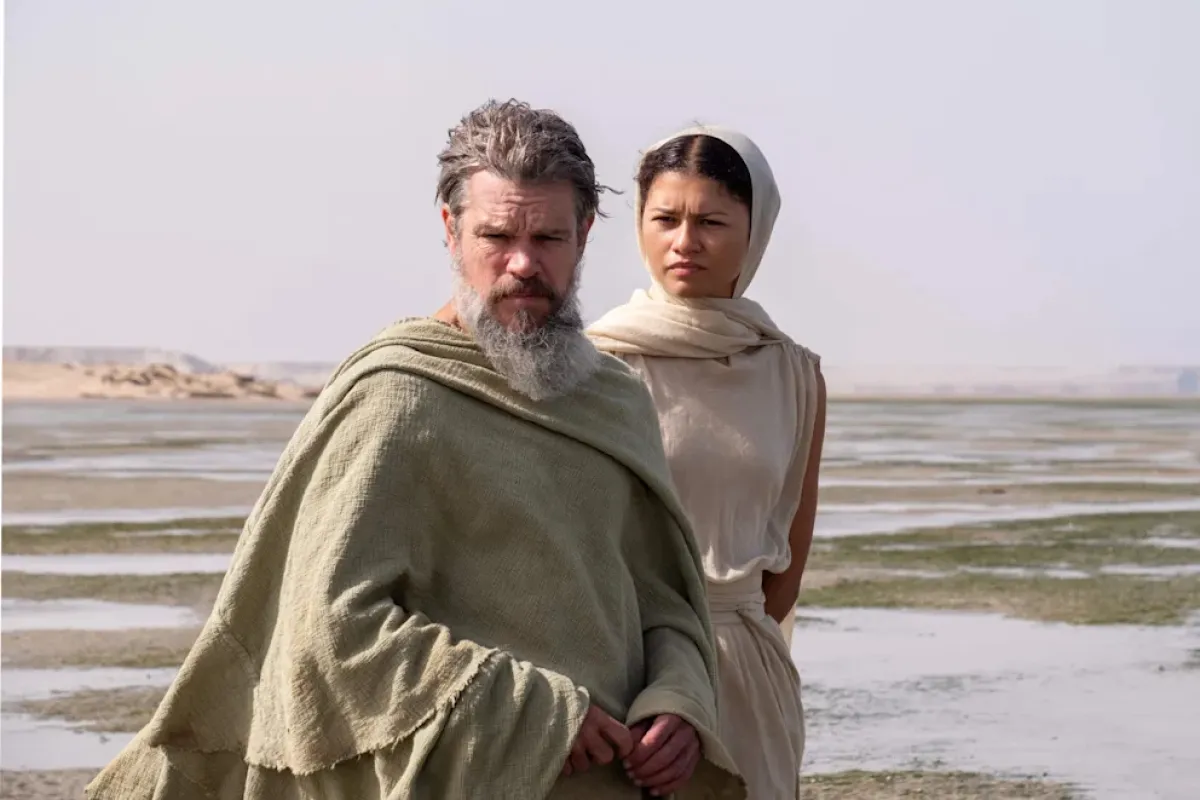
Yet there is by no means a lack of acting presence. Matt Damon conveys the weariness of a man who has survived the war but has long since forgotten to where he is returning. Tom Holland imbues Telemachus with youthful uncertainty, while Anne Hathaway lends Penelope a quiet, controlled dignity. Zendaya, Robert Pattinson, and Charlize Theron also take on their roles with the professionalism one would expect from an ensemble of this calibre.
Yet even these actors often seem like people who have been bundled into mythological robes that are too big for them. The costumes are magnificent, the close-ups monumental, but the characters disappear behind the significance they are meant to embody. They exist less as characters than as stages along a well-trodden myth.
The same principle governs the audio-visual design. Ludwig Göransson’s score does indeed forgo the traditional “gladiator film” orchestra and combines ancient instruments with electronic soundscapes—an appealing concept. But like nearly everything in this film, the music, too, is subordinated to a single idea: impact is to be created through escalation. The music does not accompany; it explains. It does not open up spaces; rather, it seals them off. What the dialogue has already expressed is translated again into sound.
The same applies to the visuals. As the first blockbuster shot entirely with newly developed 70-mm IMAX cameras, the film relentlessly showcases its technical grandeur. But grandeur alone does not create an experience. Monumentality is not an end in itself; rather, it must arise from an inner necessity. With Nolan, it often seems to be the actual objective.
This gives rise to that peculiar excess that runs through the entire film. Every scene aspires to be a climax, every shot claims significance, every musical crescendo marks the ultimate emotional peak. But because everything is important, any importance at all is soon lost. The constant assertion of grandeur ultimately devalues grandeur itself.
Homer’s Modernity
Yet Homer's Odyssey would be astonishingly relevant today. Unlike the Iliad, whose world is defined by glory, honour, and military prowess, it tells of a society in flux. Goods, stories, and people cross the Mediterranean; strangers encounter one another; hospitality becomes a matter of survival. Time and again, the epic poses the same questions: Who can you trust? Who keeps their promises? How do you communicate with people whose rules and languages are unfamiliar?
Odysseus survives not primarily because he is the strongest warrior. His true talent lies in his ability to transform himself. He deceives, tells stories, assumes new identities, adapts to changing situations, and realises more quickly than others that rigid roles are of little use in a complex world. His famous cunning is less a matter of military ingenuity than of social intelligence.
Penelope, too, is far more than the expectant wife that later tradition has often portrayed her as. While Odysseus tries out different identities on his travels, she engages in an equally sophisticated masquerade on Ithaca. She buys time, deceives her suitors, never fully reveals her thoughts, and, with narrative skill, keeps open a political space that seems long lost. The homecoming succeeds, therefore, not thanks to the hero alone but to two people who have learned to endure ambiguity.
It is precisely this fluidity that makes the Odyssey such an open-ended text even today. It is about the return of a warrior, yes, but also about migration, cultural translation, and the question of how identity remains possible at all under conditions of constant change. Home does not appear as an unchanging place, but as something that must be constantly renegotiated. When Odysseus finally reaches Ithaca, he does not find a world that has been patiently waiting for him. Even his homeland has become a different place during his absence.
Adorno and Horkheimer, therefore, recognised Odysseus as a key figure of European modernity. For them, he embodies the beginning of that instrumental reason with which humanity attempts to master nature, myth, and ultimately itself. Therein lies the true ambivalence of the epic: it celebrates the triumph of cunning while simultaneously revealing the price demanded by this cunning. The clever hero saves his own life, but every act of salvation takes him further from himself and ends in violent conflict.
Precisely for this reason, Nolan’s film could have found numerous points of connection with the present. One could have read the Odyssey as a narrative about migration, about cultural encounters, about identity politics, about the collapse of familiar orders, or about the fragility of home in a globalised world. One could have asked how a person can even return home after twenty years of war—and whether returning home does not always also mean acknowledging the loss of one’s own past.
Nolan, however, shows little interest in this openness. His film reduces Homer’s polyphonic text to the self-examination of an extraordinary man. Odysseus suffers, fights, resists temptations, falls, gets back up, and ultimately reclaims his home through violence. An epic about change thus becomes a narrative about self-assertion. Social mobility is replaced by heroic steadfastness; cultural ambiguity gives way to an ideal of masculinity that seems to stem less from Homer himself than from the redemptive fantasies of modern blockbusters.
This is precisely where the real disappointment of this film lies. Nolan does not fail because he tells Homer’s story inaccurately. He fails because he once again turns a text—whose survival for nearly three millennia has depended on its adaptability—into a frozen monument.
The Return of the Myth
Perhaps this is also the real difference between James Joyce and Christopher Nolan. Joyce understood that Homer’s epic has survived not because it is immutable, but because every era has been able to discover something different in it. His Ulysses is not a tribute to the original, but its productive transformation. The myth remains alive because it continually exposes itself to the questions of a new present.
Nolan chooses the opposite path. He treats the Odyssey like a cultural high altar, whose greatness must be authenticated above all by its monumentality. The technical resources are overwhelming, the cast is top-notch, and the effort is enormous. Yet it is precisely this reverence that robs the material of the flexibility that has sustained it for nearly three millennia. The film does not retell Homer’s story; it preserves it.
Ultimately, what remains above all is the image of an extraordinary man who, after a long odyssey, returns to his home and forcibly restores the old order. That is one possible interpretation of the Odyssey. But it is probably the least surprising one. For Homer’s epic tells not only of homecoming, but also of alienation, transformation, hospitality, identity, and the realisation that no one returns unchanged to the place from which they once set out.
Perhaps this is what explains the peculiar emptiness that sets in despite all the visual power. Not because Nolan misunderstood Homer, but because he has turned one of the most open texts in European literature into one of the most closed films of his career. Where Joyce opened up the myth, Nolan turns it back into a monument.
After three hours, you therefore leave the theatre with an unexpected realisation. Not about how grand Christopher Nolan’s Odyssey has become. But about how modern Homer still seems—provided one reads him not as a monument, but as an invitation to set out anew time and again.
Did you enjoy this text? If so, please support our work by making a one-off donation via PayPal, or by taking out a monthly or annual subscription. Want to make sure you never miss an article from Literatur.Review again? Sign up for our newsletter here.




 Universal