



Those who remain silent about techno-capitalism are talking about vampires
 Macmillan
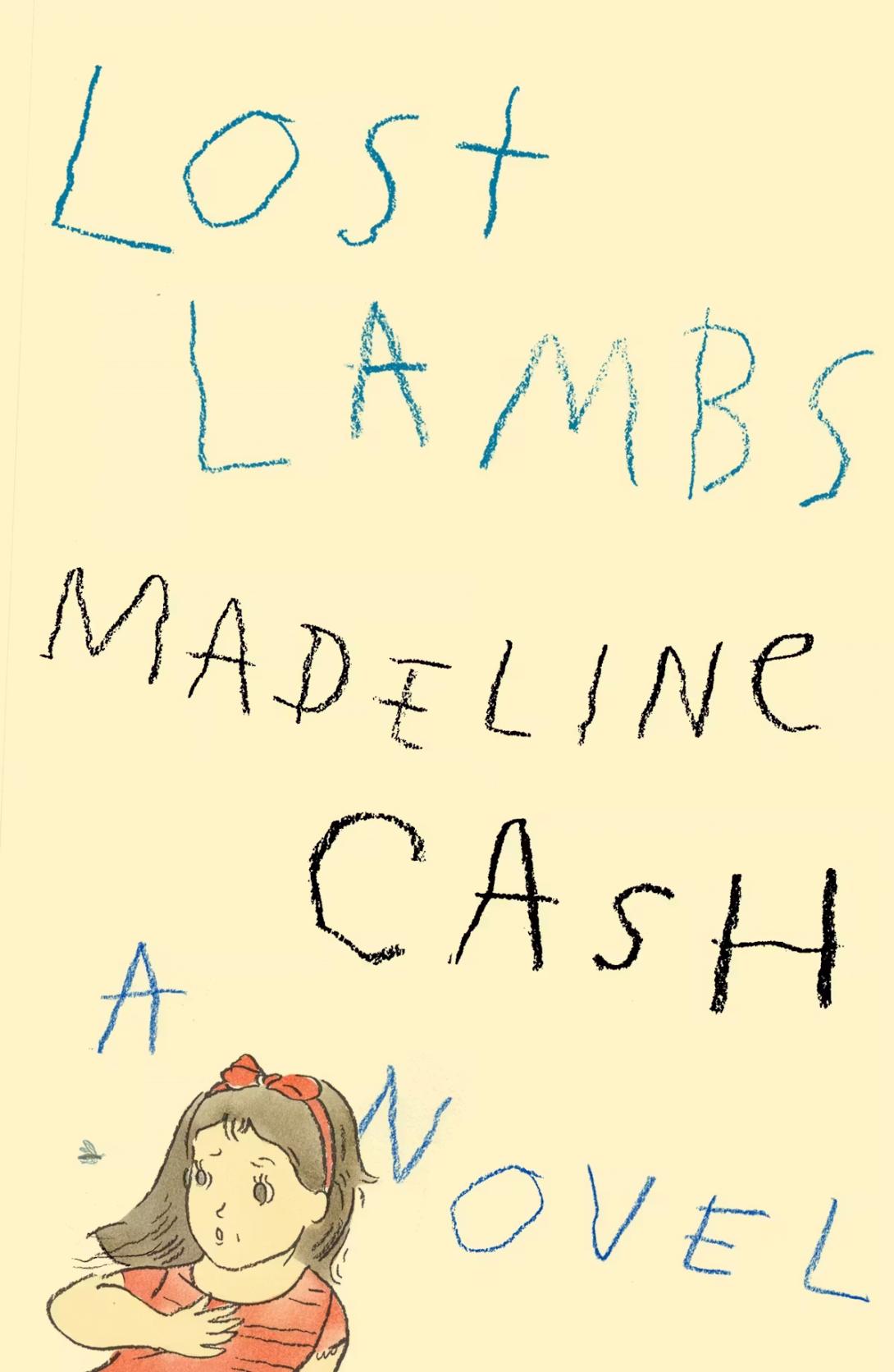
Madeline Cash | Lost Lambs | Macmillan Publishers | 336 pages | 28 USD
Poor sheep!
Since the pandemic, sheep have no longer been able to graze peacefully. They have been driven from the meadow by ‘resistant fighters' and forced to serve as a rhetorical device: sheep are herd animals who continue to munch contentedly, oblivious to the fact that their paths around the field are predetermined and that their complacency marks the end of critical thinking, making it impossible to see beyond the fence. From this metaphorical cage, the sheep are supposed to bleat their way to freedom for the human herd animals, or, penned up, replace the tired old trope of “government puppets.” When are sheep ever allowed not to have a hidden agenda? When will they not have to follow some larger plan?
Now they’re also being used for the German translation of Madeline Cash’s 'Lost Lambs'. The novel, published in the U.S. in January 2026, quickly becoming a national bestseller, has in May 2026 also been published in German under the title “Verlorene Schäfchen,” translated from English by Sophie Zeitz.
The setting: Contemporary America in a suburb
This very humorously written novel, told through a network of characters and with multiple narrative voices, tells the story of the problems faced by the Harpers, a family in a small Southern California town, almost a suburb of a suburb. Looming over this world is the power of the multi-billionaire Alabaster, son, heir, and owner of the harbour—the man in whom economic, social, and symbolic power converge. Rumours, desires, and obscene fantasies of youth, beauty, and immortality swirl around his mansion; teenage girls, in particular, are drawn to this promise.
Abigail, the Harpers’ eldest daughter, also gets caught up in this maelstrom. In the context of social media visibility, proximity to Alabaster’s world becomes a sign of having been seen, desired, and chosen. Beauty appears here not as a quality but as currency; recognition not as an experience but as a ticket of admission.
Alongside her is Wes, a young veteran who now works in Alabaster’s security apparatus. Through him, the novel brings together the experience of war, trauma, guilt, and the question of how military violence reintegrates itself into American normality. The characters and narrative voices refer to him as “War Criminal Wes”; whether and in what sense this name is fitting remains curiously open, because Wes clings to his memories just as stubbornly as he does the present into which he has been returned. It is precisely in this character that Cash’s novel is a quintessentially American story: veterans are placed into a normality that has long been crumbling, yet still offers them security jobs with arms-obsessed managers.
The novel becomes even more powerful where it shows that American middle-class normality itself no longer constitutes a stable counterworld. Bud Harper, father, employee, accounts-and-systems manager, lives an outwardly sheltered existence, though in a world whose order seems to be constructed of nothing but cardboard. One doesn’t have to step outside it to feel despair. Normality itself is enough to push people to their limits. There is no harmless life with which all of this could be defended.
The Harper daughters, for their part, navigate the marital crisis of their parents, the demands of everyday family life, and greater temptations typical of our time. The middle daughter, Louise, for example, searches for a form of uniqueness and stumbles online into spaces where loneliness, religious radicalisation, manipulation, and desire become indistinguishable. The younger sister, on the other hand, navigates this world with a shrewdness that almost assumes a narrative function. And around Abigail, connections emerge through which the private, the familial, the conspiratorial, and the political become increasingly intertwined.
Up to this point, there have been quite a few “because” and “therefore” sentences. For what the characters experience and what they think often follows neatly from their respective identity categories. The novel attributes them typical contemporary narratives of radicalisation, gender, social mobility, trauma, or political powerlessness. The narrative world of “Lost Lambs” is so heavily focused on contemporary characters and themes that what is said sometimes becomes predictable.
The fact that the novel provides so much grounds for “because” and “therefore” sentences in this critique reveals its reductionism. In fact, the characters largely read like templates. This is also because the novel’s multi-perspective structure is primarily evident in the fact that, depending on the narrative perspective, a few social circumstances, environmental clues, and insights are exchanged, but not the narrative style itself.
The novel’s network-like quality certainly sells well to postmodern critics. However, this characteristic is primarily situated at the level of representation, not at the level of the text. This does not make the writing literarily exciting, let alone subversive, but rather Netflix-like: Everything is connected to everything else, every character is in the right place at the right moment, every motif finds its connection to another. The network-like structure does not resolve conflicts because the novel truly exposes power structures, but because it folds reality into a plot. What remains unwieldy on the outside can be elegantly interwoven here. That is precisely where the irony lies: the world is presented as complicated, but narratively arranged in such a way that, ultimately, it functions surprisingly well.
Concealing Contexts: A Poetology of Conspiracy
Unless, that is, we follow Tibet's example and allow conspiracy theories to explain the world to us. Abigail’s best friend is a white, middle-class teenager and “internet geek” who spends her evenings immersed in her hobbies, Reddit and Telegram equivalents. This was also how she obtained information on Alabaster who, out of the blue, had invited Abigail to his party: “Within minutes, she received a flood of replies, opinions, photos, links to articles, scans of microfilms, and songs played backwards. Tibet sifted through the material. Separating fact from fiction was the key to her work.” Tibet makes use of the conspiracy theories. The “research” conducted with the help of the threads—which the narrative voice had already labelled as conspiracy theories—thereby alters their status as knowledge. And the novel’s plot then confirms what Tibetans read in the evening about “generations-old networks, secret ceremonies, and immortality.” Tibet’s fictions reveal themselves, prove themselves; they are no longer heterodox knowledge but provide insights into the connections between Alabaster and the city administration. They are the motivators of the plot. After her research, Tibet calls Abigail’s younger sister, who in turn informs the war criminal. Tibet’s research can thus be read as a program of discovery that the novel itself has adopted in its form.
Yet while Tibet sorts through her sources and critically examines discourses with regard to their fictionality, the origins of those narratives that help construct the concrete narrative of 'Lost Lambs' remain unreadable. Alabaster’s “vampirism”—which has been met with a smirk by critics so far—bears a striking resemblance to the anti-Semitic figuration of vampirism in its connection to money and “generations-old old-boy networks.” This similarity is not merely hermeneutical; it is evident in the plot. While Bud accepted hush money from Alabaster, the middle daughter Louise converted to Judaism after her foray into Islamic fundamentalism. For this, she accepts her father’s “blood money”: “[…] I’ll buy you something silly and expensive with my blood money. “Fine,” said Louise. “I need a mezuzah.” The text does not reflect on the fact that this combination evokes historically significant associations.
Why is vampirism associated with Judaism—wouldn’t it be more obvious to attribute the urge for immortality among tech billionaires like Alabaster to their de facto omnipotence; in a system of unbridled capitalism and the political, ongoing strain of digital and technological change?
Louise is radicalised online by an Islamist: a scenario also found in the narratives of the far-right nationalist imagination.
Digital radicalisation through Islamism does, of course, occur, but currently originates primarily from other milieus: the Manosphere, incel forums, or tradwife communities. In many other respects, Lost Sheep draws on popular social and political discourses. Its characters embody recognisable narratives of the present: the traumatised veteran, the precarious middle-class family. Here, the novel tells its story through a right-wing nationalist threat narrative. Why this particular distortion?
In fact, only white characters appear in the narrative world. The “Islamist,” as the only non-white person, does not speak; his speech is transposed indirectly via a chat forum. And he is nothing but a terrorist.
The narratives that help construct the story are not only conspiratorial; they are also part of specific political agendas. They speak of national communitarianism; they ignore the tragedy of everyday life except for Bud’s excursions; they exploit “the Others” so as not to attack the current development of capitalism and those who actually help govern America. One should be cautious about reviewing this very narrative as the “book of the moment” or the “book of the summer.”
On Silence and Lambs
The English title is “Lost Lambs.” Here, too, animals must once again serve as metaphors, as they so often do. Only in the latter sense is the young sheep not to blame for its wandering. While lambs are portrayed as dull, finger-pointing figures, the “lamb” is the absolute object, the victim. The English version of the title, on the other hand, addresses the brutality of this novel: someone always has to play the object.
To be the lamb. That is why conspiracy theories are not harmless: in one scenario, they exploit the very real material hardship of techno-capitalism today, while remaining silent about that injustice. In the other, groups of people must line up behind centuries-old ciphers, play the lamb, serve as a scapegoat so that the super-rich can graze away the livelihoods of all the little sheep. “Lost Sheep” does not confuse these two constellations. It cannot find a way to deal with them, so instead tells yet another vampire story.
Did you enjoy this text? If so, please support our work by making a one-off donation via PayPal, or by taking out a monthly or annual subscription.
Want to make sure you never miss an article from Literatur.Review again? Sign up for our newsletter here.