


Michael Jackson, who devoured my father
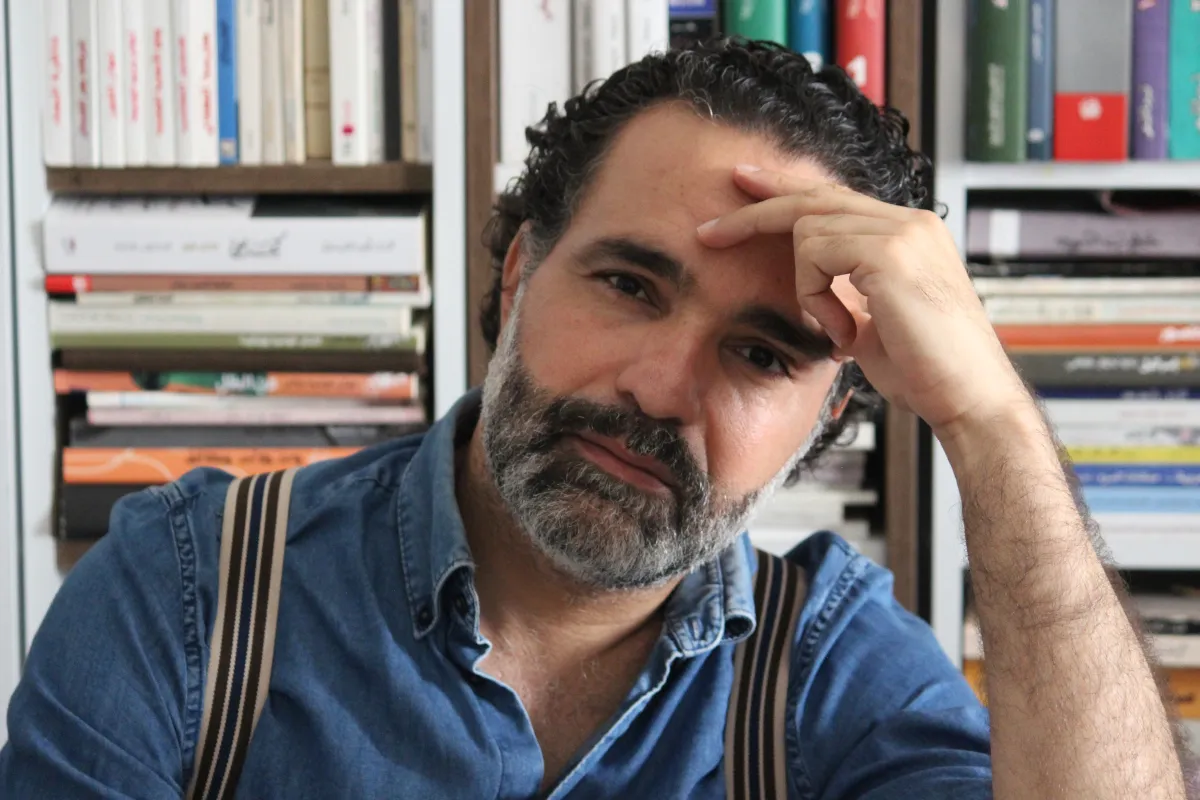
A novelist, literary critic and writing workshop facilitator, Kamel Riahi is a Tunisian writer based in Toronto, Canada. He has taught at Carleton University and the University of Toronto and was a research associate at Massey College in 2025. A member of PEN Canada, he founded the House of the Novel in Tunisia and Bayt al-Khayal, a literary writing laboratory that now also operates as a cultural centre in Toronto. He has contributed to the Arab and international press, including The New York Times and The Globe and Mail.
The author of around sixteen books, including Al-Mishrat, Al-Ghorila and Wahid-Sifr lil-Qatil, his work spans fiction, literary criticism, diary writing and political thought. Translated into numerous languages, he has received several awards, including the Comar d’Or (2007), the Beirut 39 Prize (2010) and the Ibn Battuta Prize (2018). His work is studied at universities around the world.
‘There he is at last. Thank God,’ said my mother before getting back to tidying the house. All she'd needed was a glimpse of the little bicycle appearing on the horizon, right at the end of the path, to put her mind at rest. An chill had run through her heart an hour earlier, reminding her of her husband’s face that morning when she had adjusted his chechia*. A dark cloud seemed to hang over him as he pushed his bicycle to the weekly market. He was due to meet his brothers there and remind them, for the third time, that it was time to plough the land they’d inherited from their father. ‘We’re not ready this year either,’ they’d replied. Last time, he’d shouted in their faces that it was a disgrace. The land would not be left fallow for another year. ‘I’ll pull up the jujube trees myself.’
‘Pray for the Prophet, my dear. God will sort things out in the end,’ my mother had said.
He had nodded without smiling, stepped on the pedal and ridden off. My mother had watched him go for several minutes. His knee seemed to weigh heavily on the pedal. As she always did when he left the house, she had prayed for him, then gone back to check on the red-haired goat. She was due to give birth any moment now.
A few hours later, hearing the sound of the bicycle, my mother went out to fetch the basket. It was lighter than usual. My father’s face had grown even darker since that morning. This time, my mother said nothing. She lifted the basket and went into the kitchen. My father absolutely loved mokli. He’d forgotten to buy the potatoes. My mother, though, had a solution for everything. She slipped under the eaves and pulled out three potatoes. My father liked them sliced. He also liked green chillies – the really hot ones. She carefully chopped the tomatoes and threw them into a small saucepan to make the mokli** sauce. Then she poked her head through the door. My father was lying on the mattress, right on the floor.
For a whole week, my father worked tirelessly to uproot the jujube trees. His hands had ended up swollen. He was the sort of person who never gives up. He’d sworn to himself that he’d get rid of every last one, on his own. From him, I inherited my soft palms and my obstinacy.
It was October 1996. All the talk in Tunis was about the Michael Jackson concert. I was wandering round the Friday market, rummaging through the shirts in search of one I could wear for my upcoming start at university, when I suddenly decided to head home. My brother was waiting for me there. We had to catch the train. Our father was ill. How had he found out? Someone from the village must have phoned him. Back then, we didn’t have mobile phones. The only landline number where my brother could be reached was at his workplace.
We didn’t exchange a word. I changed my clothes and we set off. On the way to the station, I spotted Michael Jackson fans queuing outside the El Menzah stadium, hoping for tickets.
For two and a half hours, the train crawled along, as if reluctant to arrive. A month had passed since my last journey. That day, before I set off for Tunis, my father had accompanied me from our village. He walked beside me, pushing his bicycle whilst talking to me. It was as if he were saying goodbye to me. For the first time, he spoke to me as if I were a friend. “Just keep reading… I’d like to see you become a great writer, like Tawfiq al-Hakim.”
We’d sat in front of the station, waiting for the train to arrive. I’d kissed him, and given him a hug. He smelled good. We hardly ever hugged. I could only remember one other time, ages ago, when I’d nearly died after an accident with a wild boar. But that scent—I’d sometimes catch it on his chechia, which I’d secretly try on. Through the train window, I’d seen him climb back on his bicycle and set off for home again.
+++
My brother roused me from my daze: we had arrived. A Peugeot 404 was waiting for us. At the wheel was our neighbour from the village, with his Salvador Dalí-style moustache and serious expression; he asked my brother about life in Tunis and his work. He seemed sad, but didn’t breathe a word about my father’s illness – the very reason for our return. What on earth could that phrase, ‘my father is ill’, possibly mean? In his entire life, my father had never once seen a doctor.
When we arrived, my mother hugged us both, my brother and me. She cried for a few moments before pulling herself together.
‘Is he…?’ asked my brother.
‘No. But… he’s waiting for you. ”
She meant he was on his deathbed.
She told us that, two days earlier, after making lunch, she’d called out to him, but he hadn’t answered. Since then, he’d been lying there, silent. That was how we found him when we entered the room. A strange rattle was coming from his throat. I rushed over to him to kiss his hand.
‘We brought him home from hospital two days ago,’ said my mother. ‘The doctor told us there was nothing more to be done. It was better to bring him home before things got any more complicated. If he’d stayed in hospital, his body would have been held for a post-mortem.’
Throughout the day, my brothers flocked from all over. But his soul had not yet left him. It remained there, suspended.
My mother, whom my father had always cherished so dearly, suddenly seemed possessed by him. She began to issue instructions.
‘You, take the money from your father’s bag and go and have the shrouds made. He insisted that his shroud be paid for with his own money. And you,’ she said, pointing at me, ‘take the bicycle, go to your uncle’s place in town, and bring back the jar of honey. That will help his soul to depart. ‘You, go and ring your brother in the army. Tell him to come. Your father's soul won’t leave until he's seen you all again. I know him. I know him well.’
I jumped on my father’s bicycle and set off, pedalling fast and furiously. Seven kilometres away, I collected the jar of honey and turned back. Halfway home, a question gripped me by the throat. What was I doing? Was I taking this honey back to kill my father? How could I live with that? What a burden have you just placed on me, Mum?
The closer I got to the house, the heavier my knees felt. When I reached the entrance to the courtyard, I dismounted. I hid the jar of honey behind my back, clutching it tightly, ready to fight off anyone who tried to snatch it from me. It was then that I heard my mother’s voice.
‘Come. Come in. Your father is asking for you.’ ”
He took my hand in his—so gentle—and squeezed it lightly. His gaze pierced right through me. For a moment, I felt as though he were rising up from his bed to enter me, to fill me to the very depths of my being, before his hand gradually loosened its grip.
He didn’t move. He said nothing. He merely looked at me, with that look of his.
My mother took me by the arms and led me out, then waved away all those who had gathered round him. She stood in the doorway, firmly tightening the belt that held her melia*** at her waist. ‘ No one must come in now. Neither woman nor man. ”
Then she shut the door behind the two of them.
In the vast, deserted courtyard, there we were: my brothers and I, the goats, the little short-legged donkey, the hens, the partridge, the fat turkey, the sick dog and the birds perched in the trees. We were all there, our eyes fixed on the closed wooden door, waiting.
After a while, we saw water seeping under the door and flowing towards us. The water flowed, laden with soap; it flowed on, mingled with soap; then it flowed, flowed, flowed, finally clear, as pure as my father’s palm when it held mine.
The door opened. My mother appeared, her melia slightly damp.
‘Come on, come in. Forgive him, one by one.’
We stepped towards him, suddenly like tiny children again. We all stepped forward – my brothers and I, the hens, the kid, the goats and the birds – to kiss his forehead.
My mother stood as straight as a tree. This was the very same woman who, just a few days earlier, had looked like a withered nettle, exhausted by kidney disease.
We stood up and lined up in front of her, like a night patrol. She placed a finger on my forehead.
‘You. You, young man, go and tell your uncle that your father… Only God is eternal.’
Suddenly, I felt as though my head were touching the ceiling. I had grown. I felt even taller as I ran towards my uncle, who was at the foot of the mountain, busy breaking stones to build his new house. I was running towards him, and the faster I ran, the more I seemed to grow…
Ever since that day, the image of Michael Jackson has remained inextricably linked to my father’s death. Until 25 June 2009, when I learnt of the singer’s death. That day, I wept bitterly. I was about to leave Tunis for Algeria. I no longer knew whether I was crying for my father, for myself, or for Michael, whom I was beginning to believe had come, in that October of 1996, to perform my father’s farewell concert.
Explanatory notes:
*chéchia: A traditional Tunisian headdress in the shape of a skullcap, made of felted wool, usually red in colour.
**mokli: A popular Tunisian dish consisting of fried vegetables, notably potatoes, peppers and tomatoes, sometimes served with eggs.
***mélia: A traditional Tunisian garment for women consisting of a large piece of fabric draped around the body, held in place by brooches and cinched at the waist with a belt.
+++
The English adaptation is based on the French translation from Arabic by Rita Barotta.
Did you enjoy this article? If so, please support our work a one-off donation or a monthly subscription via one of our subscription options. We’d be delighted!
Don’t want to miss any more articles on Literatur.Review? Then sign up for our newsletter free of charge!