


When the streets of Paris stir memories of Beirut
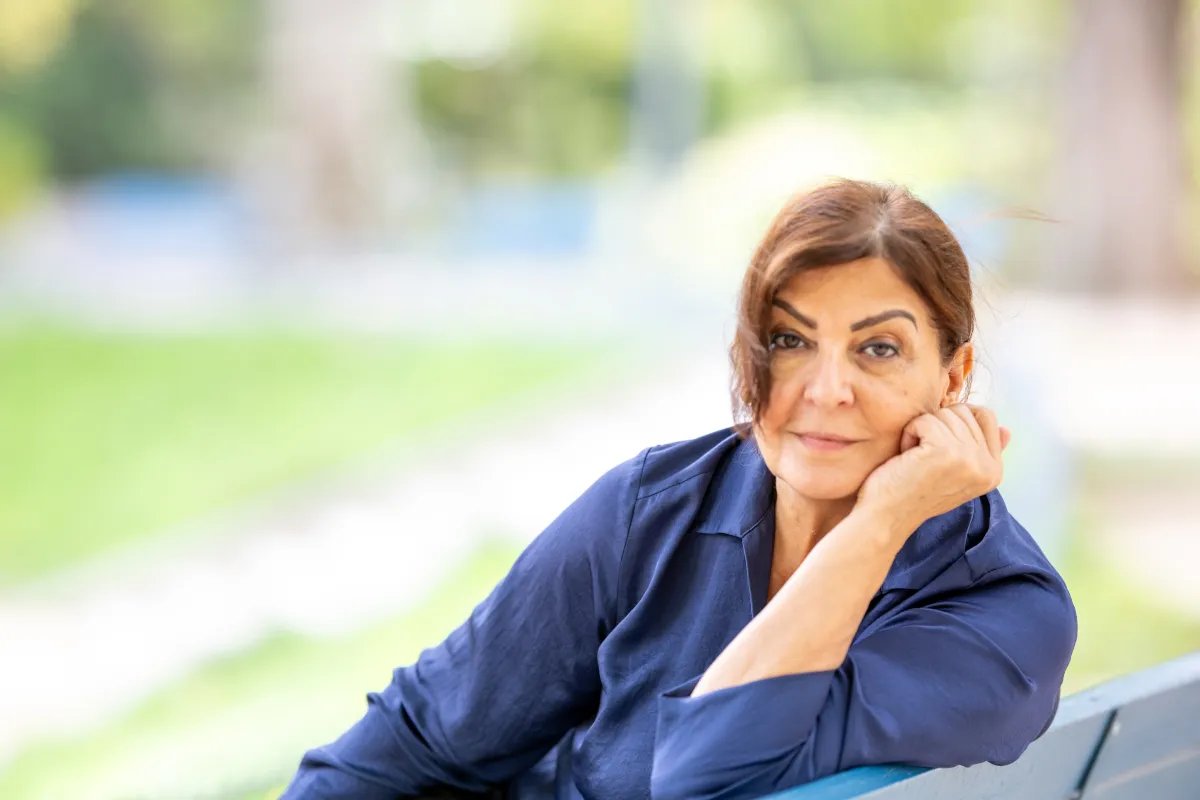
Iman Humaydan, born in Ain Anub, Lebanon, studied sociology and anthropology at the American University of Beirut. She has published six novels and various short stories, and has written screenplays, all of which have been translated into international languages. In her novels, she gives women a voice and allows them to tell their own stories. Her fourth novel, 50 Grams of Paradise, was awarded the Katara Prize (Qatar) in 2016. She teaches Arabic and creative writing at universities in Europe and North America, and her creative writing course at the University of Saint-Denis in France is the first course on creative writing to be taught in Arabic. Humaidan was a jury member for the 2022 International Prize for Arabic Fiction (IPAF). She is a co-founder of the Lebanese P.E.N. Centre, of which she was president from 2015 to 2022, and a board member of Pen International from 2017 to 2023.
She is an author and editor at @literatur.review.
Since the student protests began in France in September 2026, I have found myself returning to old questions I thought I had long since left behind – or at least gained enough distance from to consider more calmly. I follow images of young people in the streets, read the slogans on their banners and try to understand what drives them to protest, what they want to change and what they fear losing. Yet I see more than the present: faces from the past, other streets, and I hear voices that once rang out in different parts of the world, their echoes still alive within us long after they fell silent.
It is difficult to see what is happening in Paris as merely a contemporary French event. For me, it evokes memories of distant times, personal and collective experiences, and questions that have lost none of their significance. What does it mean to be young in turbulent times? What leads a generation to believe that the world it has inherited is no longer a world it can live in? And does the meaning of protest change with the times, or is it the language in which we express our anger, hope and fear that changes?
I think back to May 1968 in France, when students at the University of Nanterre took to the streets. The movement spread, drawing in students from across the country and growing into a social and political crisis that engulfed large sections of society and culminated in major workers’ strikes. The uprising was more than a protest against conditions at universities. It reflected a desire to challenge the social and political order in France and beyond, to question authority and reconsider relations between generations.
May ’68 is more than a historical memory. It has become the symbol of a generation that wanted to open closed doors, test the limits of what was possible and declare that the world as it stood was not an unalterable fate. Yet when we look back on that moment, we may be tempted to turn it into a complete, coherent picture, forgetting the contradictions that accompanied it, the hopes that were only partly fulfilled and those that were disappointed.
I reflect on the distance separating today’s protests from the generation of May ’68. Every generation has its own circumstances, crises and anxieties. We cannot place the two experiences within a single framework or assume that history literally repeats itself. Yet there are moments when young people feel that the language available to them can no longer adequately describe their reality, and that the usual ways of expressing their demands no longer reach anyone. At such moments, the street becomes a space in which to speak – and perhaps also to discover what it means to stand together.
The 1970s in Beirut
I follow the school pupils’ demonstrations in France on social media. They are protesting for better conditions in their schools and classrooms. They have not taken to the streets to steal, destroy property or set fires. I refuse to let those intent on destruction undermine my belief in the justice of the pupils’ demands. Nor will I overlook the sight of teachers and parents joining hands to form a circle in front of the pupils, facing the security forces to protect the children from harm.
What I see awakens memories that remain vivid within me. My thoughts return to Lebanon, to the demonstrations that filled the streets of Beirut in the 1970s. I remember the feeling that accompanied us as we took to the streets with our ideas and questions, convinced to varying degrees that our participation could change something about the reality in which we lived.
Beirut was then a city where cultural vitality existed alongside political and social tensions. Debates took place in universities, newspapers, cafés and homes. Questions of justice, freedom, equality and the country's future were part of everyday life. Politics was never separate from daily existence. It entered into our decisions and relationships, shaping how we understood ourselves and our place in society.
Taking part in demonstrations did not mean that we knew the way forward or always agreed on what the future should look like. Like every generation, we carried our differences and contradictions and tried to reconcile our convictions with what circumstances allowed. Yet going out into the streets gave us a sense that we were not alone, that our concerns were not merely private matters, and that the words exchanged in our discussions could find their way into the public sphere.
Today, I look back on those moments across a great distance of time. I know what happened afterwards, how war entered our lives and transformed our cities, relationships and dreams, and how what once seemed possible became threatened or slipped beyond our reach. Yet I do not want to read the past solely through the lens of what came afterwards, or reduce the experience of an entire generation to the outcome of later events. The lives we lived were not merely a prelude to what followed. They were lives in their own right, filled with the desire for change, friendship, love, work and writing, and a belief in our ability to help shape the world.
Despite the war in Beirut and everything that followed, writing about culture, literature and art as a journalist remained more than a profession for me. It was part of a larger project: the vision of a homeland that could accommodate freedom and difference, and of a life not governed by fear. Through writing, as well as through other activities in which I was involved, I tried to contribute to building that possible homeland – or at least to keep its image alive in my dreams and memories.
Writing was inseparable from our questions about society and our desire to see Lebanon become something different from what it was. Culture, literature and art offered spaces in which we could imagine another life, express our contradictions and open windows onto possibilities that reality denied us. At times, writing was our way of resisting a sense of helplessness and holding on to the belief that a homeland is more than borders and geography. It is also something we work to make more just and more welcoming to everyone.
During the war years, I came to understand what it meant to move through a divided city whose streets could no longer be trusted, and what it meant for fear to become part of everyday life. That fear arose not only from danger itself but also from uncertainty: what might await us along the way, whether we would reach our destination, and whether the life we were trying to preserve would remain possible.
I thought that leaving Beirut and putting those years behind me would create enough distance between myself and that feeling. But fear does not remain in the place where we first encountered it. Sometimes it returns in another city, in a fleeting moment, without our knowing exactly what has summoned it back.
+++
Today, on a street in Paris, I was suddenly overcome by that familiar fear, though it was less intense than the fear I had known in Beirut. It was not necessarily fear of any particular danger, but fear that the city might lose its soul. For me, Paris is the city of May 1968 and its spirit; I cannot see it otherwise. I was afraid that the experience of loss might repeat itself, that I might once again face the possibility of losing a place that had become my home.
It became increasingly difficult for me to regard the protests simply as political events. I watched them with the anxiety of someone who knows that a sense of security can never be taken for granted, and that the place we choose in which to live and express ourselves may prove as fragile as our own lives.
As I watched the young Elwan Benoît, who had become a prominent figure on social media, speaking to the press about his generation's justified anger and its fears for the future, I was overcome by conflicting emotions. On the one hand, I felt solidarity with the school pupils and believed in their need to change the world they inhabited. On the other, I felt an urgent, almost overwhelming desire to find a distant, safe place where I could spend the rest of my life.
Tishreen – Beirut 2019
As I follow the protests in Paris, I find myself returning to our Tishreen in Beirut. Not because what is happening here is a continuation of what happened in Beirut, or because the two movements are directly connected, but because personal memory does not observe political or geographical boundaries. Sometimes all it takes is the sight of young people under twenty occupying a square, raising a banner or confronting those in power with questions they refuse to abandon for images from another place and another time to awaken within me.
October 2019 brought voices back to Lebanon's streets that many had believed had fallen silent, or that the exhaustion left by the disappointments of the post-war years would prevent from returning. The uprising began amid a profound economic, social and political crisis. Among the immediate triggers was a proposal to impose a tax on WhatsApp calls. But people were not taking to the streets merely to protest against a small tax. Their anger had been building for years: anger at corruption, the collapse of public services, deteriorating living conditions and a political system that seemed unable or unwilling to respond to their demands. There was also the weakness and fragility of a state increasingly supplanted by armed groups that imposed their will and determined almost everything, particularly Lebanon's relations with the wider world and its image abroad.
Lebanese people filled the squares and streets, carrying images and banners expressing what they wanted and what they rejected. Something seemed to be happening beyond the usual political calculations. People from different regions and backgrounds came together, demanding dignity, accountability and the right to a life not exhausted by one crisis after another. Strikingly, many who took part in the revolution of 17 October 2019 were not acting out of allegiance to traditional political organisations. They were driven instead by the conviction that things could no longer go on as they were. They said: Enough!
The revolution was not without contradictions, nor was its path clear. Revolutions do not always have a unified programme, and those who gather in the streets do not necessarily agree on everything. Nor does protest automatically confer the power to transform deeply entrenched structures. Nevertheless, Lebanon's October uprising left an undeniable mark. It exposed the widening gulf between the people and the political system governing them, and showed how a sense of powerlessness can, at a certain moment, turn into a desire to regain the initiative.
The Lebanese October of 2019 had its own particular context, just as the student protests in France have their own causes and circumstances. Yet I find myself wondering what each experience reveals about the relationship between generations and the world they inhabit. When do young people begin to feel that institutions are no longer listening to them? When do individual demands become a collective conviction that something fundamental must change? And what enables certain moments to bring different people together in one place, even when they do not agree on everything?
I return to my own youth in the 1970s, to the demonstrations and protests in the streets of Beirut. Perhaps the difference between our experience then and that of young people today lies in our relationship with time. Back then, before the outbreak of the Lebanese Civil War in 1975, the future seemed distant and open, even when circumstances were difficult. We could imagine that change remained possible, however long the road towards it might be. Today, by contrast, young people face profound anxiety and an increasingly uncertain future. They must contend with interconnected crises involving work, housing, climate, social justice, war, displacement and refuge, alongside declining trust in institutions and the growing difficulty of building a stable life.
I am not suggesting that my generation was more hopeful, or that today's generation is less capable of dreaming. Every generation carries its own fears and confronts challenges that those who came before it can never fully understand. Perhaps we are mistaken when we compare today's young people with the young people we once were, as though our past experience gave us the right to judge what they feel or how they choose to express themselves.
Experience has undoubtedly changed my relationship with protest over time. I no longer see it through the eyes of the young woman who took to the streets imagining that the world could change all at once. I now know that the road is longer and more complicated, that enthusiasm alone is not enough, and that political systems do not always yield to the power of crowds. I also know that some defeats are not easily erased, and that disappointment can make people more cautious or lead them to withdraw.
But this knowledge must not become a call for silence or an excuse to dismiss the dreams of the young. On the contrary, perhaps it makes me more attentive to the value of moments of protest, even when they do not bring about change. The street is not merely a place where demands are made. It is a space where people discover that they can express themselves beyond their isolation, and that what they once thought was a problem affecting them alone may be part of a wider experience extending beyond the borders of their country.
Uprisings, moreover, are no promise of victory. They are a declaration that reality as it stands is unacceptable, and that some people refuse to regard their circumstances as an inevitable fate. A movement may achieve some of its demands, or it may lose momentum and fragment. But its impact cannot be measured solely by what it achieves in the moment. Sometimes that impact emerges in language, in the ways we describe our reality and in the questions left behind.
Today, as I watch thousands of young French people in the streets, I cannot separate hope from anxiety. I want them to find what we did not find, to succeed in turning their anger into the power to bring about change, and not to have to pay too high a price for their right to demand a better future. But history does not move in a straight line, and the desire for change may encounter forces and interests beyond the capacity of any single generation to confront.
I now feel that I stand somewhere between two experiences. I am no longer at the heart of events, but neither am I outside them. I am a witness carrying the memory of Beirut's streets, the experience of war, dreams shaped by writing and art, and the vision of a homeland I had hoped would be freer and more just. And then there is the life I have built in Paris, a city that has become part of my identity and memory.
From such a position, it is not easy to judge the experience of those now fighting their own battles. Perhaps generations learn from one another not through the advice of their predecessors, but through listening and recognising that every age has its own language and conditions, that what once seemed possible or impossible may change with time, and that the most we can offer this generation is an honest account of what we have lived through – without idealising the past or holding it solely responsible for where we find ourselves today.
Perhaps the homeland I dream of resides in the language I choose to express myself, in the stories I tell and in my ability to see the diversity of my experiences as an enrichment of my life. It is a project that is never completed once and for all, and that belongs to no single generation. Each generation brings its own questions to it, testing it against the changes, fears and hopes of its time.
Seen in this light, the journey from the protests in France back to Beirut and then to October 2019 may be more than a movement between places and times. It is a return to the same question from different perspectives: How can we preserve our ability to dream without denying the constraints reality imposes? How can we continue to belong to a place without ceasing to question it? And how can we aspire to change while recognising the fragility of life and what it might mean to lose the place we call home?
In young people, I see a desire to speak out and to protest, but also a search for a place and a future in a world that does not listen to them. And I think that this desire, despite its different forms and causes, is part of an enduring human need: to feel that one's voice is heard and that the future is not entirely closed off.
The spring of 1968 did not remain confined to the streets and universities, or to the political and social demands of the protesters. Over time, it became a turning point in culture, art, literature, music and song, leaving its mark on forms of expression and on our relationship with authority, society and ourselves. It was as though the desire to change the world had extended to the desire to change the language with which we describe it, the images through which we represent it and the voices with which we express our dreams and objections.
Are we witnessing a similar transformation today? Could the protests of young people in France and elsewhere leave a mark that reaches beyond the present moment, open new horizons in literature, art, music and song, and offer us a different language in which to express our anxiety, anger and hope? It is a legitimate question, perhaps even a necessary one, but I cannot answer it with certainty. Not every expression of anger gives rise to new creativity, and not every moment of protest becomes a cultural turning point. The answers, when they eventually emerge, may disappoint some of our hopes. Even so, I do not think we should rush to judgement. Some transformations are not visible at the moment they begin. They need time to take shape, and distance from which we can see what has truly changed and what has remained the same.
In the end, what matters is not whether history repeats itself, but what remains of our experiences as places and generations change. There remain the traces of the streets we walked, the voices that accompanied us, the homelands we dreamed of and the writing through which we tried to keep those dreams alive. There remains, too, that fear mingled with hope, which may return in another city, even if its features have changed.
I do not know where the protests in France will lead, or what memory will preserve of them years from now. But I know that as I follow them, I recover something of my former self. And I realise that although I no longer seek the same answers, I have never abandoned the belief that imagining another life is the first step towards making it possible, and that writing, like protest, can open a space for what has yet to come into being.
As for the young people in the streets of France today, I do not know what they will write about this moment in thirty or forty years. But I want them, when they look back, to find something worth telling, and for their memories not to become merely a catalogue of disappointments. I want there to be room for hope in their stories, and for them to retain the freedom to dream, even when things do not turn out as they had wished.
+++
More from Iman Humaydan on Literatur.Review:
“As Long as I Dream in Arabic, I Will Write in Arabic”
A conversation with Lebanese writer Iman Humaydan about her latest novel, Lebanon, memory, patriarchy, migration – and why literature is stronger than a manifesto
The Foreigner’s Widow
A story from Lebanon - translated from Arabic into German by Hartmut Fähndrich
Breaking the silence, overcoming fear
The Arabic language and creative writing as a means of linguistic emancipation and social liberation
Did you enjoy this text? If so, please support our work by making a one-off donation via PayPal, or by taking out a monthly or annual subscription.
Want to make sure you never miss an article from Literatur.Review again? Sign up for our newsletter here.
Did you enjoy this article? If so, please support our work a one-off donation or a monthly subscription via one of our subscription options. We’d be delighted!
Don’t want to miss any more articles on Literatur.Review? Then sign up for our newsletter free of charge!