



You can't talk about oil

 Sujet Verlag
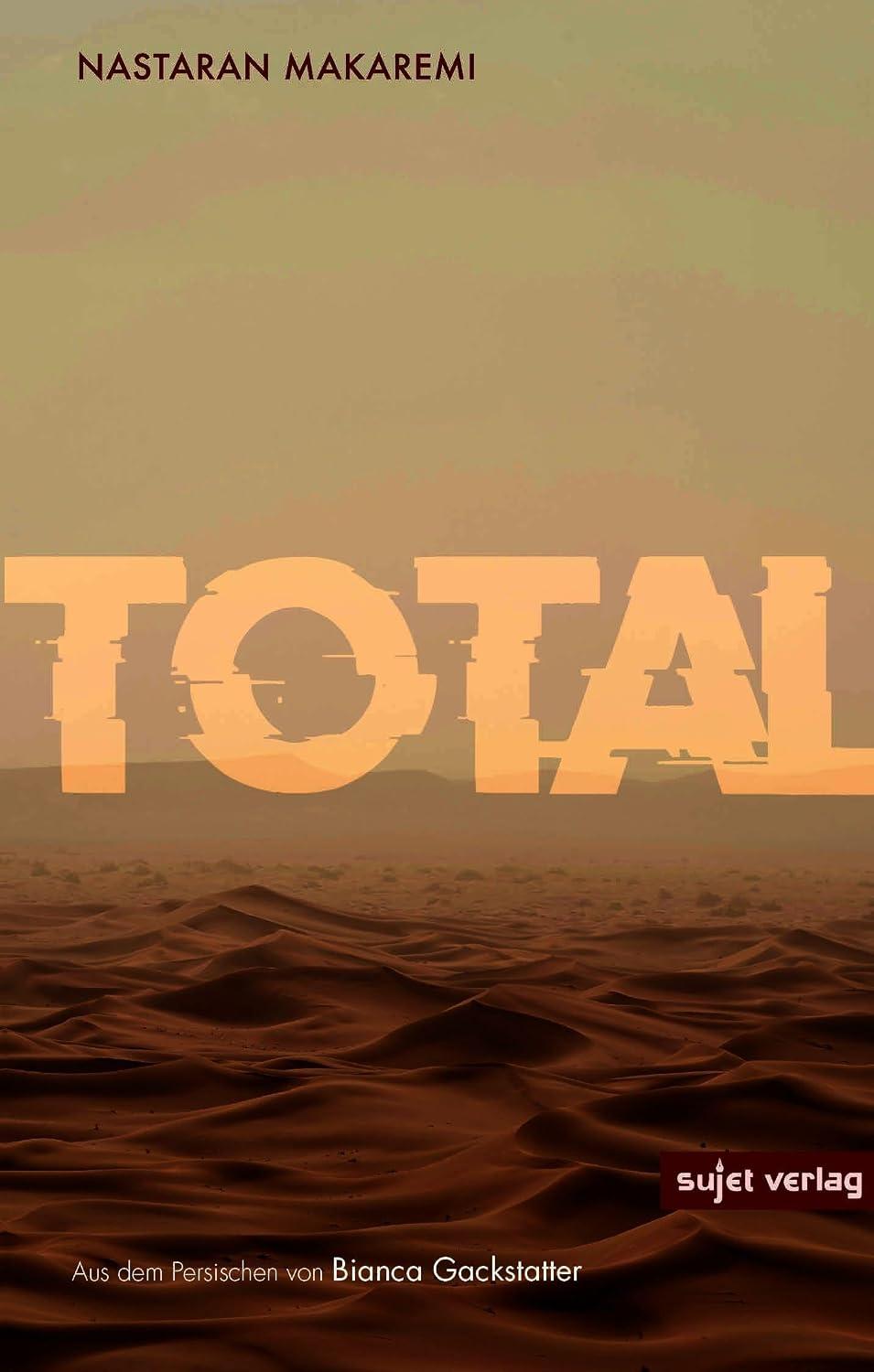
Nastaran Makaremi | Total | Sujet Verlag | 220 pages | 20 EUR
I was the dark energy of the masses.
You can’t talk about oil. You can’t feel it; it has turned into solid asphalt beneath our feet, and even if it sometimes seems to be burning, we are far removed from its original form, which could burst into flames at any moment. You can’t talk about oil because we carry it with us or absorb it into ourselves. Yet we know its transformations; we open the door to everyday life - it is part of us, or perhaps we are already its next form: how much microplastic makes up a human being? How much does microplastic define a person of our time…? Yet we cannot speak of oil. Something essential is lost, slipping away: the connection between the various stages of petroleum’s transformation as it flows through pipelines, across the negotiating tables of corporations and nations. What has been lost - or never even existed - is this connection between the different states of matter, transformations, and life forms of petroleum.
The melancholy of the formless flowing through the pipes
We cannot tell the story of petroleum because we can scarcely think without our fossil fuel-based existence: our narrative forms, at most, allow it a background role. Since the modern era, European literature has centred on humanity; nature becomes a backdrop, and industrialisation is recounted primarily as social history. Yet wasn’t it literature, long before science fiction, that conceived alternative utopian worlds? The Indian writer Amitav Ghosh takes up this objection, arguing that even utopias usually rely on reconciliation through a different place or new technologies. We, on the other hand, have only this one Earth.
In his socio-historical essay The Great Derangement , he explores why the climate crisis - the most comprehensive crisis of modernity - has barely entered literature. He asks to what extent literature acts as an accomplice to the contradictory, fossil-fuel-driven dynamics of progress: “Is it possible that the arts and literature of this time will one day be remembered not for their audacity […] but rather for their complicity in the Great Derangement?” And his answer is sobering: The language from which literature is (still) made remains a logocentric labyrinth. And since the Anthropocene must also be understood as a cultural crisis, literature itself is right in the thick of our fossil-fuelled sensory world, in which, when we talk about plastic, almost no-one thinks of oil.
Riding the Tiger
And then, in July of this year, Total by Nastaran Makaremi will be published, a text translated from Persian by Bianca Gackstatter and explicitly labelled a 'novel' by Sujet Publishing. It deals exclusively with the extraction of oil in the Iranian desert of Khanazir - or rather, its ramifications. The 'novel' weaves together myths about “black gold,” colonial settlement and extraction plans by the company “Total,” the history of several generations, the daily grind of labour, and the lies told by British engineers to cover up the murders of Palestinian and Iranian workers, into a dense tangle of text centred on petroleum. The narrative styles alternate irregularly; they are polyphonic - sometimes told in the form of letters, sometimes in an autofictional manner - with interspersed legends which are at times exposed as lies, at other points successfully mythologising the narrative world. Things can get confusing; is there really a whale living beneath the desert sand, or not? Originally, this was a story told by the British engineer Jonah to avoid having to report that he’d lost track of the Iranian workers in the sand and shot one of them. But as the story unfolds, Raei and Afsoon’s father comes to believe he actually saw it. This could be a successful rewriting of colonial history on a small scale, or it could be the improbable lurking in the desert, where “nature” suddenly becomes unmanageable.
In the novel, not every narrative thread can be explained by the colonialism of the British occupation, even if much of it stems from that. And oil shapes not only landscapes but also bodies and desires.
The colonial order engenders a constellation in which repressed desire is violently articulated. The engineer Sir Herord forces his “protégée” into prostitution. And yet, throughout the novel, the white characters are constsntly haunted by a mythical, “bearded woman” whom they both desire and fear. Where colonial violence and repressed desire meet, this woman - who transcends binary gender markers - appears to the British characters as a threat to their colonial identity, a disruptive force.
Its streaks slide down my leg like menstrual blood
Crude oil has changed everything for the characters and narrative voices in different ways:
“Oil was like the blood flowing through our veins. It was a part of us. The flowing mass, black and ominous, had unwittingly transformed our lives into a kind of modern slavery. Basically, everyone in that region was, in their own way, a slave to the system of discovering, extracting, and transporting oil. Slaves who had a hierarchy among themselves.”
And it doesn’t just change the characters—it permeates them; the “luxurious and prosperous image” of oil “in human form,” but also “the ugly, black […] and stinking […] part [,] its true identity.” It's strange. On the one hand, oil is personified; quite critically - for aren’t these always attributions, “images” (can we even penetrate the actual tangle?) - but on the other hand, its “true” identity is already naturalised in the very next sentence and dissolves into the most human description of all: “ugly and stinking.”
Here, the substance is shaped into a form, as it is throughout most of the novel. The text recounts what the characters do with the crude oil. It recounts the power dynamics surrounding the crude oil; indeed, it seems to carry meaning precisely through these dynamics. That is why it would be wrong to write that the text is about what the oil does to the characters - even if, on a representational level, it reads exactly that way: “Undoubtedly, the oil - along with lies and droughts - was one of the greatest curses to have befallen our country.” Crude oil, clearly to the narrative voice, provides the basis for colonial conditions - stabilises them, by its very nature. It appears precisely within this constellation, given narrative space; but wasn’t it the British colonial government - and also the investing sheikh - which forced it into this role originally?
Oil becomes a curse. This must finally be said out loud and unravelled. The way we impose our concepts of transcendence onto our environment, pretending that there is a destiny already turned back towards us, exonerating us, has to stop once and for all.. But if we want to take the state of our environment - and ourselves - seriously, then we must also take the beings around us seriously.
That which underlies all light
Crude oil thus appears within the familiar discursive framework of the “oil curse.” The narrative voices portray it this way. The narration, however - the textual form that incorporates myths, whether in a colonial context, as in Jonah and the Whale (and thus also a distinctly Christian one), or an otherwise spiritual one - alters the constellation in which oil is situated. In the legend of the god Avil, it is a sacred liquid in which “a black fish swam and sang Avil’s songs,” the final merciful act. Oil sanctifies Avil and becomes sacred itself. It embodies moral values and connects generations both materially and ethically.
The novel also includes an appendix with excerpts from reports on the living conditions of the workers, accounts of oppression, and political commentary: “They claim there’s no money, yet there is great waste in the oil sector’s pension funds.” It is an open oil archive that can be accessed via the embedded links and continues to unfold in reality. It is a record of what, in European terms, is merely “batteries, flashlights, industrial rationality.” Makaremi continues to write there by making visible where the political and social dimensions of oil begin.
*سوژه (Sujet, Theme): Themes and voices migrate between languages and scripts—in keeping with the idea of “air-root literature,” which transcends national and linguistic boundaries.
Madjid Mohit of Sujet Verlag speaks of publishing “ literature with aerial roots.” It carries voices, lets سوژه (language) soar*, flies across national borders—a twist on the term “exile literature.” This new release, too, does not anchor the narrative to a fixed place, but rather sets meanings in motion.
“And at that very moment, Khanazir opened its maw. The grains of sand poured like a stream flowing down from a cliff into the maw of a deep well, and as they watched this spectacle in disbelief, a massive whale suddenly shot out of the well, swallowed David and his four companions, and retreated back into the well's depths. Then Khanazir’s maw closed, and everything was calm again, like a still, motionless sea. The jeep rolled over in the sand and landed right at the entrance to the well that had swallowed everything.”
+++
The subheadings are quotes from the poem Restschnee by Marion Poschmann.
Did you enjoy this text? If so, please support our work by making a one-off donation via PayPal, or by taking out a monthly or annual subscription.
Want to make sure you never miss an article from Literatur.Review again? Sign up for our newsletter here.